
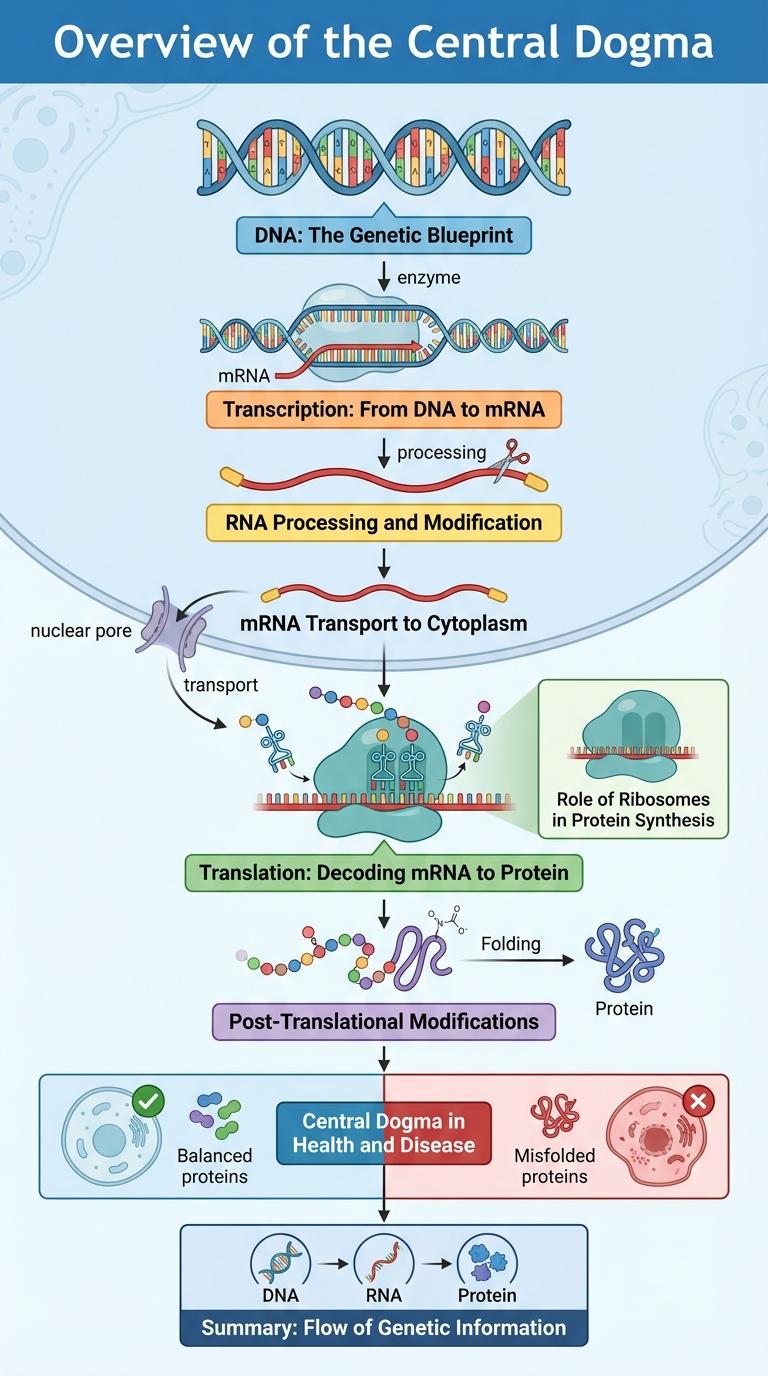
The central dogma of molecular biology explains the flow of genetic information from DNA to RNA to protein. This process is essential for cellular function and gene expression. Understanding each step helps illustrate how genetic codes are translated into functional molecules.
Overview of the Central Dogma
The Central Dogma of molecular biology explains the flow of genetic information from DNA to RNA to protein. It describes how genetic instructions are transcribed into messenger RNA and then translated to synthesize proteins. This fundamental process governs gene expression and cellular function across all living organisms.
DNA: The Genetic Blueprint
| Concept | Details |
|---|---|
| DNA Structure | Double helix composed of nucleotide pairs (adenine-thymine, cytosine-guanine) |
| Function | Stores genetic instructions essential for growth, development, and reproduction |
| Location | Found primarily in the cell nucleus with small amounts in mitochondria |
| Role in Central Dogma | Acts as the template for RNA synthesis during transcription |
| Genetic Code | Sequence of nucleotides determines amino acid sequence in proteins |
Transcription: From DNA to mRNA
The central dogma of molecular biology describes the flow of genetic information from DNA to RNA to protein. Transcription is the first step, where DNA is transcribed into messenger RNA (mRNA).
During transcription, the enzyme RNA polymerase reads the DNA template strand and synthesizes a complementary mRNA strand. This process takes place in the cell nucleus in eukaryotes or the cytoplasm in prokaryotes. The mRNA carries the genetic code from DNA to the ribosome for protein synthesis.
RNA Processing and Modification
The central dogma of molecular biology describes the flow of genetic information from DNA to RNA to protein. RNA processing and modification are crucial steps between transcription and translation that ensure accurate gene expression.
RNA undergoes processes such as 5' capping, splicing, and 3' polyadenylation to become mature messenger RNA (mRNA). These modifications enhance RNA stability, export to the cytoplasm, and translation efficiency into proteins.
mRNA Transport to Cytoplasm
The central dogma of molecular biology describes the flow of genetic information from DNA to RNA to protein. mRNA transport to the cytoplasm is a critical step where the processed messenger RNA exits the nucleus through nuclear pores. This transport enables mRNA to reach ribosomes in the cytoplasm for translation into proteins.
Translation: Decoding mRNA to Protein
Translation is the process of converting messenger RNA (mRNA) sequences into functional proteins. This step is essential for gene expression and cellular function.
- Ribosome binds mRNA - The ribosome attaches to the mRNA strand to read its codons sequentially.
- tRNA delivers amino acids - Transfer RNA molecules bring specific amino acids matching each mRNA codon to the ribosome.
- Polypeptide chain formation - Amino acids are linked together by peptide bonds to form a growing protein chain.
Proper translation ensures proteins are synthesized accurately according to genetic information.
Role of Ribosomes in Protein Synthesis
What role do ribosomes play in protein synthesis? Ribosomes are the molecular machines that read messenger RNA (mRNA) sequences to assemble amino acids into polypeptide chains. They facilitate the translation process by matching transfer RNA (tRNA) anticodons with mRNA codons, ensuring accurate protein formation.
Post-Translational Modifications
The central dogma of molecular biology describes the flow of genetic information from DNA to RNA to protein. Post-translational modifications (PTMs) occur after protein synthesis, altering protein function and activity.
Common PTMs include phosphorylation, glycosylation, ubiquitination, and methylation, each impacting protein stability, localization, and interaction. These modifications regulate cellular processes such as signal transduction, enzyme activity, and protein degradation.
Central Dogma in Health and Disease
The central dogma of molecular biology describes the flow of genetic information from DNA to RNA to protein. Understanding this process is crucial in recognizing its role in health and disease mechanisms.
Errors in the central dogma can lead to mutations, causing various genetic disorders and cancers. Therapeutic interventions often target specific steps in this pathway to restore normal cellular function.
- DNA Replication - Accurate copying of DNA is essential for cell division and genetic stability.
- Transcription - RNA synthesis from DNA directs protein production critical for cellular function.
- Translation - Proteins are assembled based on RNA sequences, influencing cell behavior and health.