
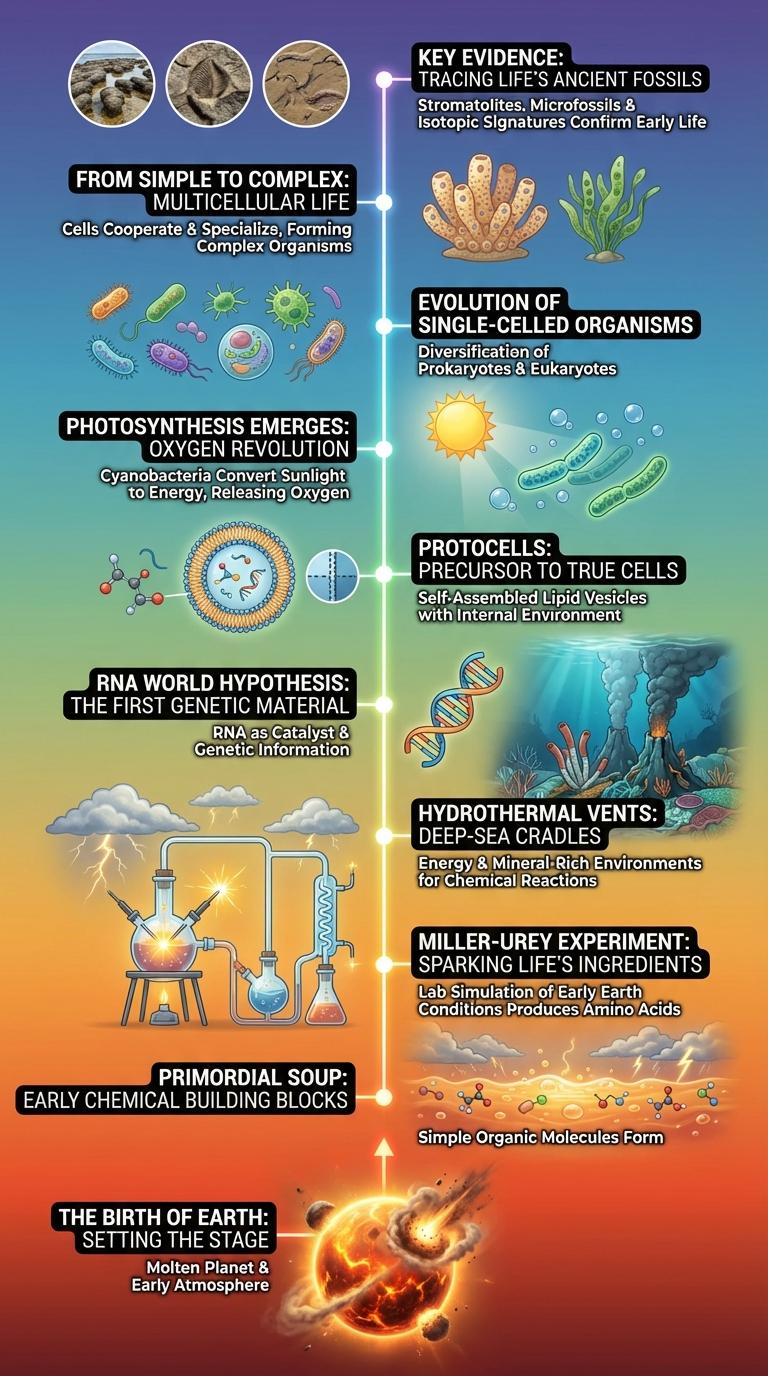
The origin of life remains one of science's most intriguing mysteries, tracing how simple molecules evolved into complex organisms. Exploring key theories such as abiogenesis and hydrothermal vent hypotheses reveals the chemical and environmental conditions that may have sparked life on Earth. This infographic visually maps the evolutionary milestones and scientific discoveries that shed light on life's earliest beginnings.
The Birth of Earth: Setting the Stage
The origin of life began with the formation of Earth approximately 4.5 billion years ago. Early Earth's conditions created a unique environment that enabled the emergence of life.
- Formation of Earth - Earth formed from the solar nebula through accretion and differentiation processes.
- Primitive Atmosphere - Early Earth's atmosphere was rich in volcanic gases like methane, ammonia, and water vapor.
- Liquid Water Presence - Surface temperatures cooled enough to allow liquid water, crucial for life's chemical reactions.
Primordial Soup: Early Chemical Building Blocks
The origin of life began in the primordial soup, a rich mixture of early Earth's water and chemicals. Simple molecules like amino acids formed through energy sources such as lightning and volcanic activity. These building blocks eventually combined to create the first organic compounds essential for life.
Miller-Urey Experiment: Sparking Life's Ingredients
| Aspect | Details |
|---|---|
| Experiment Name | Miller-Urey Experiment |
| Year Conducted | 1952 |
| Lead Scientist | Stanley Miller |
| Purpose | Simulate early Earth conditions to test the chemical origins of life. |
| Key Outcome | Produced amino acids, essential building blocks for life, by sparking gases like methane, ammonia, hydrogen, and water vapor. |
Hydrothermal Vents: Deep-Sea Cradles
Hydrothermal vents are underwater geysers found along mid-ocean ridges, where heated mineral-rich water flows from the Earth's crust. These vents provide unique chemical and thermal environments believed to support the origin of life on Earth.
- Mineral-Rich Environment - Hydrothermal vents emit water rich in minerals such as iron, sulfur, and hydrogen, creating chemical gradients that drive metabolic processes.
- Thermal Stability - The stable high temperatures of vent fluids create ideal conditions for biochemical reactions essential to early life.
- Catalytic Surfaces - Minerals like pyrite and other metal sulfides act as natural catalysts, facilitating organic molecule synthesis near vents.
RNA World Hypothesis: The First Genetic Material
The RNA World Hypothesis proposes that ribonucleic acid (RNA) was the first genetic material, predating DNA and proteins in the origin of life. RNA molecules are capable of storing genetic information and catalyzing chemical reactions, making them a crucial component in early life forms.
Experimental evidence shows that RNA can self-replicate and form complex structures essential for biochemical processes. This hypothesis explains how life could have arisen from simple molecules through the formation and evolution of RNA-based systems.
Protocells: Precursor to True Cells
Protocells are simple, membrane-bound structures that formed spontaneously on early Earth, serving as the precursors to true living cells. These primitive compartments encapsulated organic molecules, creating a microenvironment for chemical reactions essential for life. Protocells exhibited basic properties of life, such as growth and division, laying the foundation for biological complexity.
Photosynthesis Emerges: Oxygen Revolution
The emergence of photosynthesis transformed Earth's atmosphere by producing oxygen as a byproduct. This process, known as the Oxygen Revolution, created conditions for aerobic life to evolve and diversify.
- Photosynthetic organisms develop - Cyanobacteria began converting sunlight, carbon dioxide, and water into organic compounds, releasing oxygen.
- Oxygen accumulates in atmosphere - Oxygen levels rose significantly, causing the Great Oxygenation Event around 2.4 billion years ago.
- Impact on Earth's environment - Increased oxygen led to the formation of the ozone layer, protecting organisms from harmful UV rays.
The Oxygen Revolution marked a critical turning point, enabling complex aerobic life forms to emerge and thrive on Earth.
Evolution of Single-Celled Organisms
How did life begin on Earth?
Life originated around 3.8 billion years ago with the formation of simple single-celled organisms. These early cells evolved in aquatic environments, marking the beginning of biological complexity.
What are the key stages in the evolution of single-celled organisms?
Single-celled organisms evolved through processes like genetic mutation and natural selection. Over time, they developed specialized functions, leading to increased diversity and complexity.
Which organisms represent the earliest form of life?
Prokaryotes, such as bacteria and archaea, are the earliest life forms. They lack a defined nucleus but possess essential genetic material for reproduction and metabolism.
How did single-celled organisms adapt to their environments?
Adaptations included the development of photosynthesis and respiration, enabling energy absorption from sunlight and oxygen use. These innovations facilitated survival in various ecological niches.
What is the significance of single-celled organisms in the history of life?
Single-celled organisms laid the foundation for multicellular life and ecosystems. They contributed to atmospheric changes, like oxygen increase, shaping Earth's environment.
From Simple to Complex: Multicellular Life
The origin of life began with simple, single-celled organisms emerging billions of years ago. These early life forms laid the foundation for all complex life that followed.
Over time, single-celled organisms evolved into colonies, eventually leading to multicellular life forms. This transition allowed for specialization of cells and greater biological complexity. Multicellularity enabled organisms to develop tissues and organs, creating the diversity of life seen today.