
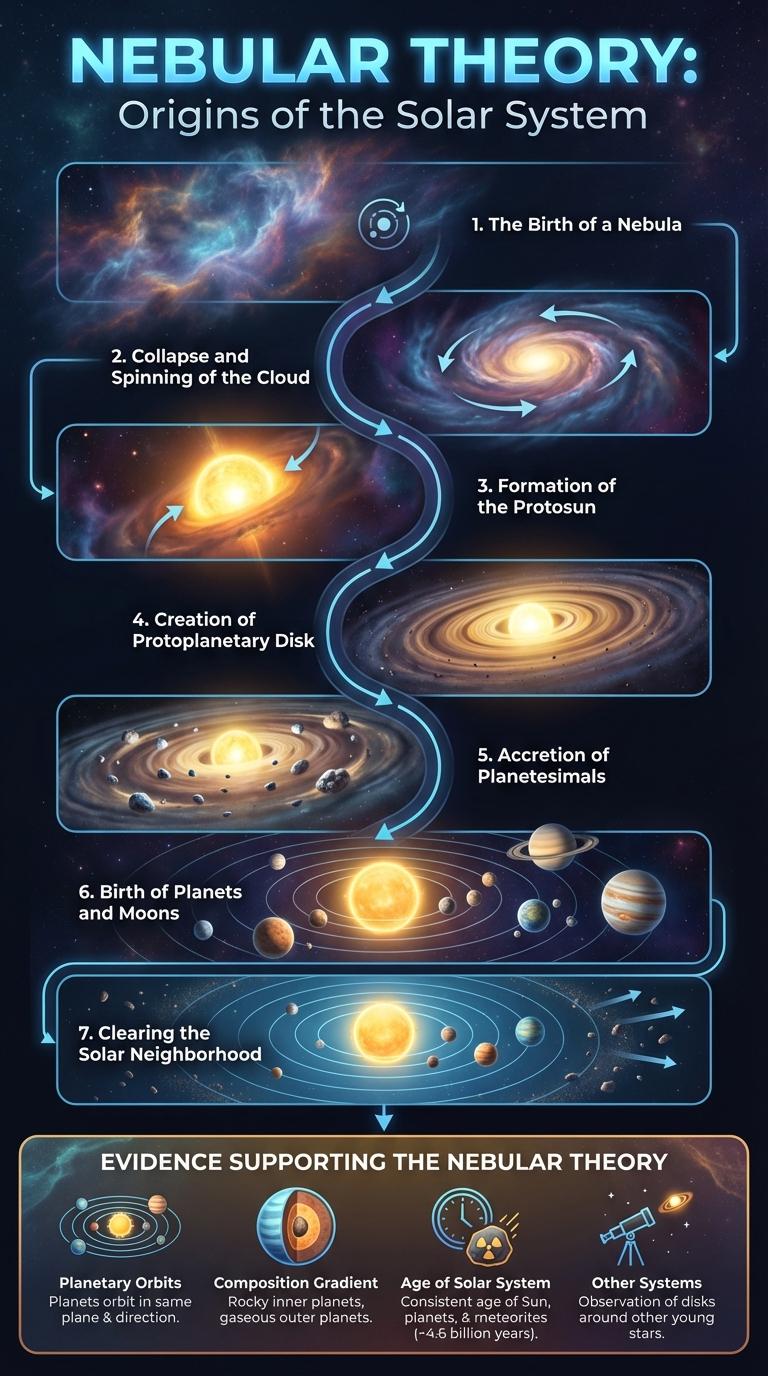
The nebular theory explains the formation of the solar system from a giant cloud of gas and dust called a nebula. Gravity caused the nebula to collapse, spinning into a flattened disk where the Sun formed at the center and planets developed from the surrounding material. This theory provides key insights into the origins and structure of our planetary system.
What is the Nebular Theory?
The Nebular Theory explains the formation of the solar system from a giant cloud of gas and dust called a nebula. It describes how gravitational forces caused the nebula to collapse and form the Sun and planets.
Initially, the nebula began to contract under its own gravity, spinning faster as it shrank. The central region formed the Sun, while the remaining material flattened into a rotating disk. Particles within this disk collided and stuck together, gradually creating planets, moons, and other solar system bodies.
Origins of the Solar System
The Nebular Theory explains the origins of the Solar System as a process beginning with a giant cloud of gas and dust, called a nebula. Gravity caused this nebula to collapse and spin, forming a flattened disk with the Sun at its center. Planets and other solar system bodies formed from the remaining material in the spinning disk over millions of years.
The Birth of a Nebula
The birth of a nebula begins with a vast cloud of gas and dust in space, primarily composed of hydrogen and helium. Gravitational forces cause the cloud to collapse, increasing temperature and pressure at the core. This process initiates the formation of new stars within the nebula, marking the beginning of stellar evolution.
Collapse and Spinning of the Cloud
| Collapse of the Cloud | The nebular cloud, composed mainly of gas and dust, begins to collapse under its own gravity, triggering the formation of a protostar at the center. |
| Causes of Collapse | Gravity overcomes internal pressure and external forces, causing a dense core to form within the molecular cloud. |
| Spinning of the Cloud | The collapsing cloud starts rotating faster due to conservation of angular momentum, flattening into a spinning protoplanetary disk. |
| Angular Momentum | The increase in rotational velocity is a direct consequence of the cloud shrinking in size, preserving momentum as it contracts. |
| Outcome | The central protostar forms surrounded by a rotating disk of material, setting the stage for planet formation. |
Formation of the Protosun
The formation of the protosun marks a critical phase in the nebular theory, where a collapsing cloud of gas and dust initiates nuclear fusion. This process sets the foundation for the birth of a new star within a solar nebula.
- Gravitational Collapse - The nebula's gas and dust begin contracting due to gravity, increasing density and temperature at the core.
- Core Heating - Rising pressure in the center raises the core temperature, initiating the conditions necessary for fusion.
- Rotation and Flattening - Conservation of angular momentum causes the collapsing cloud to spin faster and flatten into a rotating disk.
The protosun becomes hot and dense enough to ignite hydrogen fusion, marking the emergence of a new star at the center of the solar system.
Creation of Protoplanetary Disk
The nebular theory explains the formation of the solar system from a giant cloud of gas and dust. The creation of the protoplanetary disk is a crucial early stage where material begins to flatten and spin, leading to planet formation.
- Gas and dust collapse - Gravitational forces cause a molecular cloud to contract and rotate, forming a dense core.
- Rotation increases - Conservation of angular momentum accelerates the spinning motion as the cloud contracts.
- Disk flattening - Centrifugal force flattens the rotating cloud into a disk shape, concentrating material in the mid-plane.
Accretion of Planetesimals
The nebular theory explains the formation of the solar system from a giant rotating cloud of gas and dust. Accretion of planetesimals is a crucial step where small solid objects collide and stick together to form larger bodies.
Planetesimals, measuring from meters to kilometers, gradually clump through gravitational attraction. This process leads to the creation of protoplanets, which eventually become planets or other solar system objects.
- Formation of Dust Grains - Microscopic dust particles collide and stick, forming the initial solid seeds within the protoplanetary disk.
- Growth to Planetesimals - Dust grains accumulate into kilometer-sized planetesimals through repetitive collisions and coagulation.
- Gravitational Accretion - Planetesimals attract additional material via gravity, causing them to increase in size rapidly.
- Collisional Merging - Larger planetesimals collide and merge, leading to the formation of protoplanets with complex structures.
- Clearing of Surrounding Material - Growing protoplanets sweep up smaller debris, clearing their orbits and influencing the solar system's architecture.
Birth of Planets and Moons
How do planets and moons form according to the Nebular Theory?
Planets and moons emerge from a rotating cloud of gas and dust called a solar nebula. Gravity causes materials to clump together, forming planetesimals that grow into planets and their natural satellites.
Clearing the Solar Neighborhood
The nebular theory describes the formation of the solar system from a rotating cloud of gas and dust called the solar nebula. Clearing the solar neighborhood is a crucial phase where the young Sun's gravity and solar wind eject remaining debris and planetesimals from its orbit.
This process ensures that planets have stable, clear orbits without collisions from leftover material. The efficient clearing supports planet formation and maintains the distinct boundaries of the solar system's planetary zones.