
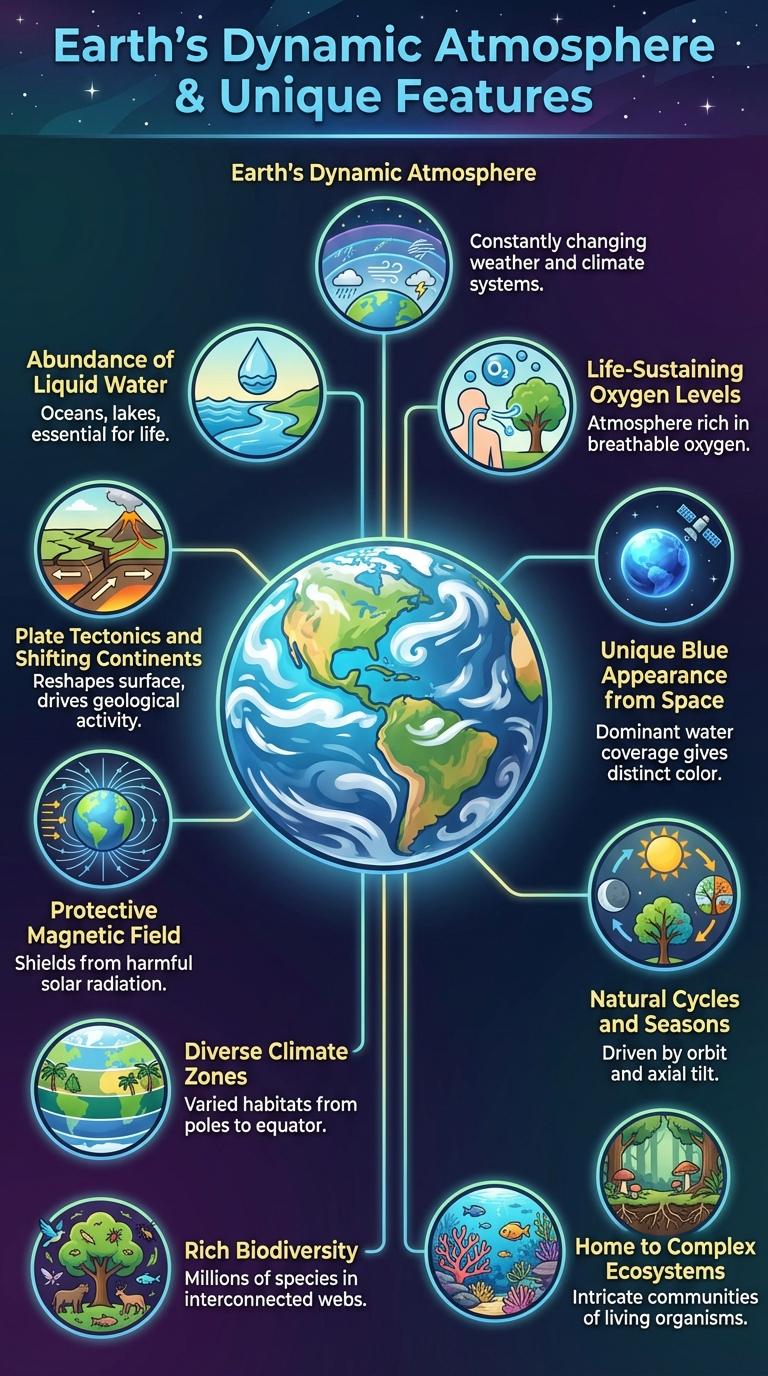
Earth boasts a remarkable blend of characteristics that distinguish it from other planets, including its abundant liquid water, protective atmosphere, and diverse ecosystems. These features create an environment capable of supporting a vast array of life forms and complex natural processes. Understanding these unique traits offers insights into the planet's vital role within the solar system and highlights the importance of preserving its delicate balance.
Earth's Dynamic Atmosphere
Earth's dynamic atmosphere is a complex and ever-changing system that supports diverse life forms. It actively regulates temperature and protects the planet from harmful solar radiation.
- Composition of gases - Earth's atmosphere consists mainly of nitrogen (78%) and oxygen (21%), essential for respiration and sustaining life.
- Layered structure - The atmosphere is divided into five layers, including the troposphere where weather phenomena occur.
- Climate regulation - Atmospheric processes drive weather patterns and climate stability, influencing ecosystems worldwide.
Abundance of Liquid Water
Earth is the only known planet with abundant liquid water covering over 70% of its surface. This vast presence of liquid water supports diverse ecosystems and regulates the planet's climate. The abundance of water drives Earth's unique weather patterns and sustains life in ways no other known celestial body does.
Plate Tectonics and Shifting Continents
What makes Earth's plate tectonics unique compared to other planets? Earth's lithosphere is divided into large and small plates that float on the semi-fluid asthenosphere below. These moving plates cause earthquakes, volcanic activity, and the creation of mountain ranges.
How do shifting continents affect Earth's geography? Continents drift at rates of a few centimeters per year, reshaping oceans and landmasses over millions of years. This movement influences climate patterns and biodiversity by altering habitats and ocean currents.
| Plate Tectonics Feature | Description |
|---|---|
| Plate Boundaries | Divergent, convergent, and transform edges create diverse geological activity |
| Continental Drift | Slow movement of continents driven by mantle convection |
| Earthquakes | Result from stress release along plate boundaries |
| Mountain Formation | Caused by plate collision and subduction zones |
| Sea-floor Spreading | New crust forms at mid-ocean ridges, pushing plates apart |
Protective Magnetic Field
Earth's protective magnetic field, generated by the movement of molten iron in its outer core, shields the planet from harmful solar radiation. This magnetic shield deflects charged particles from the sun, preserving the atmosphere essential for life.
The magnetic field also creates the stunning auroras near the polar regions. Without this protective barrier, Earth's surface would be exposed to dangerous cosmic rays, making it inhospitable for living organisms.
Diverse Climate Zones
| Characteristic | Description |
|---|---|
| Diverse Climate Zones | Earth features multiple climate zones ranging from tropical, arid, temperate, cold, to polar regions, creating varied ecosystems and weather patterns. |
| Equatorial Region | Characterized by warm temperatures and high humidity, supporting rainforests and rich biodiversity. |
| Temperate Zones | Experience four distinct seasons with moderate temperature variations, home to deciduous forests and grasslands. |
| Polar Regions | Extremely cold climates with ice-covered landscapes, supporting specially adapted flora and fauna. |
| Arid Zones | Deserts with minimal rainfall and extreme temperature fluctuations, hosting uniquely adapted plant and animal species. |
Rich Biodiversity
Earth boasts an unparalleled richness in biodiversity, home to millions of species ranging from microscopic organisms to massive mammals. This diversity is primarily sustained by its varied ecosystems, including forests, oceans, and wetlands, which provide essential habitats and resources.
The planet's complex web of life supports ecological balance, offering services such as pollination, climate regulation, and nutrient cycling. Unique to Earth is the presence of vast rainforests like the Amazon, which harbor countless endemic species. Conservation efforts focus on protecting this rich biodiversity to ensure ecosystem resilience and human well-being.
Life-Sustaining Oxygen Levels
Earth's atmosphere contains approximately 21% oxygen, an ideal concentration to support diverse life forms. This precise oxygen level allows efficient cellular respiration and sustains complex organisms. Fluctuations outside this range could disrupt ecosystems and hinder biological processes vital for life.
Unique Blue Appearance from Space
Earth is famously known as the "Blue Planet" due to its distinctive blue appearance when viewed from space. This unique coloration is primarily caused by the vast coverage of water on its surface and the interaction of sunlight with the atmosphere.
- Water Coverage - About 71% of Earth's surface is covered by oceans, which reflect blue wavelengths of sunlight.
- Atmospheric Scattering - Rayleigh scattering in the atmosphere disperses sunlight, emphasizing the blue color visible from space.
- Cloud Contrast - White clouds over the blue oceans enhance the planet's vibrant and dynamic appearance.
These factors combine to make Earth visually distinct from other planets in the solar system.
Natural Cycles and Seasons
Earth's unique tilt and orbit around the Sun create distinct natural cycles, driving the changing seasons. These cycles regulate temperature, weather patterns, and biological rhythms across the globe.
Seasonal changes influence ecosystems, agriculture, and human activities by controlling daylight, precipitation, and temperature variations. The interplay of Earth's axial tilt and revolution ensures a dynamic environment essential for life.