
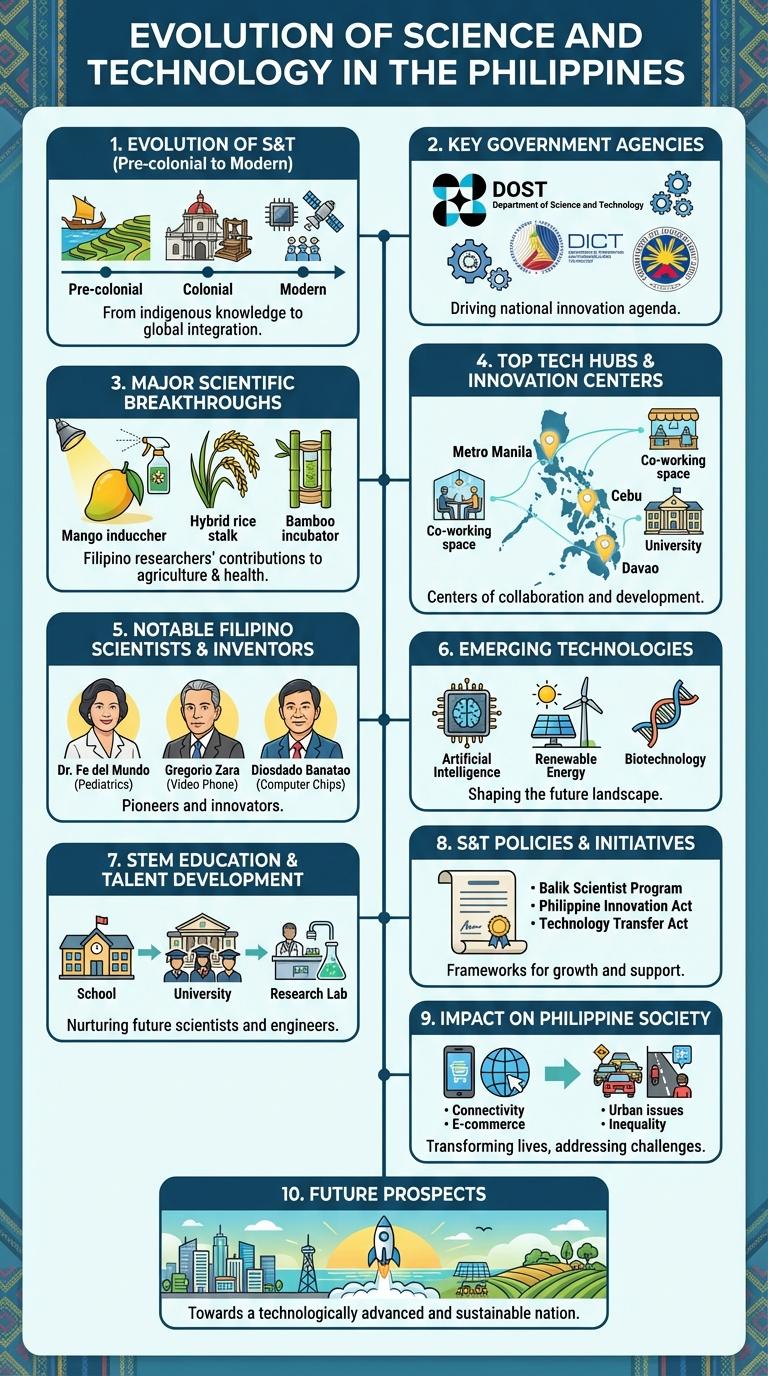
The Philippines has rapidly advanced in science and technology, driving innovation across various sectors. This infographic highlights key achievements, ongoing projects, and future prospects shaping the country's technological landscape. Explore how science initiatives are transforming industries and improving everyday life nationwide.
Evolution of Science and Technology in the Philippines
The Philippines has witnessed significant growth in science and technology over the decades, marking key milestones that shaped its innovation landscape. This evolution reflects the country's commitment to advancing research, education, and technological development.
- Pre-colonial Knowledge - Indigenous Filipinos used herbal medicine and early engineering techniques long before Spanish colonization.
- Colonial Era Advances - The Spanish introduced formal education and scientific methodologies, laying the groundwork for modern science in the country.
- Post-Independence Development - Establishment of institutions like the Philippine Science High School and the Department of Science and Technology promoted local research and innovation.
- Modern Technology Integration - The rise of IT parks and BPO industries contributed to the country's emergence as a tech hub in Southeast Asia.
- Future Prospects - Government initiatives aim to increase investments in STEM education and green technologies to boost sustainable growth.
The continuous evolution of science and technology in the Philippines drives economic progress and addresses national challenges through innovation.
Key Government Agencies Driving Innovation
The Philippines is rapidly advancing in science and technology through key government agencies dedicated to innovation and research. The Department of Science and Technology (DOST) spearheads numerous programs supporting technological development and scientific research nationwide. Other vital agencies include the Philippine Council for Industry, Energy and Emerging Technology Research and Development (PCIEERD) and the Philippine Atmospheric, Geophysical and Astronomical Services Administration (PAGASA), each playing a critical role in fostering innovation.
Major Scientific Breakthroughs by Filipino Researchers
| Breakthrough | Filipino Researcher(s) & Year |
|---|---|
| Anthrax Vaccine Development | Dr. Ramon Magsaysay Jr., 1974 |
| Yeast-based Dengue Diagnostic Test | Dr. Raul Destura, 2014 |
| Banana Xanthomonas Wilt Resistance | Dr. Hilario Mendoza Jr., 2009 |
| Enzyme for Plastic Degradation | Dr. Danilo E. Gutierrez, 2018 |
| Solar-Powered Water Purification System | Dr. Grace Aguiling-Dalisay, 2020 |
Top Technology Hubs and Innovation Centers
The Philippines has rapidly grown as a key player in science and technology with several top technology hubs driving innovation. These centers foster collaboration among startups, academic institutions, and government agencies to boost research and development.
- Quezon City Science and Technology Park - This hub focuses on startups specializing in AI, software development, and green technologies.
- UP Diliman Technology Business Incubator - Supports emerging tech entrepreneurs through mentorship, funding access, and industry partnerships.
- Ayala TechnoHub - Houses multinational tech companies and facilitates innovation in fintech, cybersecurity, and digital solutions.
Notable Filipino Scientists and Inventors
The Philippines has produced numerous scientists and inventors who have made significant contributions to global science and technology. Their innovations continue to inspire advancements in various fields such as medicine, engineering, and agriculture.
- Dr. Fe del Mundo - Renowned pediatrician and the first woman admitted to Harvard Medical School, known for developing a bamboo incubator for rural areas.
- Dr. Edgardo Gomez - Marine scientist recognized for his pioneering efforts in coral reef conservation and marine biodiversity preservation.
- Agapito Flores - Inventor credited with popularizing fluorescent lamp technology, enhancing energy-efficient lighting solutions worldwide.
Emerging Technologies Shaping the Future
The Philippines is rapidly advancing in emerging technologies such as artificial intelligence, blockchain, and renewable energy solutions. These innovations are transforming industries, enhancing productivity, and driving sustainable development across the nation. Government initiatives and private sector investments continue to support the growth of these cutting-edge technologies, positioning the Philippines as a key player in the global tech landscape.
STEM Education and Talent Development
The Philippines continues to advance in STEM education, fostering a skilled workforce proficient in science, technology, engineering, and mathematics. Government initiatives and private sector partnerships enhance access to quality STEM programs nationwide.
Talent development programs target young innovators, encouraging participation in research, robotics, and coding competitions. These efforts aim to prepare Filipino students for global technology challenges and drive national economic growth.
Science and Technology Policies and Initiatives
How does the Philippines support advancements in science and technology?
The Philippine government implements various policies aimed at fostering innovation and research. Key initiatives focus on enhancing education, funding research, and promoting technology transfer.
What are the major science and technology policies in the Philippines?
The Science Act of 199 scientific innovation. The Department of Science and Technology (DOST) leads programs that support research and infrastructure development in multiple scientific fields.
Which institutions drive science and technology development in the Philippines?
DOST and the Philippine Council for Industry, Energy, and Emerging Technology Research and Development (PCIEERD) are central to policy implementation. Universities also collaborate as research hubs for technological advancement.
How does funding contribute to science and technology progress in the Philippines?
The government allocates significant budget for research and development projects. Public-private partnerships help increase investment and accelerate technology commercialization.
What initiatives promote science education and innovation in the country?
Programs such as the Balik Scientist Program and Science for Change support knowledge transfer and capacity-building. Scholarships and training encourage youth participation in STEM fields.
Impact of Technology on Philippine Society
Technology has transformed various sectors in the Philippines, driving economic growth and improving daily life. Innovations in communication, agriculture, and healthcare have significantly influenced Philippine society.
Access to mobile technology and the internet has enhanced education and business opportunities for Filipinos nationwide. Modern agricultural tools have increased food production, supporting both farmers and the economy. Healthcare technologies have improved disease diagnosis and treatment, elevating overall public health standards in the country.