
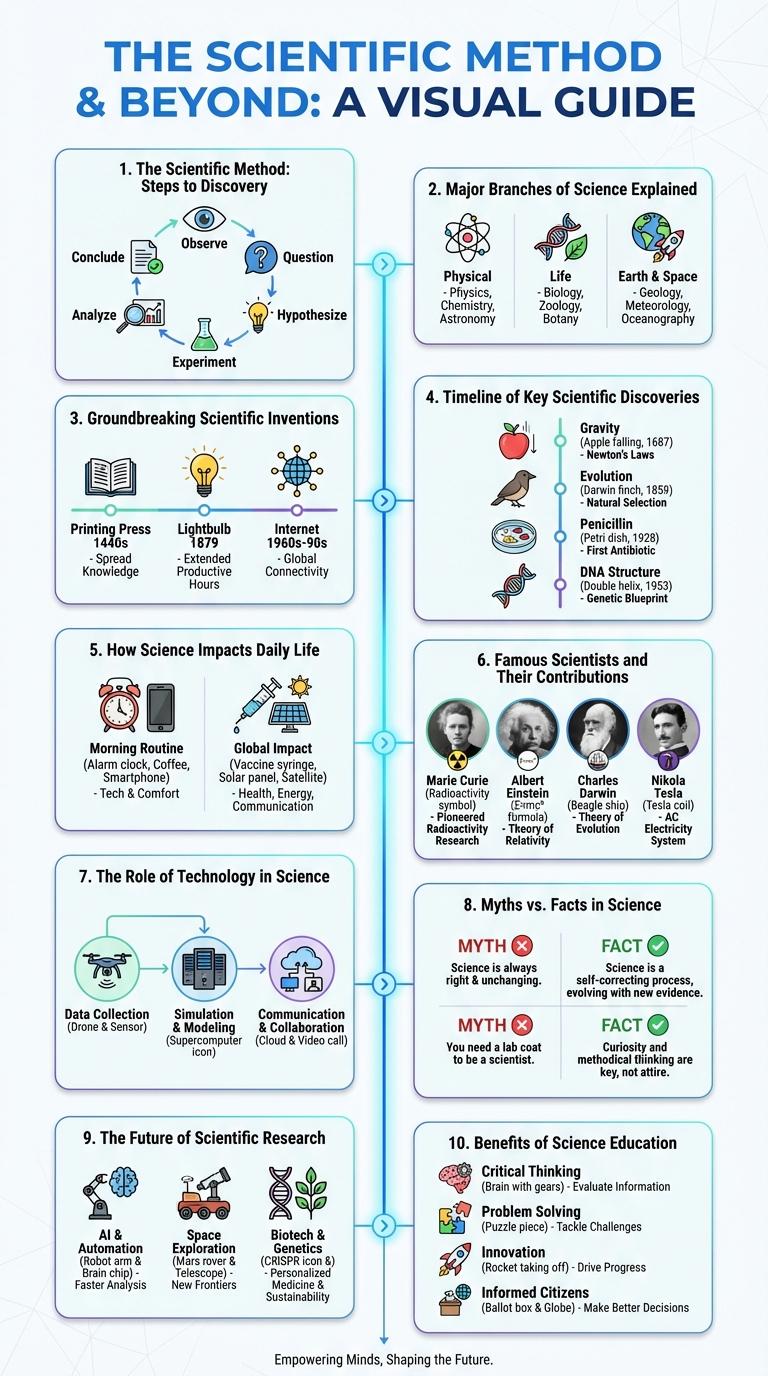
Science infographics visually distill complex concepts into clear, engaging formats, making data easier to understand and remember. They combine compelling graphics with concise information to highlight key scientific discoveries, trends, and statistics. This approach enhances learning by presenting intricate details in a visually appealing and accessible manner.
The Scientific Method: Steps to Discovery
The Scientific Method is a systematic approach to research that ensures objective and reliable results. It consists of defined steps: Observation, Hypothesis, Experimentation, Analysis, and Conclusion. Following these steps allows scientists to make discoveries and advance knowledge in various fields.
Major Branches of Science Explained
What are the major branches of science and their core focus areas?
Science is broadly divided into several key branches, each exploring different aspects of the natural world. Understanding these branches helps clarify how various scientific disciplines contribute to knowledge and innovation.
| Branch | Focus Area |
|---|---|
| Physics | Studies matter, energy, and the fundamental forces of nature. |
| Chemistry | Examines substances, their properties, and chemical reactions. |
| Biology | Explores living organisms, their structure, function, and evolution. |
| Earth Science | Focuses on the Earth's structure, processes, and atmosphere. |
| Astronomy | Studies celestial objects and the universe beyond Earth. |
Groundbreaking Scientific Inventions
Groundbreaking scientific inventions have transformed the way we live, work, and understand the world. These innovations span various fields including medicine, physics, and technology.
The invention of the microscope revolutionized biology by allowing scientists to observe microorganisms. The discovery of the transistor paved the way for modern electronics and computing.
Timeline of Key Scientific Discoveries
Science has transformed human understanding through groundbreaking discoveries over centuries. Innovative research continues to shape the way we interact with the world and beyond.
The timeline of key scientific discoveries highlights pivotal moments such as Newton's laws of motion in 1687, Darwin's theory of evolution in 1859, and Einstein's theory of relativity in 1905. In 1953, Watson and Crick uncovered the double helix structure of DNA, revolutionizing genetics. Recent advances include the discovery of the Higgs boson particle in 2012, confirming fundamental physics theories.
How Science Impacts Daily Life
Science drives innovation in technology, improving communication, transportation, and healthcare, making daily tasks more efficient and accessible. It deepens our understanding of the environment, influencing sustainable practices and public health policies that enhance quality of life. Everyday products like smartphones, medicines, and clean energy solutions showcase how scientific discoveries shape modern living.
Famous Scientists and Their Contributions
Science has been shaped by the groundbreaking work of influential scientists throughout history. Their discoveries have laid the foundation for modern technology and understanding of the natural world.
- Isaac Newton - Formulated the laws of motion and universal gravitation, revolutionizing physics.
- Marie Curie - Discovered radioactivity, advancing the field of atomic science and medical treatments.
- Albert Einstein - Developed the theory of relativity, transforming concepts of space, time, and energy.
- Charles Darwin - Presented the theory of evolution by natural selection, changing biology forever.
- Rosalind Franklin - Produced critical X-ray images that revealed the DNA double helix structure.
These scientists' contributions continue to influence research and innovation around the world.
The Role of Technology in Science
Technology drives scientific discovery by providing advanced tools for experimentation and analysis. It enhances data accuracy and accelerates research processes across various scientific fields.
Innovative devices and software enable scientists to explore complex phenomena and solve intricate problems.
- Data Collection - Modern sensors and imaging technologies capture precise scientific data in real-time.
- Simulation Models - Computational models allow researchers to predict outcomes and test theories virtually.
- Communication - Digital platforms facilitate rapid sharing of scientific knowledge globally.
Myths vs. Facts in Science
Science is often misunderstood due to widespread myths that obscure factual understanding. Clarifying these misconceptions helps promote accurate knowledge and critical thinking.
Many believe that humans only use 10% of their brains; however, neuroscientific research shows nearly all brain areas have known functions. Another common myth claims vaccines cause diseases, but extensive studies confirm their safety and effectiveness in preventing illnesses.
The Future of Scientific Research
Scientific research is evolving rapidly with new technologies and interdisciplinary approaches. The future of science promises groundbreaking discoveries and innovative solutions to global challenges.
- Artificial Intelligence Integration - AI accelerates data analysis and predictive modeling, transforming research methodologies.
- Collaborative Global Networks - International partnerships enable resource sharing and diverse expertise to drive complex projects.
- Sustainable Science Practices - Emphasis on eco-friendly methods reduces environmental impact in experimental research.