
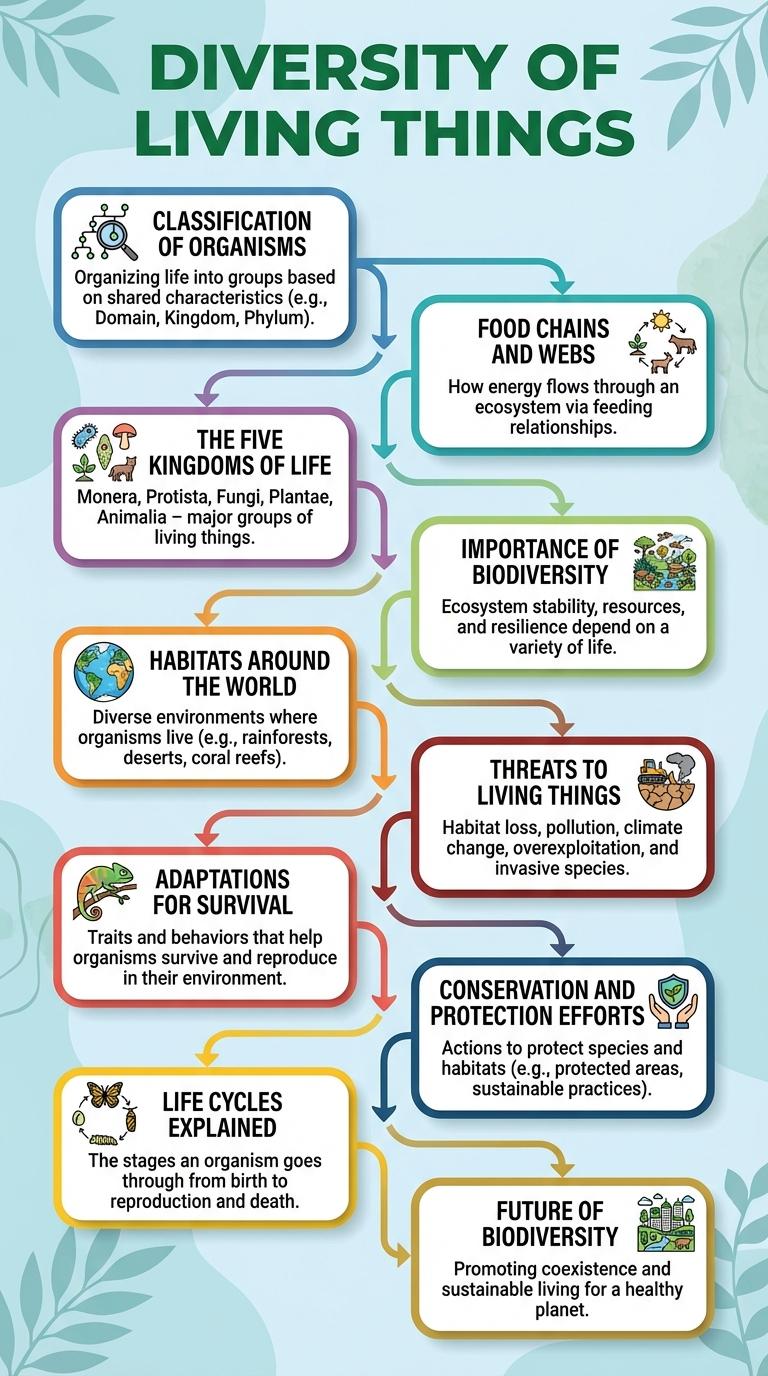
Living things encompass a vast array of organisms, each playing a crucial role in ecosystems worldwide. This infographic highlights the key characteristics that define life, such as growth, reproduction, and response to stimuli. Understanding these features helps clarify the diversity and complexity of life on Earth.
Diversity of Living Things
Living things display an incredible range of forms, functions, and habitats on Earth. This diversity is essential for ecosystem stability and adaptation to environmental changes.
- Species Variety - Over 1.7 million species have been identified, ranging from microscopic bacteria to giant blue whales.
- Habitat Distribution - Living organisms inhabit every environment, including deep oceans, arid deserts, and dense rainforests.
- Genetic Diversity - Genetic variation within species supports resilience to disease and changing ecosystems.
Classification of Organisms
What is the classification of living organisms? Classification organizes living things into groups based on shared characteristics and evolutionary history. This system helps scientists understand relationships among diverse species.
| Classification Level | Example |
|---|---|
| Kingdom | Animalia (animals) |
| Phylum | Chordata (vertebrates) |
| Class | Mammalia (mammals) |
| Order | Carnivora (meat-eaters) |
| Species | Panthera leo (lion) |
The Five Kingdoms of Life
| Kingdom | Key Characteristics |
|---|---|
| Monera | Unicellular, prokaryotic organisms; includes bacteria and cyanobacteria |
| Protista | Mostly unicellular, eukaryotic organisms; diverse group including algae and protozoa |
| Fungi | Multicellular (mostly), eukaryotic organisms; decomposers like mushrooms and molds |
| Plantae | Multicellular, eukaryotic, photosynthetic organisms; includes mosses, ferns, and flowering plants |
| Animalia | Multicellular, eukaryotic organisms; heterotrophic with complex organ systems |
Habitats Around the World
Living things thrive in diverse habitats across the globe, ranging from dense rainforests to vast deserts. Each habitat offers unique conditions that support specific plants and animals adapted to survive there.
Forests, wetlands, oceans, grasslands, and tundras are key habitats that sustain biodiversity. Understanding these environments helps protect ecosystems and the species dependent on them.
Adaptations for Survival
Living things have developed unique adaptations to survive in their environments. These adaptations enhance their ability to find food, avoid predators, and reproduce.
- Camouflage - Enables organisms to blend into their surroundings, reducing chances of being detected by predators.
- Hibernation - A state of inactivity that helps animals conserve energy during extreme weather conditions.
- Mimicry - Allows species to imitate other organisms or objects, providing protection through deception.
Life Cycles Explained
Living things undergo life cycles that describe their development from birth to reproduction and eventual death. These stages often include birth, growth, reproduction, and aging, varying across species such as plants, insects, and mammals. Understanding life cycles reveals essential biological processes and adaptations enabling survival and reproduction.
Food Chains and Webs
Living things depend on food chains and webs to transfer energy within ecosystems. Producers like plants form the base, supporting herbivores, which in turn feed carnivores and omnivores. Food webs show the interconnected feeding relationships, illustrating ecosystem stability and biodiversity.
Importance of Biodiversity
Biodiversity encompasses the variety of all living organisms, from plants and animals to microorganisms, playing a crucial role in maintaining ecosystem balance. Diverse species contribute to ecosystem services such as pollination, water purification, and climate regulation.
Preserving biodiversity ensures food security, medicinal resources, and genetic diversity essential for adaptation to environmental changes. Human well-being and global sustainability depend heavily on rich and balanced biodiversity.
Threats to Living Things
Living things face numerous threats that impact their survival and biodiversity. Habitat loss, pollution, climate change, invasive species, and overexploitation are primary factors endangering wildlife and plants.
Habitat loss reduces the natural environments necessary for species to thrive, often caused by deforestation and urban development. Pollution contaminates air, water, and soil, harming organisms across ecosystems. Climate change alters temperature and weather patterns, disrupting food sources and breeding cycles for many living beings.