
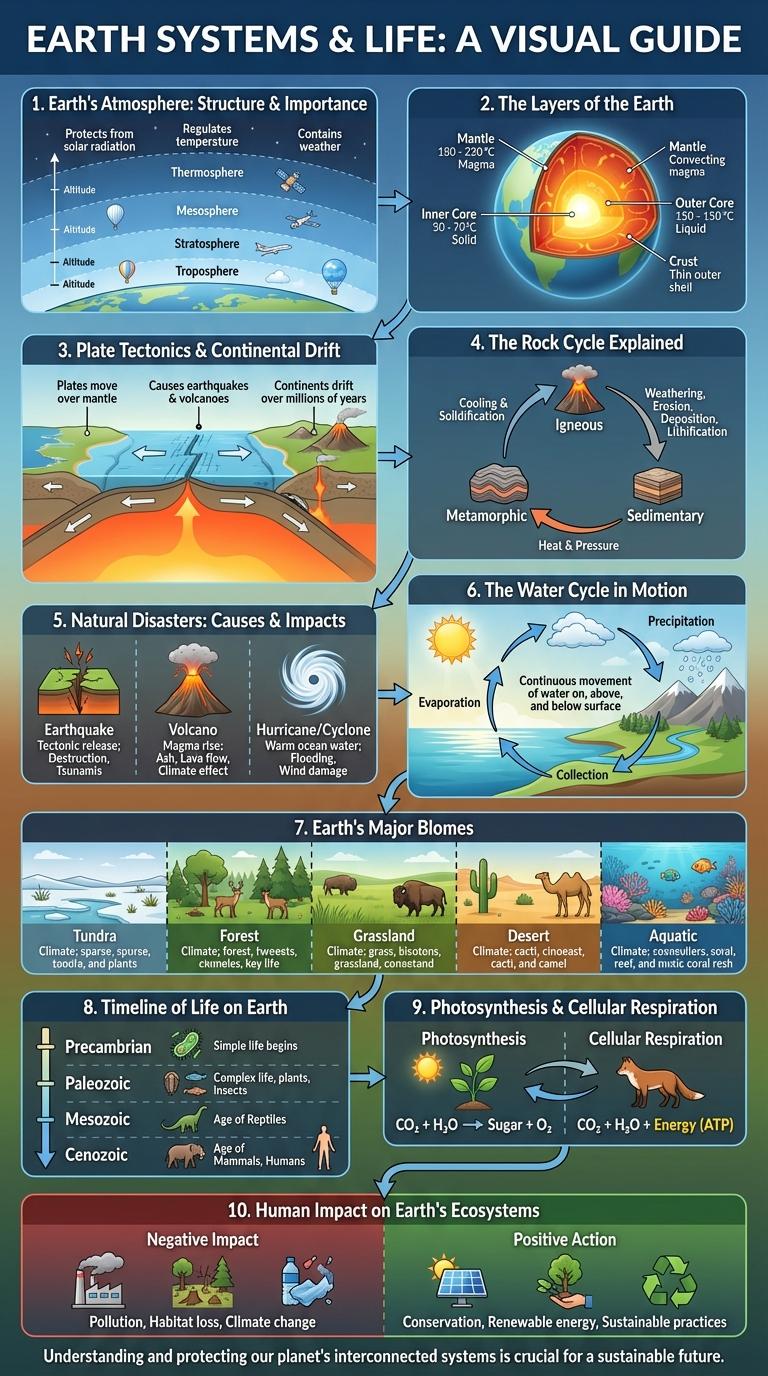
Explore the intricate connections between Earth and life science through a visually engaging infographic that highlights key concepts and processes shaping our planet and its ecosystems. Discover how geological phenomena interact with biological systems, influencing biodiversity and environmental changes. This infographic offers a concise overview of the dynamic relationship between Earth's physical features and the life it supports.
The Layers of the Earth
The Earth is composed of four main layers: the crust, mantle, outer core, and inner core. Each layer varies in composition, temperature, and physical state, with the crust being solid rock, the mantle semi-solid, the outer core liquid metal, and the inner core solid metal. Understanding these layers helps explain geological phenomena such as earthquakes, volcanic activity, and magnetic field generation.
The Rock Cycle Explained
The rock cycle is a continuous process describing the transformation of rocks through various geological stages. It illustrates how igneous, sedimentary, and metamorphic rocks interconvert over time.
Igneous rocks form from cooled magma or lava, sedimentary rocks develop from compressed sediments, and metamorphic rocks arise from existing rocks altered by heat and pressure. This cycle plays a vital role in Earth's dynamic system, recycling materials and shaping landscapes.
Earth's Major Biomes
Earth's major biomes represent distinct ecological regions defined by climate, vegetation, and animal life. These biomes play a critical role in sustaining biodiversity and regulating the planet's climate.
- Tropical Rainforest - Characterized by high rainfall and dense vegetation, tropical rainforests host over half of Earth's plant and animal species.
- Desert - Deserts have low precipitation and extreme temperature variations, supporting specially adapted flora and fauna.
- Grassland - Grasslands feature vast open areas dominated by grasses, essential for herbivores and supporting rich soil ecosystems.
- Temperate Forest - Temperate forests experience four distinct seasons with diverse tree species and abundant wildlife.
- Tundra - Tundras have cold temperatures, permafrost soils, and limited vegetation, primarily mosses and lichens.
Plate Tectonics & Continental Drift
Plate tectonics is the scientific theory explaining the movement of Earth's lithospheric plates. These large plates float on the semi-fluid asthenosphere beneath the crust, causing geological phenomena such as earthquakes and volcanic activity.
Continental drift, a key component of plate tectonics, describes the gradual movement of continents over geological time. This movement has shaped Earth's surface, leading to the formation and breakup of supercontinents like Pangaea.
The Water Cycle in Motion
The Water Cycle is a continuous process that moves water through the Earth's atmosphere, surface, and underground. It plays a critical role in sustaining life by distributing water essential for ecosystems and human activities.
Water evaporates from oceans, lakes, and rivers, rising into the atmosphere as vapor. It cools and condenses to form clouds, which eventually release precipitation back to the surface. This precipitation replenishes water sources, completes the cycle, and supports life on Earth.
Timeline of Life on Earth
How has life on Earth evolved over billions of years? Life on Earth began approximately 3.5 billion years ago with simple single-celled organisms. Over time, complex multicellular life forms developed, leading to the diverse ecosystems we see today.
| Time Period | Significant Event |
|---|---|
| 3.5 billion years ago | First single-celled organisms appeared |
| 600 million years ago | Emergence of multicellular life |
| 540 million years ago | Cambrian Explosion: rapid diversification of species |
| 360 million years ago | First land plants and animals |
| 65 million years ago | Dinosaurs extinction, rise of mammals |
Photosynthesis & Cellular Respiration
| Photosynthesis | Cellular Respiration |
|---|---|
| Definition: Process by which green plants, algae, and some bacteria convert light energy into chemical energy, producing glucose and oxygen from carbon dioxide and water. | Definition: Metabolic process that converts glucose and oxygen into energy (ATP), carbon dioxide, and water within cells of plants, animals, and other organisms. |
| Equation: 6 CO2 + 6 H2O + light energy - C6H12O6 + 6 O2 |
Equation: C6H12O6 + 6 O2 - 6 CO2 + 6 H2O + ATP energy |
| Primary Organisms: Plants, algae, cyanobacteria | Primary Organisms: Most eukaryotic cells including plants, animals, fungi, and many bacteria |
| Location: Chloroplasts | Location: Mitochondria |
| Purpose: Produce glucose to store chemical energy and release oxygen as a byproduct | Purpose: Generate ATP to supply energy for cellular activities |
Natural Disasters: Causes & Impacts
Natural disasters such as earthquakes, hurricanes, and volcanic eruptions result from Earth's dynamic processes including tectonic plate movements and atmospheric conditions. These events can cause significant damage to ecosystems, human infrastructure, and can lead to loss of life. Understanding the causes and impacts of natural disasters is crucial for disaster preparedness and mitigation strategies.
Human Impact on Earth's Ecosystems
Human activities have significantly altered Earth's ecosystems, leading to biodiversity loss and environmental degradation. Understanding these impacts is crucial for sustainable management and conservation efforts.
- Deforestation - Clearing forests for agriculture and urban development disrupts habitats and reduces carbon sequestration.
- Pollution - Chemicals, plastics, and waste contaminate air, water, and soil, harming wildlife and human health.
- Climate Change - Emissions of greenhouse gases from human activities drive temperature rises, affecting ecosystems globally.