
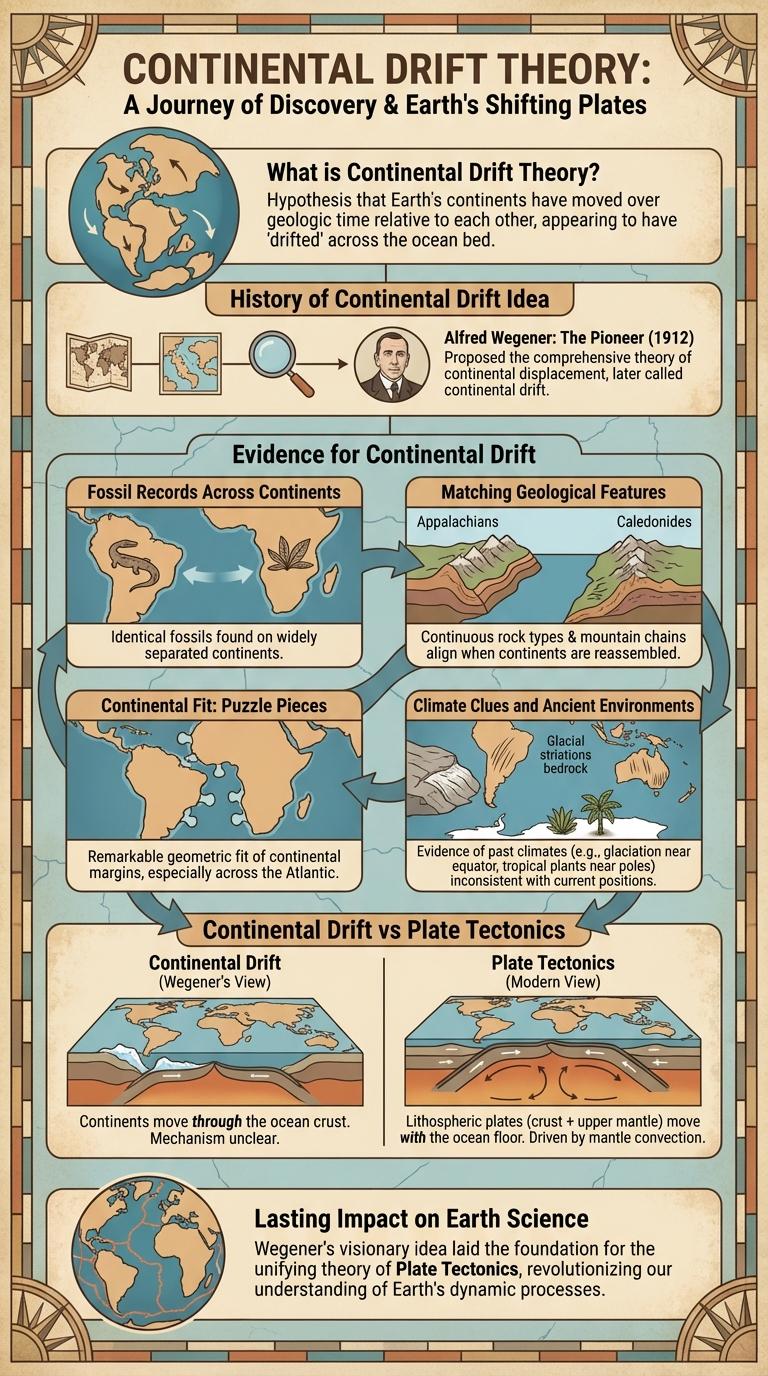
The continental drift theory explains how the Earth's continents have shifted positions over millions of years. It provides evidence from geology, fossil records, and the fit of continental coastlines to support the movement of landmasses. This infographic visually represents the key concepts and historical development of the theory.
What is Continental Drift Theory?
The Continental Drift Theory explains the movement of Earth's continents relative to each other over geological time. This theory suggests that continents have shifted their positions across the Earth's surface.
- Definition - Continental Drift refers to the gradual movement of continents due to tectonic forces.
- Originator - Alfred Wegener proposed the theory in 1912 based on fossil and geological evidence.
- Significance - The theory laid the foundation for modern plate tectonics, explaining continental and oceanic changes.
History of Continental Drift Idea
The concept of continental drift was first introduced by Alfred Wegener in 1912, proposing that continents were once joined in a single landmass called Pangaea. Wegener's theory suggested that continents slowly moved across the Earth's surface over millions of years. Initial skepticism gave way to acceptance with the discovery of plate tectonics in the mid-20th century, providing evidence for continental movement.
Alfred Wegener: The Pioneer
Continental drift theory revolutionized geology by proposing that continents are not fixed but move over Earth's surface. Alfred Wegener, a German meteorologist and geophysicist, pioneered this groundbreaking concept in the early 20th century.
Wegener introduced the idea in 1912, suggesting that all continents were once part of a supercontinent called Pangaea. He supported his theory with evidence from fossil distribution, geological similarities across continents, and the fit of continental coastlines. Though initially controversial, his work laid the foundation for modern plate tectonics.
Evidence for Continental Drift
The theory of continental drift explains the movement of Earth's continents over geological time. This concept was first proposed by Alfred Wegener in the early 20th century.
Key evidence includes the matching shapes of continental coastlines, like South America and Africa. Fossil records show identical species found on continents now separated by oceans.
Geological formations such as mountain ranges align across continents, supporting the drift theory. Paleoclimatic data, like glacial deposits in now tropical regions, also provide strong evidence.
Fossil Records Across Continents
Fossil records across continents provide strong evidence supporting the Continental Drift Theory. Identical fossils of ancient plants and animals have been found on continents separated by vast oceans.
For example, fossils of the reptile Mesosaurus are discovered in both South America and Africa, indicating these continents were once connected. Similarly, the plant Glossopteris appears in continents like Antarctica, India, and Australia, reinforcing the idea of a supercontinent.
Matching Geological Features
The continental drift theory explains the movement of Earth's continents over geological time. It highlights how matching geological features across continents provide evidence for their once connected state.
- Mountain Ranges Alignment - The Appalachian Mountains in North America align with the Caledonian Mountains in Scotland and Scandinavia, suggesting they were formed together.
- Fossil Correlation - Identical fossils of extinct plants and animals found on different continents support the idea of contiguous landmasses in the past.
- Rock Type Similarities - Continuous belts of matching rock types and ages stretch across continents now separated by oceans, indicating prior connection.
These geological matches strengthen the case for continental drift by demonstrating how continents fit together like pieces of a puzzle.
Continental Fit: Puzzle Pieces
How do the continents fit together like puzzle pieces according to the Continental Drift Theory?
The Continental Drift Theory suggests that the continents were once joined in a single landmass called Pangaea. Over millions of years, these landmasses slowly separated, and their coastlines fit together like pieces of a giant jigsaw puzzle, supporting the idea of continental movement.
Climate Clues and Ancient Environments
| Aspect | Description |
|---|---|
| Climate Clues | Fossil evidence of tropical plants found in now-cold regions suggests continents were once positioned differently, indicating shifts in climate zones over geological time. |
| Glacial Deposits | Ancient glacial striations and tillites present in currently warm regions point to previous polar locations, supporting the theory of landmass movement. |
| Coal Beds | Presence of coal beds in Antarctica reveals past swampy, warm environments, implying a different continental placement conducive to such climates. |
| Marine Sediments | Distribution of marine sediments across continents aligns with continental positions in the past, highlighting oceanic and climatic changes influenced by drift. |
| Environmental Reconstruction | By analyzing fossilized flora and fauna, scientists reconstruct ancient environments, evidencing the dynamic shifts in geography due to continental drift. |
Continental Drift vs Plate Tectonics
The Continental Drift theory and Plate Tectonics theory explain the movement of Earth's continents but differ in mechanisms and scientific acceptance. Continental Drift was an early concept proposing continents moved through the ocean crust, while Plate Tectonics provides a comprehensive model involving lithospheric plates.
- Continental Drift Theory - Proposed by Alfred Wegener in 1912, suggesting continents drift across the Earth's surface.
- Plate Tectonics Theory - Developed in the 1960s, describing Earth's lithosphere divided into plates that move on the asthenosphere.
- Movement Mechanism - Continental Drift lacked a convincing mechanism, whereas Plate Tectonics explains movement through mantle convection and slab pull.
- Scientific Evidence - Continental Drift was supported by fossil distribution and fit of continents; Plate Tectonics incorporates seafloor spreading and earthquake data.
- Current Acceptance - Plate Tectonics is the widely accepted theory governing geological processes, refining and expanding on Continental Drift ideas.