
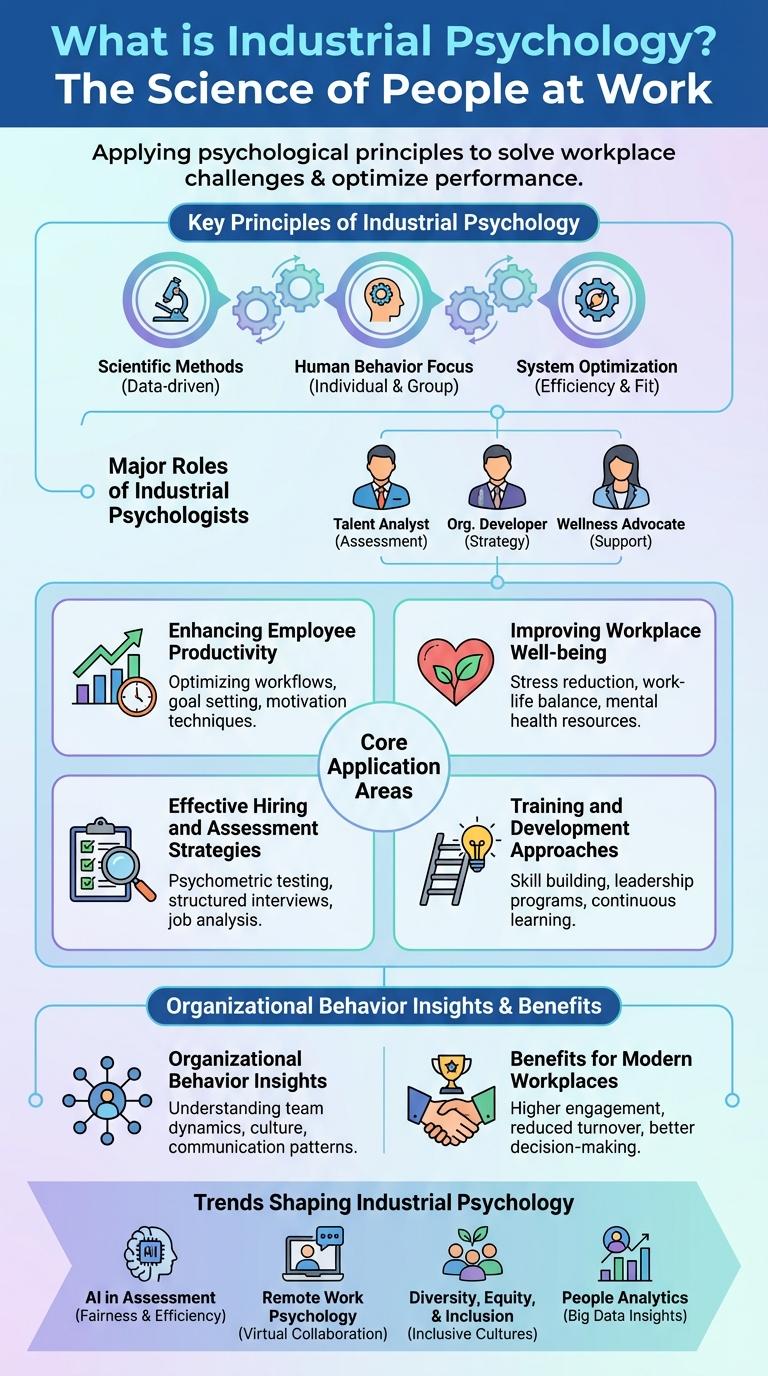
Industrial psychology explores the intersection of human behavior and workplace efficiency, focusing on optimizing employee performance and organizational culture. This infographic highlights key concepts such as motivation, job satisfaction, and leadership strategies essential for enhancing productivity. Understanding these principles helps businesses create healthier work environments that support both individual and corporate growth.
What is Industrial Psychology?
Industrial Psychology is the scientific study of human behavior in workplaces and organizations. It focuses on improving employee well-being and organizational performance through psychological principles.
This field applies research on motivation, job satisfaction, and leadership to optimize work environments. Industrial psychologists analyze how individuals interact with job tasks, teams, and management.
Key Principles of Industrial Psychology
Industrial psychology studies human behavior in workplaces to enhance productivity and employee well-being. It applies psychological principles to optimize hiring, training, and work environments, ensuring organizational success.
Key principles include understanding job analysis, employee motivation, and workplace ergonomics. Emphasizing effective communication and leadership fosters a positive and efficient work culture.
Benefits for Modern Workplaces
Industrial psychology enhances productivity and employee well-being in modern workplaces. It applies psychological principles to optimize work environments and human resource practices.
Utilizing industrial psychology leads to improved employee engagement and reduced turnover rates. It supports tailored training programs that boost skill development and job satisfaction. Companies benefit from data-driven recruitment strategies that ensure the right fit for organizational culture.
Major Roles of Industrial Psychologists
Industrial psychology applies psychological principles to workplace environments to improve employee well-being and organizational performance. Industrial psychologists analyze human behavior in professional settings to enhance productivity, satisfaction, and safety.
- Employee Selection and Recruitment - Industrial psychologists develop assessment tools to identify the best candidates for job positions.
- Training and Development - They design programs that increase employee skills and promote career growth.
- Performance Evaluation - Psychologists create fair and effective methods to measure employee performance and provide feedback.
- Workplace Motivation and Engagement - They study factors that drive motivation and implement strategies to boost employee commitment.
- Organizational Development - Industrial psychologists advise organizations on change management and improving workplace culture.
Enhancing Employee Productivity
How does industrial psychology enhance employee productivity? Industrial psychology applies psychological principles to workplace environments, boosting efficiency and job satisfaction. Techniques such as employee motivation, ergonomic design, and effective leadership training increase both productivity and well-being.
| Strategy | Impact on Productivity |
| Employee Motivation Programs | Increase engagement and reduce absenteeism |
| Ergonomic Workplace Design | Minimizes fatigue and improves focus |
| Leadership Development | Enhances team collaboration and decision-making |
| Performance Feedback Systems | Encourages continuous improvement and goal alignment |
| Stress Management Interventions | Reduces burnout and enhances mental health |
Improving Workplace Well-being
Industrial psychology examines human behavior in work environments to enhance employee well-being and organizational performance. Focused strategies improve mental health, job satisfaction, and productivity in the workplace.
- Stress Management - Implementing stress reduction techniques lowers anxiety and burnout among employees.
- Work-Life Balance - Encouraging flexible schedules promotes employee satisfaction and reduces turnover rates.
- Employee Engagement - Enhancing motivation through recognition programs boosts morale and performance.
Applying industrial psychology principles fosters a healthier, more productive work environment.
Organizational Behavior Insights
Industrial psychology studies human behavior in workplaces to improve organizational efficiency and employee well-being. Key insights into organizational behavior reveal how motivation, leadership, and team dynamics influence productivity and job satisfaction. Understanding these factors helps businesses develop strategies for effective communication, conflict resolution, and workforce engagement.
Effective Hiring and Assessment Strategies
Industrial psychology applies scientific methods to improve hiring and assessment processes, ensuring organizations select the best candidates for their roles. Effective hiring strategies include structured interviews, psychometric testing, and job simulations to accurately predict job performance. Assessment methods integrate behavioral analysis and cognitive evaluations to enhance employee productivity and reduce turnover rates.
Training and Development Approaches
| Training and Development Approaches | Description |
|---|---|
| On-the-Job Training | Practical skill development through real workplace tasks, enhancing learning by experience and direct application. |
| Behavioral Modeling | Learning by observing and imitating role models to improve interpersonal skills and workplace behavior. |
| Simulation Training | Use of virtual or physical simulations to replicate job scenarios, improving problem-solving and decision-making abilities. |
| Workshops and Seminars | Interactive sessions focused on specific skills, knowledge, or behavioral competencies critical for organizational performance. |
| E-Learning Programs | Flexible, technology-based learning opportunities enabling employees to engage in self-paced training tailored to their roles. |