
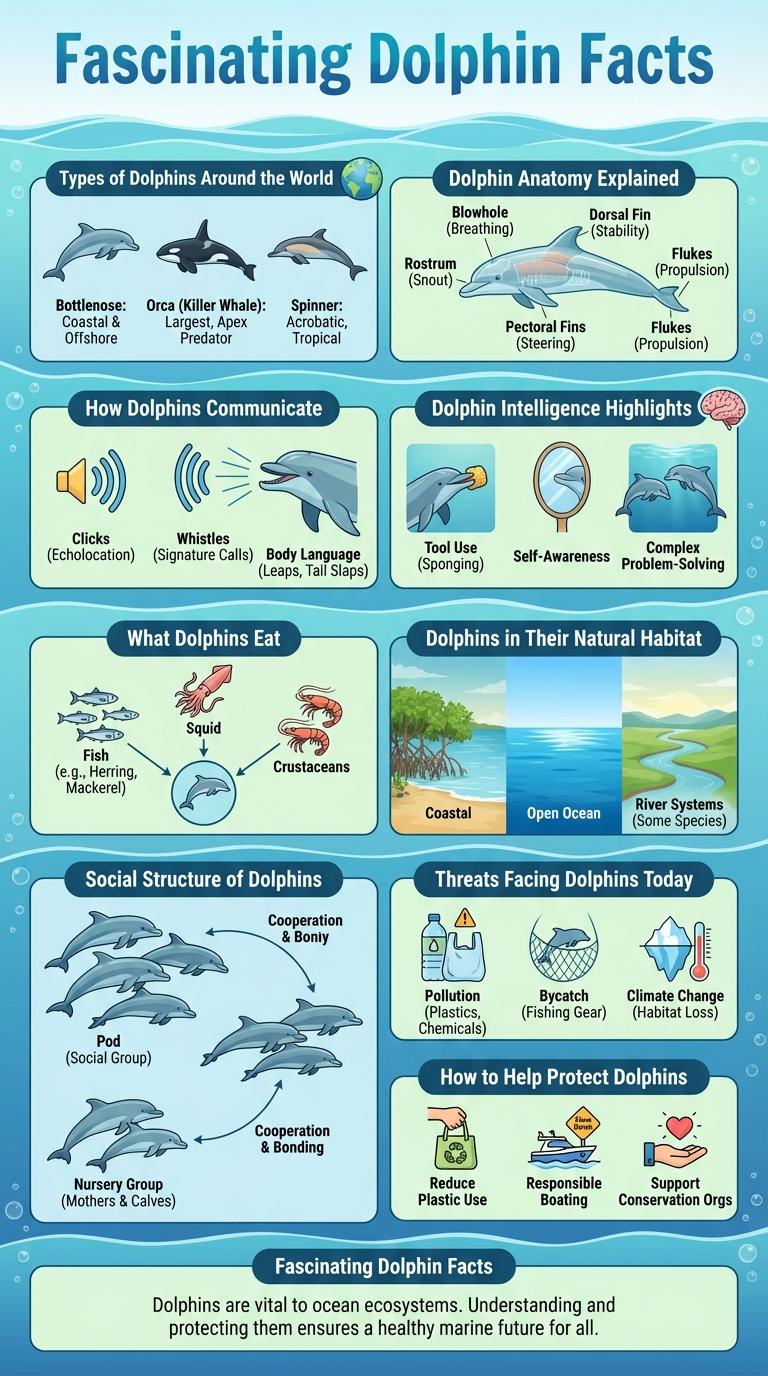
Dolphins are highly intelligent marine mammals known for their playful behavior and complex social structures. This infographic highlights key facts about their communication methods, habitat, and diet. Understanding these fascinating creatures reveals their important role in ocean ecosystems.
Fascinating Dolphin Facts
What makes dolphins one of the most intelligent marine animals?
Dolphins exhibit complex problem-solving skills and use echolocation to navigate and hunt. Their brain-to-body size ratio is second only to humans among mammals.
How do dolphins communicate with each other?
Dolphins use a variety of clicks, whistles, and body language to communicate. Each dolphin has a unique signature whistle that functions like a name.
What unique physical features help dolphins swim efficiently?
Dolphins have streamlined bodies and powerful tails called flukes for rapid swimming. Their dorsal fins provide stability and help with maneuvering in water.
How long do dolphins typically live in the wild?
The average lifespan of a bottlenose dolphin ranges from 20 to 50 years. Some individuals can live over 60 years under ideal conditions.
Are dolphins social animals?
Dolphins live in groups called pods that can consist of a few to over a hundred members. Social bonds within pods aid in hunting, protection, and raising young.
Types of Dolphins Around the World
| Type of Dolphin | Key Characteristics & Habitat |
|---|---|
| Bottlenose Dolphin | Known for intelligence and friendly behavior. Found in warm and temperate seas worldwide, including the Atlantic and Pacific Oceans. |
| Common Dolphin | Distinctive hourglass pattern on sides. Inhabits offshore waters of the Atlantic and tropical Pacific Oceans. |
| Spinner Dolphin | Famous for acrobatic spinning jumps. Lives mainly in tropical and subtropical waters such as the Indian and Pacific Oceans. |
| Amazon River Dolphin | Also called pink river dolphin. Freshwater species found in the Amazon and Orinoco river basins in South America. |
| Pacific White-sided Dolphin | Recognizable by striking white and grey coloration. Inhabits North Pacific coastal waters near the US and Japan. |
Dolphin Anatomy Explained
Dolphins possess streamlined bodies designed for agile swimming, featuring a dorsal fin, flippers, and a tail fluke. Their skin is smooth, reducing water resistance while aiding in swift movement through the ocean.
Their respiratory system includes a blowhole located on top of the head for efficient breathing at the surface. Dolphins have a complex brain, highly developed eyes, and an echolocation system used for navigation and hunting in murky waters.
How Dolphins Communicate
Dolphins use a complex system of sounds and body language to communicate with each other. Their communication plays a crucial role in social bonding, navigation, and hunting strategies.
Sounds include clicks, whistles, and burst-pulsed calls that convey different messages.
- Clicks - Used primarily for echolocation to navigate and locate prey.
- Whistles - Signature whistles function like names to identify individual dolphins.
- Burst-pulsed sounds - Express emotions such as excitement or aggression and maintain group cohesion.
Dolphin Intelligence Highlights
Dolphins exhibit remarkable intelligence, showcasing complex problem-solving skills and the ability to learn new tasks quickly. Their large brains relative to body size contribute to advanced cognitive functions and social behaviors.
These marine mammals use sophisticated communication involving clicks, whistles, and body language to coordinate within pods. Studies reveal dolphins demonstrate self-awareness, empathy, and cooperation, setting them apart in the animal kingdom.
What Dolphins Eat
Dolphins are carnivorous marine mammals known for their intelligence and agility. Their diet mainly consists of a variety of seafood found in their ocean habitats.
- Fish - Small and medium-sized fish such as herring, mackerel, and sardines form the bulk of their diet.
- Squid - Squid provide essential nutrients and are a common prey in deeper or offshore waters.
- Crustaceans - Some dolphin species consume shrimp and crabs, especially in coastal environments.
Their feeding habits adapt based on available prey and geographic location.
Dolphins in Their Natural Habitat
Dolphins inhabit diverse marine environments including coastal areas, deep oceans, and river systems. Their natural habitat offers abundant food sources such as fish and squid, supporting their complex social structures. These intelligent mammals rely on echolocation to navigate and hunt effectively in their aquatic surroundings.
Social Structure of Dolphins
Dolphins exhibit complex social structures characterized by dynamic group formations known as pods. These pods consist of related individuals and can range from small groups to large aggregations depending on species and environment.
Within pods, dolphins communicate using a variety of vocalizations, including clicks and whistles, which facilitate coordination and social bonding. Social interactions such as cooperative hunting, play, and care for offspring are common behaviors that strengthen pod cohesion. Hierarchies often emerge, with dominant individuals guiding group movement and decision-making.
Threats Facing Dolphins Today
Dolphins face numerous threats that jeopardize their populations worldwide. Human activities and environmental changes severely impact their survival and wellbeing.
- Bycatch in Fishing Nets - Dolphins often get accidentally caught in fishing gear, leading to injury or death.
- Pollution and Contaminants - Chemical pollutants accumulate in dolphin habitats, affecting their health and reproductive systems.
- Habitat Loss and Noise Pollution - Coastal development and marine traffic disrupt dolphin communication and natural habitats.