
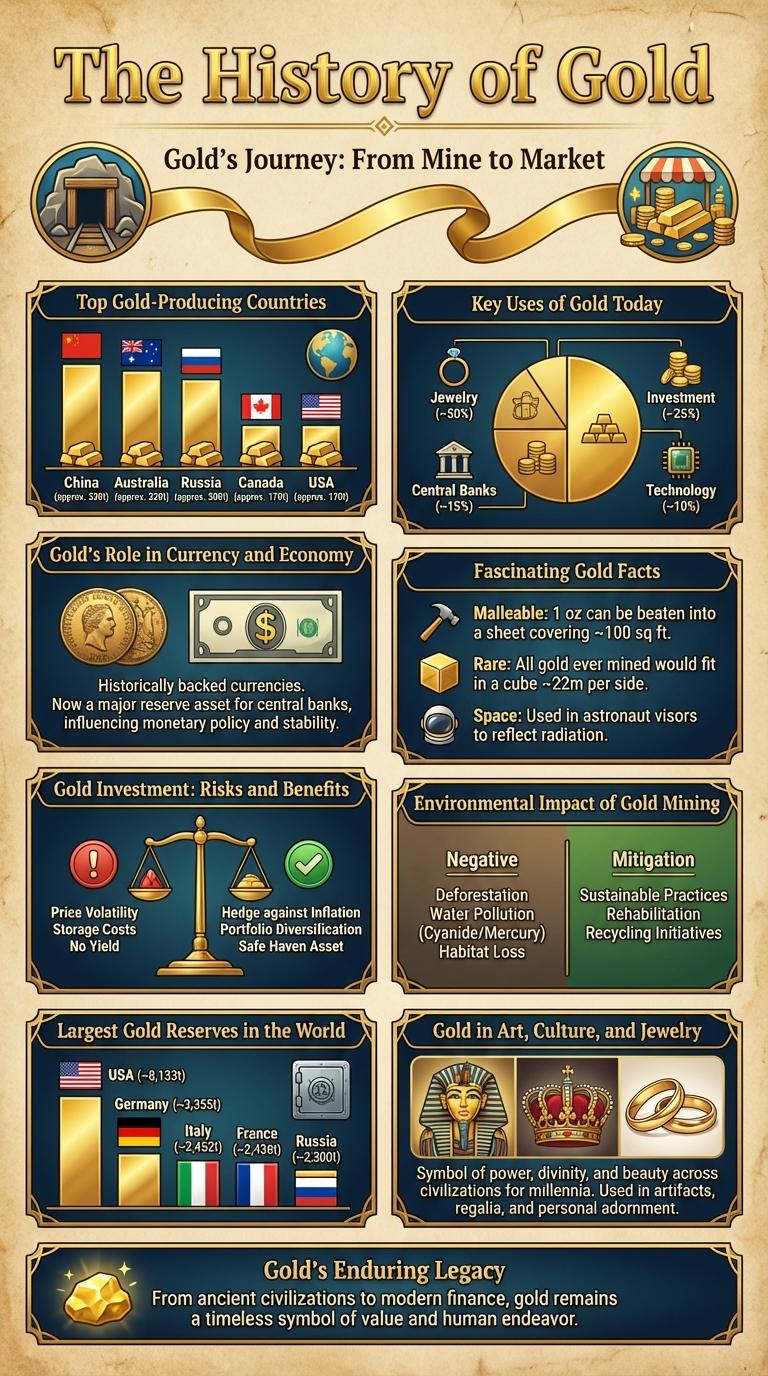
Gold has been a symbol of wealth and power for centuries, captivating civilizations with its rarity and luster. This infographic presents key insights into gold's history, market trends, and uses across industries. Explore how gold remains a valuable asset in both cultural heritage and modern economics.
The History of Gold
Gold has been a symbol of wealth and power for thousands of years. Its unique properties and rarity have made it a valuable resource throughout human history.
Gold was first used by ancient civilizations around 4000 BC for jewelry and currency. The metal played a crucial role in the economies of empires like Ancient Egypt and Rome.
- Ancient Egypt - Gold was mined extensively and used for artifacts, coins, and burial items in pharaohs' tombs.
- Roman Empire - Gold coins facilitated trade and symbolized imperial wealth and authority across vast territories.
- Gold Rushes - The 19th-century gold rushes in California and Australia sparked mass migrations and economic booms.
Gold's Journey: From Mine to Market
Gold's journey begins deep within the earth, where mining operations extract gold ore through open-pit or underground methods. After extraction, the ore undergoes processing to separate pure gold from other minerals, resulting in refined gold bars or bullion. Finally, these gold products enter global markets, where they are transformed into jewelry, investment assets, and industrial components.
Top Gold-Producing Countries
Gold remains a valuable resource worldwide, with certain countries leading in production. Understanding which nations produce the most gold reveals insights into global mining trends and economic strength.
The top gold-producing countries dominate the market by volume and influence the global gold supply chain significantly.
- China leads global gold production - China mines over 370 metric tons of gold annually, making it the world's largest producer.
- Australia ranks second - Australia's output exceeds 310 metric tons each year, driven by its rich mineral reserves.
- Russia maintains a strong position - Russia produces roughly 310 metric tons of gold annually, placing it among the top three producers.
Key Uses of Gold Today
| Key Use | Description |
|---|---|
| Jewelry | Represents over 50% of annual gold demand, prized for its luster and malleability in making rings, necklaces, and bracelets. |
| Electronics | Used in connectors, switches, and relay contacts due to excellent conductivity and resistance to corrosion. |
| Finance and Investment | Held as bullion bars and coins; a global standard for wealth preservation and hedge against inflation. |
| Medicine | Applied in dental alloys and certain medical devices; notable in precision treatment techniques like rheumatoid arthritis therapy. |
| Aerospace | Utilized in coating spacecraft components for thermal protection and in connectors to endure extreme conditions. |
Gold's Role in Currency and Economy
Gold has been a cornerstone of currency systems for centuries due to its rarity, durability, and universal value. Many countries held gold reserves to back their paper money, ensuring financial stability.
Gold played a central role in the gold standard, linking national currencies directly to a fixed amount of gold. This system helped maintain exchange rate stability and controlled inflation. Even today, central banks hold large gold reserves as a hedge against economic uncertainty and currency fluctuations.
Fascinating Gold Facts
Gold is a precious metal that has been treasured for thousands of years due to its rarity and lustrous appearance. It is highly malleable, allowing it to be shaped into extremely thin sheets called gold leaf.
Gold does not tarnish or corrode, making it ideal for use in jewelry and electronics. Over 50,000 tons of gold have been mined throughout history, with most of it still in circulation today.
Gold Investment: Risks and Benefits
Gold investment offers a unique blend of security and potential growth, making it a popular choice for diversifying portfolios. Understanding the risks and benefits associated with gold is essential for informed financial decisions.
- Store of Value - Gold maintains purchasing power during inflation and economic instability.
- Market Volatility - Gold prices can fluctuate due to geopolitical events and currency movements.
- Liquidity - Gold can be easily bought or sold in various forms, including coins, bars, and ETFs.
Balancing gold's risk and reward characteristics can enhance long-term investment strategies.
Environmental Impact of Gold Mining
Gold mining significantly impacts the environment through habitat destruction, soil erosion, and contamination of water sources with toxic chemicals such as cyanide and mercury. The extraction process generates large amounts of waste, leading to deforestation and loss of biodiversity in mining areas. Efforts to reduce these environmental effects include improved mining technologies and stricter regulations to manage waste and rehabilitate ecosystems.
Largest Gold Reserves in the World
Gold remains one of the most valuable and sought-after precious metals worldwide. Several countries hold vast gold reserves, playing a crucial role in their economic stability.
The United States has the largest gold reserve, followed closely by Germany and Italy. These reserves are measured in metric tons, reflecting the physical stockpiles maintained by central banks.