
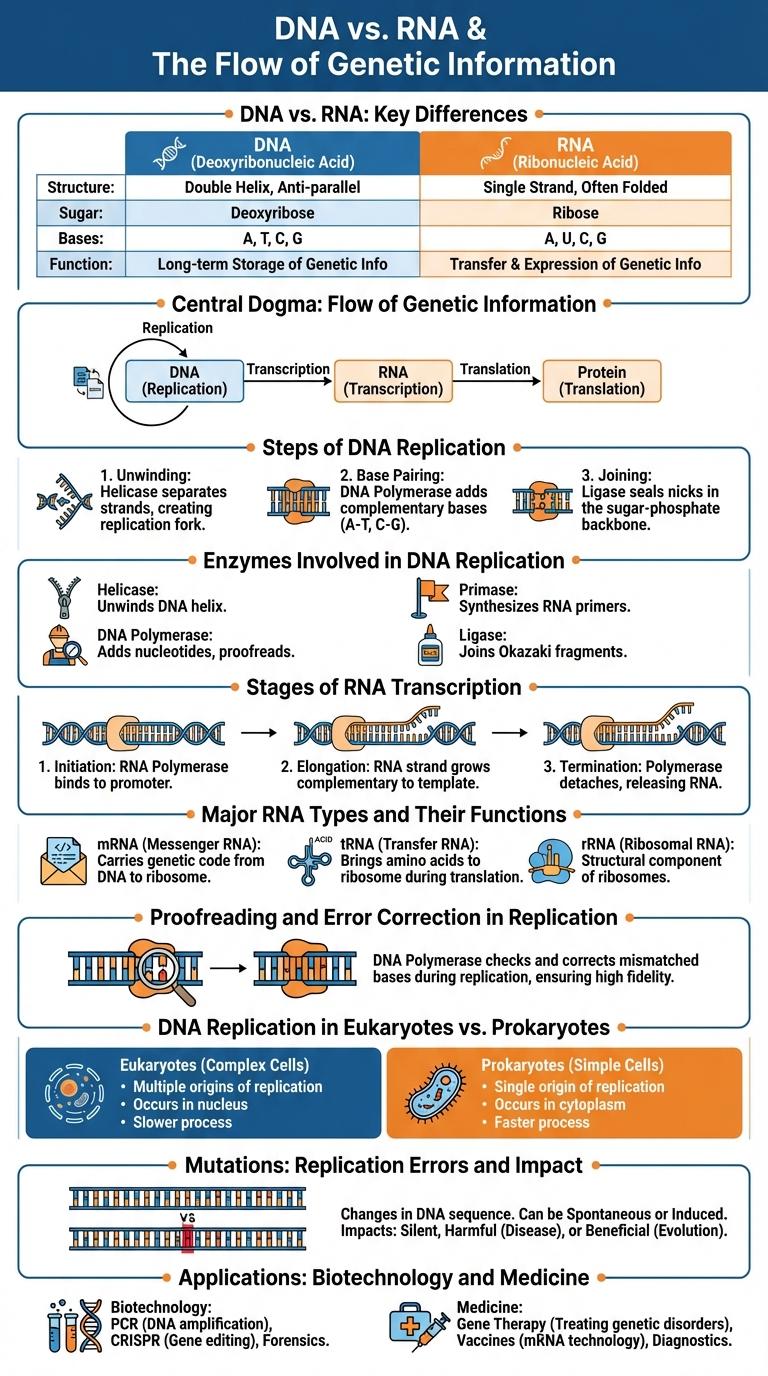
DNA and RNA replication are crucial biological processes that ensure genetic information is accurately copied and transmitted. These mechanisms involve a series of enzymes that unwind the nucleic acid strands and synthesize new complementary sequences. Understanding the detailed steps of replication enhances comprehension of cellular function and genetic inheritance.
DNA vs. RNA: Key Differences
DNA and RNA replication are fundamental biological processes essential for genetic information transmission and protein synthesis. Both involve nucleotide pairing, but they differ in structure, enzymes, and functions.
DNA replication occurs in the nucleus and utilizes DNA polymerase to create an exact double-stranded copy. RNA replication happens mainly in the cytoplasm using RNA polymerase to transcribe single-stranded RNA from DNA. DNA contains deoxyribose sugar and thymine, while RNA contains ribose sugar and uracil, highlighting key chemical differences.
Central Dogma: Flow of Genetic Information
The Central Dogma explains the flow of genetic information from DNA to RNA to protein. DNA replication and RNA transcription are key processes ensuring accurate gene expression.
- DNA Replication - DNA polymerase synthesizes a complementary DNA strand, creating an identical DNA copy.
- RNA Transcription - RNA polymerase transcribes DNA into messenger RNA (mRNA) based on the DNA template.
- Genetic Information Flow - Information flows unidirectionally: DNA - RNA - Protein, guiding cellular functions.
This precise genetic information transfer underlies all biological processes and organism development.
Steps of DNA Replication
DNA replication begins with the unwinding of the double helix by the enzyme helicase, creating two single strands that serve as templates. DNA polymerase then adds complementary nucleotides to each original strand, synthesizing new strands in a 5' to 3' direction. The process concludes with the joining of Okazaki fragments on the lagging strand by DNA ligase, ensuring two identical DNA molecules are formed.
Enzymes Involved in DNA Replication
DNA replication relies on a variety of specialized enzymes to ensure accurate copying of genetic material. Key enzymes include DNA helicase, which unwinds the double helix; DNA polymerase, responsible for synthesizing the new DNA strand; and ligase, which joins Okazaki fragments on the lagging strand. These enzymes work in a coordinated manner to maintain genome integrity during cell division.
Stages of RNA Transcription
RNA transcription is the process by which genetic information from DNA is copied into RNA. This mechanism is essential for protein synthesis and gene expression in cells.
- Initiation - RNA polymerase binds to the promoter region of DNA, unwinding the double helix to begin RNA synthesis.
- Elongation - RNA polymerase moves along the DNA template strand, adding complementary RNA nucleotides to the growing RNA chain.
- Termination - RNA polymerase reaches a terminator sequence, releasing the newly formed RNA transcript and detaching from the DNA.
Major RNA Types and Their Functions
DNA and RNA replication are essential processes for genetic information transmission and protein synthesis. RNA plays multiple roles, with distinct types carrying specific functions during gene expression and regulation.
- mRNA (messenger RNA) - Carries genetic code from DNA to ribosomes for protein synthesis.
- tRNA (transfer RNA) - Brings amino acids to ribosomes, matching codons on mRNA during translation.
- rRNA (ribosomal RNA) - Combines with proteins to form ribosomes, facilitating peptide bond formation.
- snRNA (small nuclear RNA) - Involved in splicing pre-mRNA to remove introns during RNA processing.
- miRNA (microRNA) - Regulates gene expression by degrading mRNA or inhibiting translation.
Proofreading and Error Correction in Replication
DNA and RNA replication are vital processes ensuring genetic information is accurately copied within cells. Proofreading and error correction mechanisms maintain the fidelity of these processes by identifying and correcting mistakes during replication.
DNA polymerases possess intrinsic proofreading activity through 3' to 5' exonuclease function, which removes incorrectly paired nucleotides. This error correction reduces mutation rates, preserving genome stability.
DNA Replication in Eukaryotes vs. Prokaryotes
How do DNA replication processes differ between eukaryotes and prokaryotes? DNA replication in eukaryotes occurs within the nucleus and involves multiple origins of replication due to their larger genome size. Prokaryotes have a single circular chromosome and start replication from a single origin, allowing faster replication suited to their smaller genome.
What role do enzymes play in eukaryotic versus prokaryotic DNA replication? Both use DNA polymerases to synthesize new strands, but eukaryotes utilize several types with distinct functions, including polymerase a, d, and e. Prokaryotes primarily rely on DNA polymerase III for elongation and DNA polymerase I for primer removal.
How is the replication fork structure similar or different between the two organisms? Both feature a replication fork where DNA unwinds to serve as templates for new strands. Eukaryotic replication forks are more complex, involving multiple accessory proteins to manage chromatin structure and larger genome size.
What is the speed difference in DNA replication between eukaryotes and prokaryotes? Prokaryotic replication proceeds faster, approximately 1000 nucleotides per second, due to simpler genome organization. Eukaryotic replication is slower, about 50 nucleotides per second, to ensure higher fidelity and manage complex chromatin packaging.
How do the termination mechanisms vary in DNA replication for these two cell types? Prokaryotes terminate replication when replication forks meet at the terminus region on their circular chromosome. Eukaryotes have linear chromosomes requiring specialized mechanisms like telomerase to replicate chromosome ends properly.
Mutations: Replication Errors and Impact
| Aspect | Description |
|---|---|
| DNA Replication | Semiconservative process where DNA polymerase synthesizes a complementary strand by adding nucleotides to the original template strand. |
| RNA Replication | Occurs mainly in RNA viruses; RNA-dependent RNA polymerase copies RNA strands, lacking proofreading capability. |
| Replication Errors | Incorporation of incorrect nucleotides due to polymerase mistakes or structural damage; mismatches or insertions/deletions can occur. |
| Mutation Types | Point mutations (substitutions), frameshift mutations (insertions/deletions), and large-scale chromosomal mutations can arise from replication errors. |
| Impact of Mutations | Potential outcomes include genetic diversity, hereditary diseases, cancer development, or lethal cellular dysfunctions depending on mutation location and type. |