
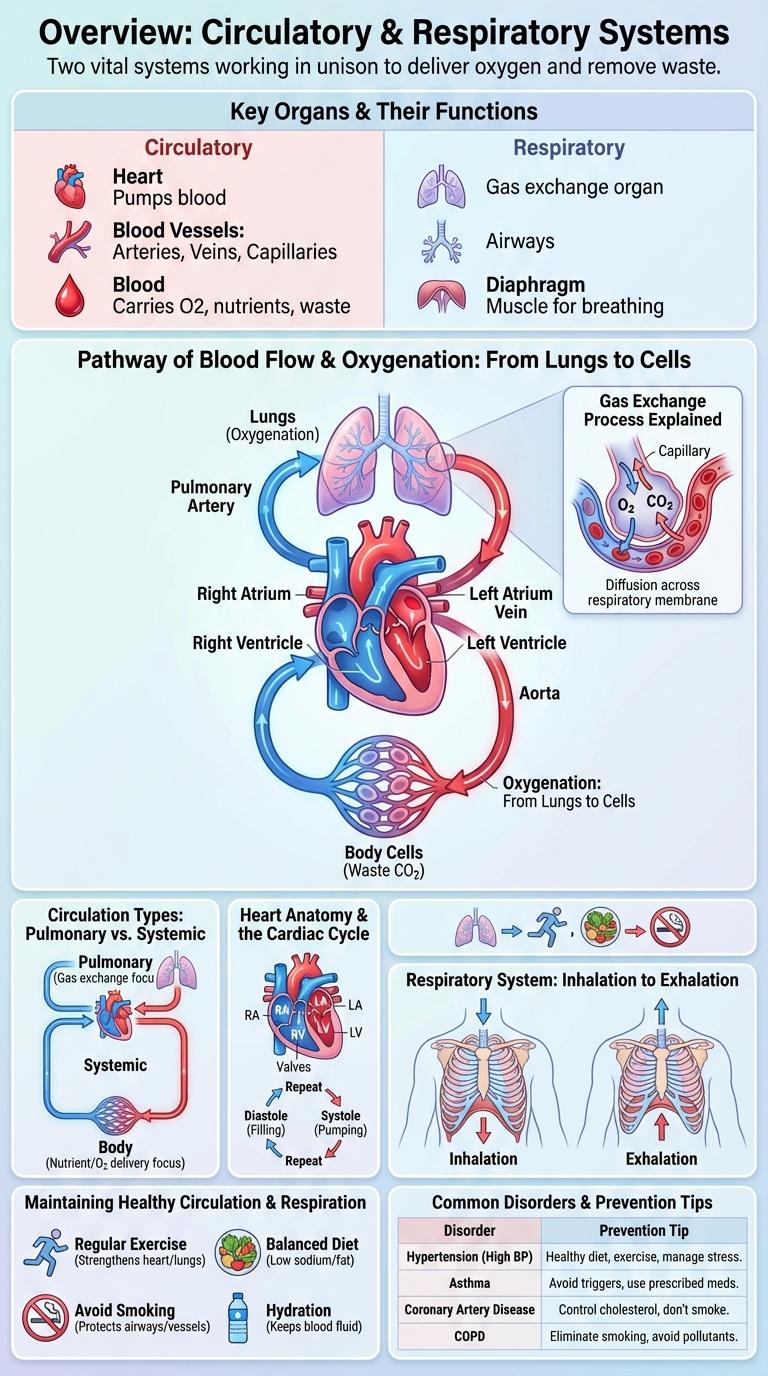
The circulatory and respiratory systems work together to deliver oxygen to the body's cells and remove carbon dioxide. The heart pumps oxygen-rich blood through the arteries, while the lungs facilitate gas exchange by inhaling oxygen and exhaling carbon dioxide. Understanding these interconnected processes is essential to grasp how the body maintains vital functions and energy production.
Overview: Circulatory & Respiratory Systems
The circulatory system transports blood, nutrients, and oxygen throughout the body via the heart, blood, and blood vessels. It supports cellular function by removing waste products like carbon dioxide.
The respiratory system enables breathing by facilitating the exchange of oxygen and carbon dioxide between the lungs and the bloodstream. It maintains oxygen levels critical for metabolism and overall health.
Key Organs & Their Functions
The circulatory system consists of the heart, blood vessels, and blood, working together to transport oxygen, nutrients, and waste products throughout the body. The respiratory system includes the lungs, trachea, and diaphragm, responsible for oxygen intake and carbon dioxide expulsion. Both systems collaborate to maintain oxygen supply and remove carbon dioxide, ensuring cellular function and overall homeostasis.
| Organ | Function |
|---|---|
| Heart | Pumps oxygenated blood to the body and deoxygenated blood to the lungs |
| Lungs | Facilitate gas exchange, oxygenating blood and removing carbon dioxide |
| Blood Vessels | Transport blood between the heart, lungs, and tissues |
| Trachea | Provides an airway for air to enter and exit the lungs |
| Diaphragm | Contracts and relaxes to enable breathing movements |
Pathway of Blood Flow
How does blood circulate through the human body? The circulatory system transports blood, delivering oxygen and nutrients while removing waste. Blood flows through the heart, lungs, and blood vessels in a continuous cycle.
| Step | Pathway Description |
|---|---|
| 1 | Deoxygenated blood enters the right atrium from the body via the superior and inferior vena cava. |
| 2 | Blood moves to the right ventricle and is pumped to the lungs through the pulmonary artery for oxygenation. |
| 3 | Oxygen-rich blood returns to the left atrium through the pulmonary veins. |
| 4 | Blood flows into the left ventricle and is pumped to the body through the aorta. |
| 5 | Oxygen and nutrients are delivered to tissues as blood circulates through arteries, capillaries, and veins. |
Oxygenation: From Lungs to Cells
The circulatory and respiratory systems work together to oxygenate blood and deliver oxygen to cells. This process is vital for cellular respiration and energy production throughout the body.
- Oxygen Intake in Lungs - Air enters the alveoli where oxygen diffuses into pulmonary capillaries.
- Oxygen Transport via Blood - Oxygen binds to hemoglobin in red blood cells for efficient transport through arteries.
- Oxygen Delivery to Cells - Oxygen-rich blood reaches body tissues, releasing oxygen for cellular respiration and metabolic functions.
Circulation Types: Pulmonary vs. Systemic
The circulatory system consists of two main types of circulation: pulmonary and systemic. Pulmonary circulation moves blood between the heart and lungs for oxygenation.
Systemic circulation delivers oxygen-rich blood from the heart to the rest of the body and returns oxygen-poor blood back to the heart. These two types work together to maintain efficient blood flow and oxygen transport.
Gas Exchange Process Explained
The gas exchange process is a vital function where oxygen enters the blood and carbon dioxide is removed. This occurs primarily in the alveoli of the lungs and capillaries of the circulatory system.
- Oxygen Intake - Oxygen from inhaled air diffuses through alveolar walls into the bloodstream.
- Carbon Dioxide Removal - Carbon dioxide diffuses from blood into alveoli to be exhaled from the body.
- Transport via Circulatory System - Oxygen-rich blood is carried by red blood cells through arteries to body tissues, while veins return carbon dioxide-laden blood to the lungs.
This efficient gas exchange supports cellular respiration and overall metabolic functions.
Heart Anatomy & the Cardiac Cycle
| Heart Anatomy | Cardiac Cycle |
|---|---|
| The heart consists of four chambers: two atria (upper chambers) and two ventricles (lower chambers). | The cardiac cycle includes systole (contraction phase) and diastole (relaxation phase). |
| The right atrium receives deoxygenated blood from the body through the superior and inferior vena cava. | During systole, ventricles contract to pump blood out to the lungs and body. |
| The left atrium receives oxygenated blood from the lungs via pulmonary veins. | During diastole, atria and ventricles fill with blood preparing for the next heartbeat. |
| Valves ensure one-way blood flow: tricuspid, pulmonary, mitral, and aortic valves. | Heart sounds "lub-dub" correspond to valve closures during the cardiac cycle. |
| The septum separates left and right sides of the heart to prevent blood mixing. | The average heart rate cycles 60 to 100 times per minute in a resting adult. |
Respiratory System: Inhalation to Exhalation
The respiratory system facilitates gas exchange, supplying oxygen to the bloodstream and removing carbon dioxide. This process involves coordinated inhalation and exhalation cycles essential for cellular respiration.
Inhalation draws oxygen-rich air into the lungs, while exhalation expels carbon dioxide-laden air from the body.
- Inhalation begins - The diaphragm contracts and moves downward, expanding the chest cavity to allow air to enter the lungs.
- Air travels - Oxygen passes through the nose or mouth, moves down the trachea, and reaches the alveoli in the lungs.
- Gas exchange occurs - Oxygen diffuses into pulmonary capillaries, while carbon dioxide diffuses from the blood into the alveoli to be exhaled.
Maintaining Healthy Circulation & Respiration
The circulatory and respiratory systems work together to deliver oxygen and nutrients to cells while removing carbon dioxide and waste. Maintaining their health is essential for overall vitality and energy.
Regular exercise strengthens the heart and lungs, improving blood flow and oxygen intake. A balanced diet rich in antioxidants reduces inflammation and supports vessel function. Avoiding smoking and managing stress protect these systems from damage and disease.