
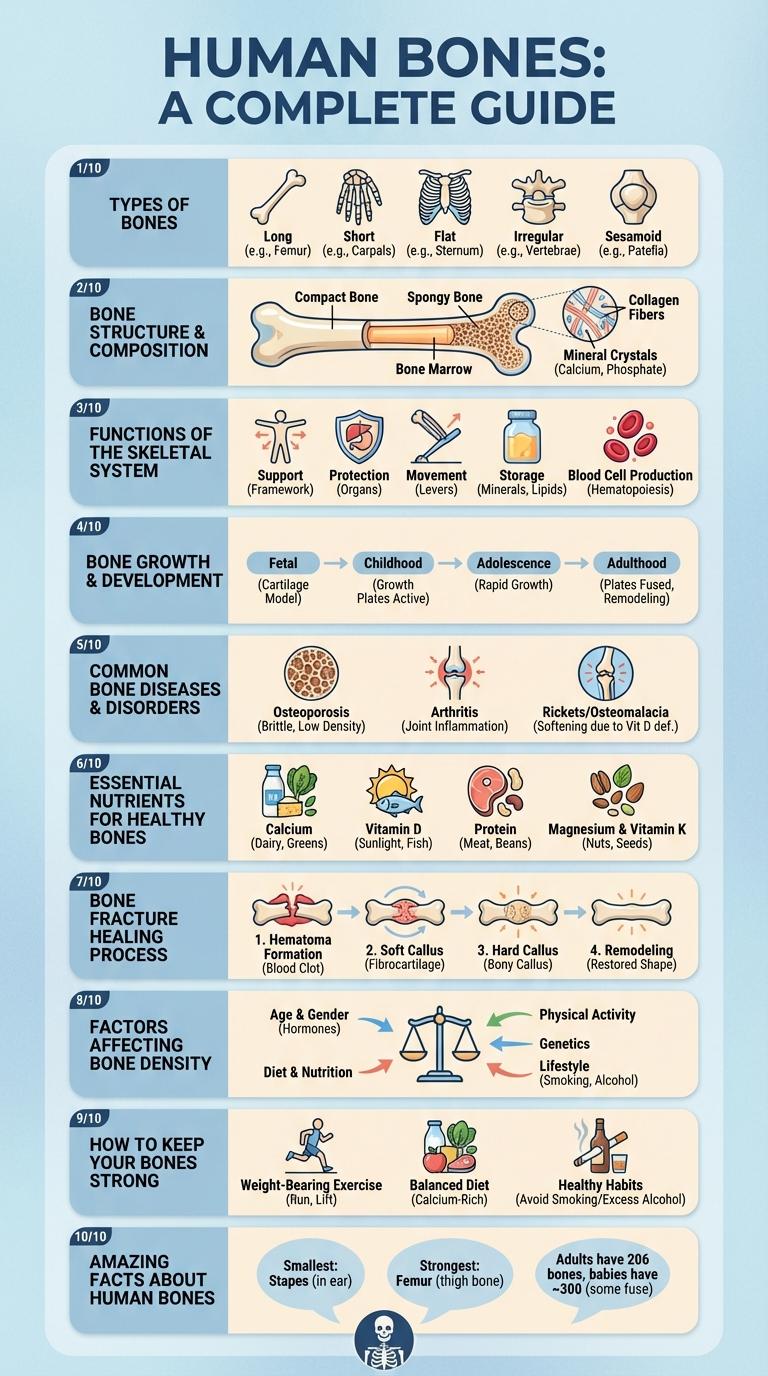
Bones provide the essential framework that supports the human body and enables movement. Understanding the structure and function of bones reveals their critical roles in protection, blood cell production, and mineral storage. This infographic highlights key facts and interesting insights about the skeletal system.
Types of Bones in the Human Body
Bones in the human body are categorized into distinct types based on their shapes and functions. Understanding these types helps in studying human anatomy and bone health.
- Long Bones - These bones are longer than they are wide and primarily support weight and facilitate movement, examples include the femur and humerus.
- Short Bones - Typically as wide as they are long, short bones provide stability and some movement, with examples like the carpals and tarsals.
- Flat Bones - Flat bones protect internal organs and provide a surface for muscle attachment; examples include the skull and ribs.
- Irregular Bones - Irregular bones have complex shapes that do not fit into other categories, such as the vertebrae and certain facial bones.
- Sesamoid Bones - These small bones develop within tendons and protect them from stress, with the patella being the most notable example.
Bone Structure and Composition
Bones are complex organs composed of a dense outer layer called cortical bone and a porous inner layer known as trabecular bone. These structures provide strength and support while housing bone marrow responsible for blood cell production.
Bone composition includes primarily collagen, which provides flexibility, and hydroxyapatite, a mineral that gives bones their hardness. Bone cells such as osteoblasts, osteocytes, and osteoclasts regulate growth, maintenance, and repair. The combination of organic and inorganic components enables bones to withstand mechanical stress and heal after injury.
Functions of the Skeletal System
The skeletal system provides the body's essential framework, enabling movement and structural support. It serves multiple vital functions that sustain overall health and physical activity.
- Support - Bones create a rigid structure that supports the body's shape and posture.
- Protection - The skeleton shields vital organs like the brain, heart, and lungs from injury.
- Movement - Bones act as levers, working with muscles to facilitate bodily movement.
- Mineral Storage - Bones store essential minerals such as calcium and phosphorus for metabolic needs.
- Blood Cell Production - Bone marrow produces red and white blood cells, critical for oxygen transport and immune defense.
The skeletal system's multifunctional role is crucial for maintaining life and physical capability.
Bone Growth and Development
Bone growth and development begin in the fetal stage, where cartilage models gradually ossify into bone through a process called endochondral ossification. Growth plates, known as epiphyseal plates, located at the ends of long bones, enable lengthening during childhood and adolescence. Bone remodeling continues throughout life, balancing bone formation and resorption to maintain strength and repair microdamage.
Common Bone Diseases and Disorders
Bone diseases and disorders affect millions worldwide, impacting bone strength and function. Common conditions include osteoporosis, characterized by decreased bone density, and arthritis, which causes joint inflammation and pain. Early diagnosis and treatment are crucial for maintaining mobility and preventing fractures.
Essential Nutrients for Healthy Bones
Healthy bones require a balanced intake of essential nutrients to maintain strength and density. Calcium, vitamin D, magnesium, and phosphorus play critical roles in bone formation and preservation.
Calcium supports bone structure, while vitamin D enhances calcium absorption in the body. Magnesium and phosphorus contribute to bone mineralization and overall skeletal health.
Bone Fracture Healing Process
The bone fracture healing process is a complex biological sequence that restores bone strength and function after injury. This process involves several distinct phases, each critical for successful healing.
- Inflammation Phase - Blood vessels break and form a hematoma around the fracture to initiate healing.
- Soft Callus Formation - Fibroblasts and chondroblasts generate a soft callus made of collagen and cartilage.
- Hard Callus Formation - Osteoblasts replace the soft callus with a hard, bony callus of woven bone.
- Bone Remodeling - Woven bone is remodeled into mature lamellar bone, restoring original bone structure.
- Healing Completion - Bone regains full strength and functionality, completing the repair process.
Factors Affecting Bone Density
Bone density refers to the amount of mineral matter per square centimeter of bones, crucial for overall bone strength and health. Several factors influence bone density, ranging from lifestyle choices to genetic predispositions.
Calcium and vitamin D intake significantly impact bone density as they are essential for bone formation and maintenance. Physical activity, especially weight-bearing exercises, stimulates bone growth and can improve bone density over time.
How to Keep Your Bones Strong
| Tips for Strong Bones | Details |
|---|---|
| Calcium Intake | Consume 1,000-1,200 mg of calcium daily from dairy, leafy greens, and fortified foods to support bone density. |
| Vitamin D | Get 600-800 IU of vitamin D daily through sunlight exposure, supplements, or vitamin D-rich foods to enhance calcium absorption. |
| Weight-Bearing Exercise | Engage in activities like walking, jogging, and strength training 3-5 times a week to stimulate bone growth. |
| Avoid Smoking and Excessive Alcohol | Reduce tobacco use and limit alcohol consumption to prevent bone loss and fractures. |
| Regular Bone Density Testing | Get screenings, especially after age 50, to monitor bone health and detect osteoporosis early. |