
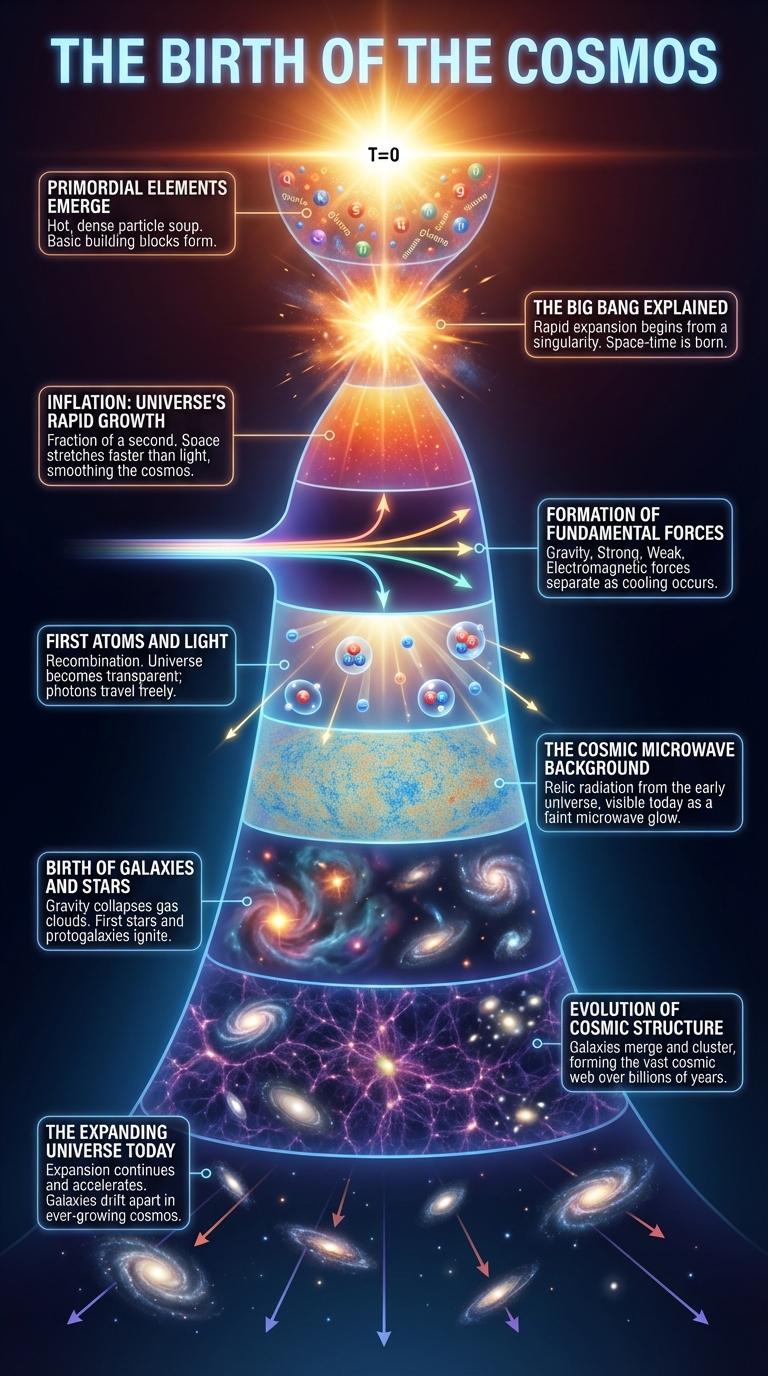
The infographic explores the origin of the universe by tracing the key scientific theories and discoveries that reveal how the cosmos began. It highlights the Big Bang theory as the leading explanation, detailing the rapid expansion and formation of matter. Visual elements illustrate cosmic evolution from primordial energy to the complex structures observed today.
The Birth of the Cosmos
The Birth of the Cosmos marks the beginning of everything we know. It began approximately 13.8 billion years ago with the Big Bang.
This event caused the rapid expansion of space and the formation of fundamental particles. Over time, these particles combined to form atoms, stars, and galaxies.
Primordial Elements Emerge
The origin of the universe began with the Primordial Elements Emerge phase, shortly after the Big Bang, roughly 13.8 billion years ago. During this period, the universe cooled enough for subatomic particles to combine, forming the first simple elements like hydrogen, helium, and traces of lithium. These primordial elements laid the foundation for the formation of stars, galaxies, and all matter observed today.
The Big Bang Explained
| Aspect | Details |
|---|---|
| Event | The Big Bang |
| Timeframe | Approximately 13.8 billion years ago |
| Description | Rapid expansion of a hot, dense singularity forming space, time, matter, and energy |
| Evidence | Cosmic Microwave Background Radiation and Redshift of galaxies |
| Significance | Origin of the universe and foundation of modern cosmology |
Inflation: Universe's Rapid Growth
The origin of the universe began with a rapid expansion known as cosmic inflation. This event occurred within a fraction of a second after the Big Bang, causing the universe to grow exponentially.
Inflation smoothed out any irregularities and set the stage for the formation of galaxies and large-scale structures. It explains the uniformity of the cosmic microwave background radiation observed today.
Formation of Fundamental Forces
How did the fundamental forces of the universe form? The origin of the universe involved the emergence of four fundamental forces: gravity, electromagnetism, the strong nuclear force, and the weak nuclear force. These forces shaped the behavior of matter and energy from the very first moments after the Big Bang.
What was the sequence of fundamental force formation during the early universe? Initially, all forces were unified in a single superforce, but as the universe cooled and expanded, they separated into distinct forces. Gravity was the first to separate, followed by the strong nuclear force, and finally the electromagnetic and weak nuclear forces split during the electroweak epoch.
First Atoms and Light
The origin of the universe marks the formation of the first atoms and the emergence of light. These events set the foundation for the cosmic structures observed today.
The first atoms formed approximately 380,000 years after the Big Bang, allowing light to travel freely. This period is known as the era of recombination.
- Formation of Hydrogen and Helium - Hydrogen and helium atoms emerged as the simplest and most abundant elements.
- Photon Decoupling - Free electrons combined with nuclei, enabling photons to move without scattering.
- Cosmic Microwave Background - Light released during this era still permeates the universe as background radiation.
The Cosmic Microwave Background
The Cosmic Microwave Background (CMB) is the afterglow radiation from the Big Bang, providing crucial evidence for the universe's origin. It represents the oldest light detectable, dating back approximately 13.8 billion years.
- Uniform Radiation - The CMB shows a nearly uniform temperature of about 2.7 Kelvin across the universe.
- Snapshot of Early Universe - It captures the state of the universe roughly 380,000 years after the Big Bang during the recombination era.
- Supports Big Bang Theory - Measurements of the CMB confirm predictions about the size, shape, and composition of the universe.
Birth of Galaxies and Stars
The birth of galaxies and stars marks a crucial phase in the origin of the universe, shaping its large-scale structure. These processes began billions of years ago, following the Big Bang's aftermath.
- Galaxy Formation - Galaxies formed as gravity pulled together massive clouds of gas and dark matter, creating the first galactic structures.
- Star Birth - Stars originated from dense regions within molecular clouds, where gas collapsed under gravity, igniting nuclear fusion.
- Evolution of Structures - Over time, galaxies merged and evolved, generating diverse shapes and star populations observed today.
The birth of galaxies and stars continues to influence cosmic evolution and the development of planetary systems.
Evolution of Cosmic Structure
The evolution of cosmic structure began with the Big Bang approximately 13.8 billion years ago, initiating the rapid expansion of the universe. Gravity caused matter to coalesce, forming the first stars and galaxies, which led to the large-scale cosmic web observed today. Dark matter played a crucial role in shaping these structures, influencing the distribution and formation of galaxies over billions of years.