
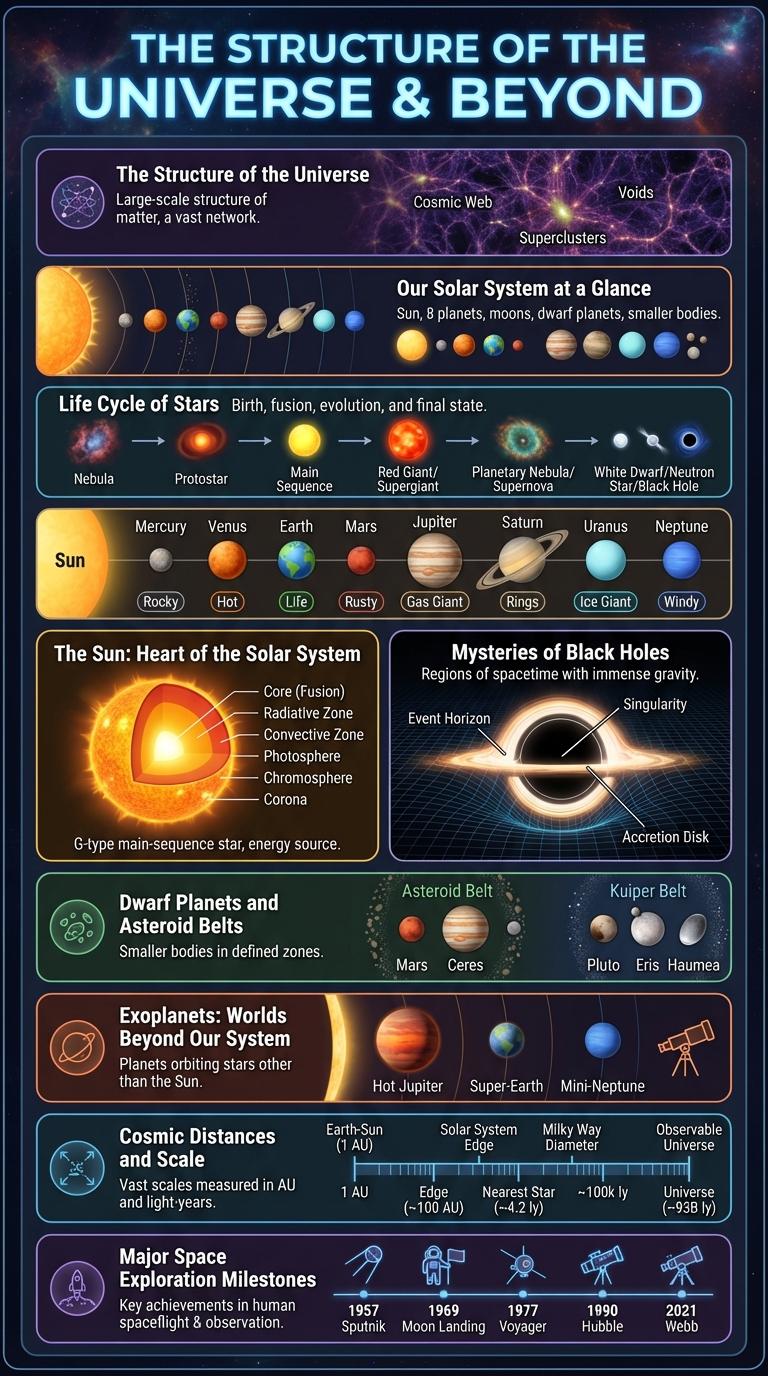
The infographic visually presents key facts about the universe and the solar system, highlighting celestial bodies, their positions, and characteristics. It provides a clear overview of planets, stars, and other cosmic phenomena, enhancing understanding of outer space. Detailed graphics help illustrate complex concepts, making the vastness of the cosmos more accessible to viewers.
The Structure of the Universe
| Component | Description |
|---|---|
| Observable Universe | Radius of approximately 46 billion light-years, containing all matter and energy visible from Earth. |
| Galaxies | Massive systems of stars, stellar remnants, interstellar gas, dust, and dark matter bound by gravity; the Milky Way is our home galaxy. |
| Solar System | Consists of the Sun, eight planets, dwarf planets, moons, asteroids, and comets orbiting the Sun. |
| Stars | Massive luminous spheres of plasma generating energy through nuclear fusion, primary components of galaxies. |
| Dark Matter and Dark Energy | Makes up about 95% of the total mass-energy content of the universe; influences the universe's expansion and structure formation. |
Our Solar System at a Glance
The universe is a vast expanse containing billions of galaxies, each with millions or billions of stars. Our solar system is a small part of the Milky Way galaxy, centered around the Sun.
Our solar system includes eight planets, dwarf planets, moons, asteroids, and comets orbiting the Sun. It spans approximately 4.6 billion years in age and extends billions of kilometers across space.
Life Cycle of Stars
The life cycle of stars begins with a nebula, a vast cloud of gas and dust where gravity causes particles to clump together and form a protostar. As nuclear fusion ignites in the core, the star enters the main sequence phase, burning hydrogen into helium for millions to billions of years. Eventually, stars evolve into red giants or supergiants and end their lives as white dwarfs, neutron stars, or black holes depending on their initial mass.
Planetary Order and Key Facts
The solar system consists of eight primary planets orbiting the Sun, each with unique characteristics. Understanding their order helps in grasping the structure of our cosmic neighborhood.
- Mercury is the closest planet to the Sun - It has a rocky surface and experiences extreme temperature variations.
- Venus is known for its thick toxic atmosphere - It is the hottest planet due to a runaway greenhouse effect.
- Earth is the only planet known to support life - It has water in liquid form and a breathable atmosphere.
- Mars is the red planet - It has the largest volcano in the solar system, Olympus Mons.
- Jupiter is the largest planet - It is a gas giant with a strong magnetic field and dozens of moons.
The Sun: Heart of the Solar System
The Sun is the heart of the Solar System, a massive ball of hot plasma that generates energy through nuclear fusion. It accounts for about 99.86% of the total mass of the Solar System, dominating the gravitational forces that keep planets in orbit.
Solar radiation from the Sun provides essential energy that sustains life on Earth and drives weather systems. Its magnetic field influences cosmic events such as solar flares and coronal mass ejections, impacting space weather and satellite communications.
Mysteries of Black Holes
Black holes are among the most enigmatic objects in the universe, warping space and time with immense gravity. These cosmic phenomena challenge our understanding of physics and astronomy.
- Event Horizon - The boundary around a black hole beyond which nothing can escape, not even light.
- Singularity - The infinitely dense core where space-time curvature becomes infinite.
- Hawking Radiation - Theoretical emission of particles from black holes, suggesting they can slowly evaporate.
Scientists continue to explore black holes to unlock the secrets of gravity, quantum mechanics, and the origins of the universe.
Dwarf Planets and Asteroid Belts
What are dwarf planets and where are they found in the universe? Dwarf planets are celestial bodies that orbit the sun but do not clear their orbital path of other debris. They are mostly located in the Kuiper Belt beyond Neptune and the asteroid belt between Mars and Jupiter.
What is the significance of asteroid belts in our solar system? Asteroid belts are regions filled with rocky debris and minor planets that orbit the sun primarily between Mars and Jupiter. These belts contain valuable clues about the early formation of the solar system and the processes shaping planetary evolution.
| Feature | Description |
|---|---|
| Dwarf Planets | Small celestial bodies not dominating their orbit, examples include Pluto, Eris, Haumea. |
| Kuiper Belt | Region beyond Neptune hosting many dwarf planets and icy objects. |
| Asteroid Belt | Area between Mars and Jupiter with millions of rocky bodies of various sizes. |
| Importance | Offers insight into the solar system's formation and material distribution. |
Exoplanets: Worlds Beyond Our System
Exoplanets are planets that orbit stars outside our solar system, vastly expanding our understanding of potential worlds in the universe. Thousands of these planets have been discovered, showcasing a wide variety of sizes, compositions, and atmospheres.
Among the most intriguing are Earth-like exoplanets located in their star's habitable zone, where conditions might support liquid water and life. Techniques such as the transit method and radial velocity help astronomers identify and study these distant worlds in detail. Research on exoplanets continues to reveal the diversity and complexity of planetary systems beyond our own.
Cosmic Distances and Scale
The universe spans unimaginable distances, with galaxies separated by millions of light-years, emphasizing the vastness beyond our solar system. The solar system itself covers about 287.46 billion kilometers from the Sun to the outer edge of the Oort Cloud. Cosmic scale is best understood using light-years and astronomical units, helping to quantify these massive distances.
| Distance | Measurement |
|---|---|
| Distance from Earth to Sun | 1 Astronomical Unit (AU) 150 million km |
| Distance from Sun to Pluto | About 39.5 AU |
| Distance to nearest star (Proxima Centauri) | 4.24 light-years |
| Diameter of Milky Way Galaxy | About 100,000 light-years |
| Observable Universe Diameter | Approximately 93 billion light-years |