
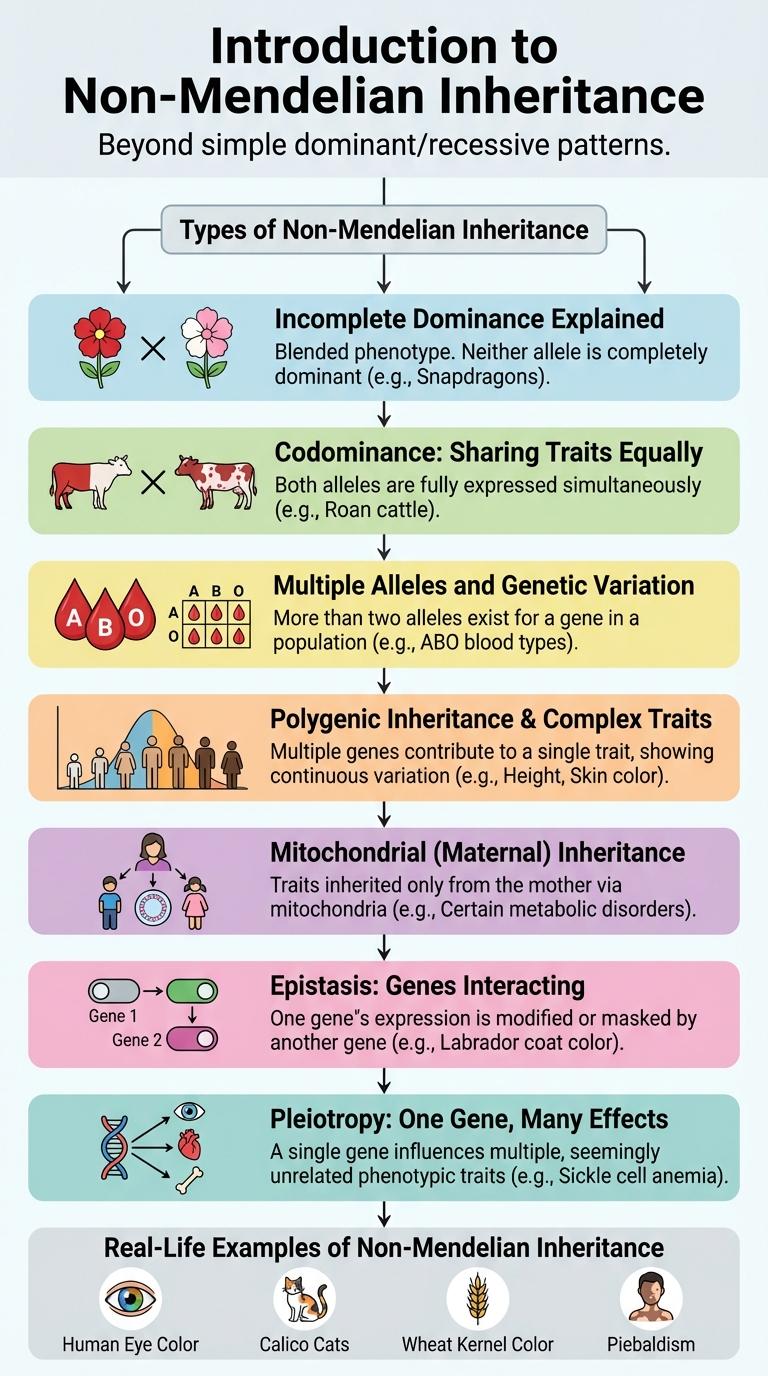
Non-Mendelian inheritance encompasses genetic patterns that deviate from classic Mendelian laws, showcasing complex mechanisms like incomplete dominance, codominance, and mitochondrial inheritance. These patterns reveal how traits can be influenced by multiple factors beyond simple dominant-recessive gene interactions. Understanding these inheritance types provides deeper insight into genetic diversity and heredity beyond traditional models.
Introduction to Non-Mendelian Inheritance
What is non-Mendelian inheritance and how does it differ from Mendelian genetics? Non-Mendelian inheritance involves genetic patterns that do not follow Gregor Mendel's laws of segregation and independent assortment. It includes phenomena such as incomplete dominance, codominance, multiple alleles, and mitochondrial inheritance, which explain more complex traits and genetic variations.
Types of Non-Mendelian Inheritance
Non-Mendelian inheritance encompasses genetic patterns that do not follow Gregor Mendel's traditional laws of inheritance. These patterns reveal complex mechanisms affecting gene expression and phenotype variation.
- Incomplete Dominance - Neither allele is completely dominant, resulting in a blended phenotype in heterozygotes.
- Codominance - Both alleles in a heterozygote are fully expressed without blending, producing distinct traits.
- Multiple Alleles - More than two allele forms exist for a gene, increasing genetic diversity beyond simple dominant-recessive relationships.
- Polygenic Inheritance - Multiple genes influence a single trait, leading to continuous variation such as height or skin color.
- Epigenetic Inheritance - Gene expression changes are inherited without alterations in DNA sequence, affecting phenotype across generations.
Understanding non-Mendelian inheritance expands insight into genetic complexity and variation in living organisms.
Incomplete Dominance Explained
Incomplete dominance is a type of non-Mendelian inheritance where neither allele is completely dominant over the other. This results in a heterozygous phenotype that is a blend or intermediate of the two homozygous phenotypes. For example, in snapdragon flowers, crossing red and white flowers produces pink offspring with incomplete dominance.
Codominance: Sharing Traits Equally
Codominance is a form of non-Mendelian inheritance where both alleles in a gene pair are fully expressed. This results in offspring exhibiting traits from both alleles equally, rather than one being dominant over the other.
- Alleles Expressed Equally - Both alleles contribute to the phenotype without blending, resulting in distinct visible traits.
- Example: Blood Type AB - Individuals with AB blood type express both A and B antigens on red blood cells equally.
- Genotypic and Phenotypic Ratio - In codominance, heterozygous individuals display a phenotype that reflects contributions from both alleles, differing from dominant-recessive patterns.
Multiple Alleles and Genetic Variation
Non-Mendelian inheritance involves genetic patterns that do not follow classic Mendel's laws. Multiple alleles refer to the presence of more than two allele forms of a gene within a population, increasing genetic variation.
Multiple alleles contribute to complex traits and diverse phenotypes, such as blood groups in humans. Genetic variation from these alleles enhances adaptability and evolution within species.
Polygenic Inheritance & Complex Traits
| Aspect | Details |
|---|---|
| Definition | Polygenic inheritance involves multiple genes contributing to a single trait, unlike Mendelian inheritance, which involves a single gene with clear dominant or recessive alleles. |
| Complex Traits | Traits influenced by polygenic inheritance and environmental factors; examples include height, skin color, and susceptibility to diseases like diabetes and heart conditions. |
| Genetic Contribution | Each gene involved adds a small, additive effect on the phenotype, resulting in continuous variation rather than discrete categories. |
| Phenotypic Variation | Phenotypes show a spectrum or gradient, often represented by a bell-shaped curve in populations due to the combined effect of multiple loci and environmental factors. |
| Examples | Human height, skin pigmentation, intelligence, and risk for complex diseases like hypertension and type 2 diabetes. |
Mitochondrial (Maternal) Inheritance
Mitochondrial inheritance, also known as maternal inheritance, is a type of non-Mendelian inheritance where genes are transmitted exclusively from the mother through mitochondrial DNA (mtDNA). Unlike nuclear DNA, mtDNA is inherited only from the egg cell, not the sperm, resulting in all offspring receiving mitochondria from their mother. This mode of inheritance plays a crucial role in studying mitochondrial diseases and tracing maternal lineage in genetics.
Epistasis: Genes Interacting
Epistasis occurs when the effect of one gene is modified by one or several other genes, highlighting complex gene interactions beyond simple Mendelian inheritance. These interactions influence phenotypic expression and can mask or modify expected genetic outcomes.
In epistasis, one gene (the epistatic gene) can suppress or alter the expression of another gene (the hypostatic gene). This alters classic Mendelian ratios, leading to unique phenotypic ratios in offspring. Common types of epistasis include recessive, dominant, and duplicate gene interactions, each affecting traits in distinct ways.
Pleiotropy: One Gene, Many Effects
Pleiotropy occurs when one gene influences multiple, seemingly unrelated phenotypic traits. This phenomenon demonstrates that a single genetic mutation can have widespread effects across an organism's biology.
Examples of pleiotropy include the gene responsible for Marfan syndrome, which affects connective tissue, the heart, and the eyes. Understanding pleiotropy helps explain complex genetic disorders and their varied symptoms.