
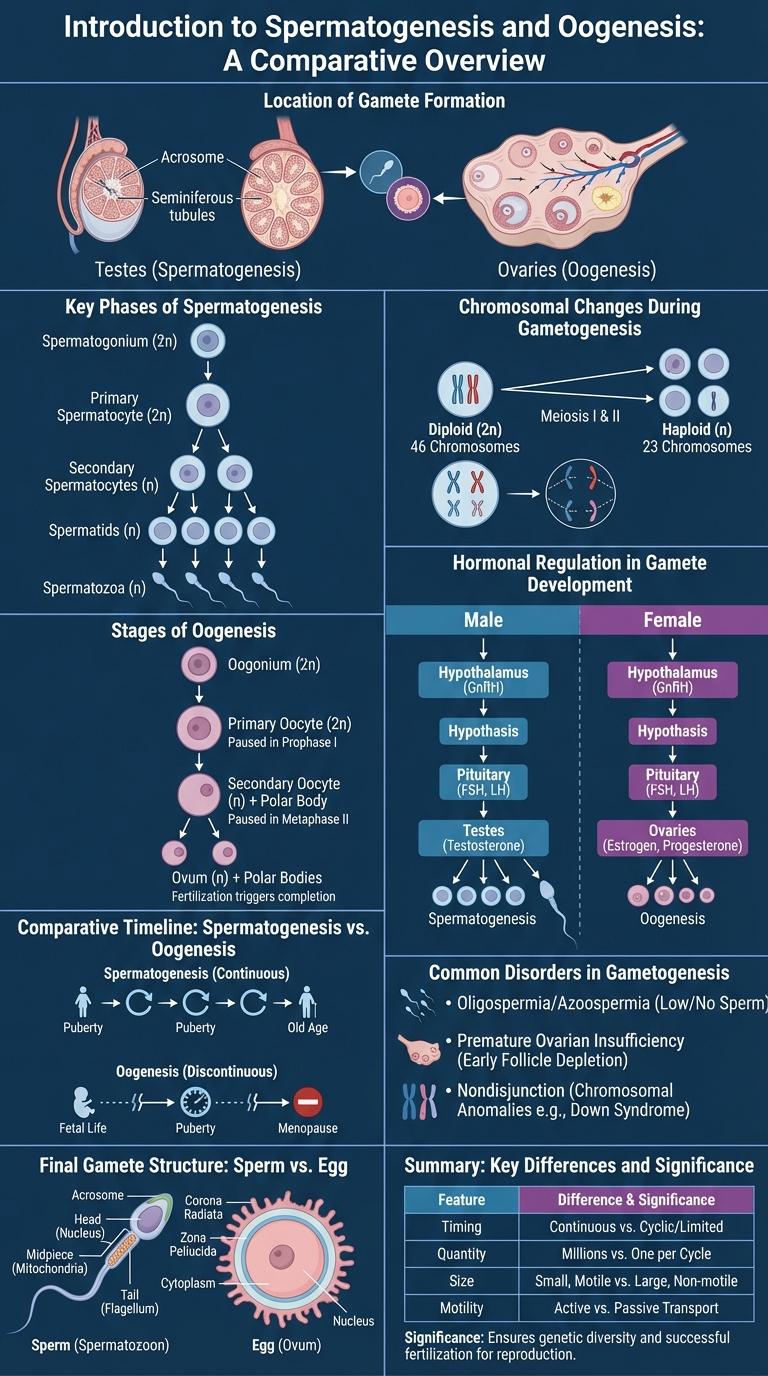
Spermatogenesis and oogenesis are fundamental biological processes responsible for the production of male and female gametes, respectively. Spermatogenesis occurs in the testes, generating sperm cells through a series of mitotic and meiotic divisions, while oogenesis takes place in the ovaries, producing mature eggs through a complex, staged development. This infographic visually breaks down the stages, hormonal regulation, and key differences between these two critical mechanisms of human reproduction.
Introduction to Spermatogenesis and Oogenesis
Spermatogenesis and oogenesis are biological processes responsible for the formation of male and female gametes, respectively. Each process ensures genetic diversity and supports reproductive success through cell division and maturation.
- Spermatogenesis occurs in the testes - It produces sperm cells through mitosis and meiosis, starting from spermatogonia and ending with mature spermatozoa.
- Oogenesis takes place in the ovaries - It generates oocytes through a prolonged process beginning before birth and completing after fertilization.
- Both processes involve meiosis - Meiosis reduces the chromosome number by half, resulting in haploid gametes essential for sexual reproduction.
Location of Gamete Formation
Spermatogenesis and oogenesis are the biological processes responsible for the formation of male and female gametes, respectively. Each process occurs in specialized locations within the reproductive systems to ensure proper development of sperm and eggs.
- Spermatogenesis Location - Occurs in the seminiferous tubules of the testes where male germ cells mature into spermatozoa.
- Oogenesis Location - Takes place in the ovarian follicles of the ovaries where oogonia develop into mature ova.
- Environmental Conditions - Testes provide a slightly lower temperature essential for spermatogenesis, whereas ovaries maintain an environment suitable for prolonged oocyte development.
Understanding the precise locations of gamete formation highlights the specialized anatomy critical for human reproduction.
Key Phases of Spermatogenesis
Spermatogenesis is the process of male gamete formation occurring within the seminiferous tubules of the testes. It involves three key phases: spermatogonial phase, where spermatogonia undergo mitosis; spermatocyte phase, featuring meiosis to produce haploid spermatids; and spermiogenesis, the transformation of spermatids into mature spermatozoa. This sequence ensures continuous production of functional sperm essential for male fertility.
Stages of Oogenesis
Oogenesis is the process by which female gametes, or ova, are produced in the ovaries. It begins with the formation of oogonia, which develop into primary oocytes arrested in prophase I of meiosis until puberty. Upon hormonal stimulation, primary oocytes complete meiosis I, forming secondary oocytes and polar bodies, and progress to metaphase II, where they remain until fertilization.
Comparative Timeline: Spermatogenesis vs. Oogenesis
How do the timelines of spermatogenesis and oogenesis compare? Spermatogenesis is a continuous process that typically takes about 64 days to complete in males. Oogenesis, in contrast, begins before birth and can take years to complete, with maturation finishing only upon fertilization.
| Spermatogenesis | Oogenesis |
|---|---|
| Starts at puberty and continues throughout life | Begins during fetal development, pauses at prophase I |
| Approximately 64 days for one complete cycle | Maturation resumes monthly after puberty until menopause |
| Produces millions of sperm daily | Typically produces one ovum per cycle |
| Occurs in seminiferous tubules of testes | Occurs in ovarian follicles |
| Results in four viable sperm cells | Results in one viable ovum and polar bodies |
Chromosomal Changes During Gametogenesis
Spermatogenesis and oogenesis are critical biological processes responsible for the formation of male and female gametes, respectively. Both involve significant chromosomal changes to ensure genetic diversity and proper chromosome number in the resulting gametes.
During spermatogenesis, diploid spermatogonia undergo meiosis to produce haploid sperm cells with exactly 23 chromosomes each. Oogenesis follows a similar meiotic process but results in one viable ovum and polar bodies, with chromosomal reduction and recombination occurring throughout meiosis I and II.
Hormonal Regulation in Gamete Development
Hormonal regulation plays a critical role in spermatogenesis and oogenesis, ensuring proper development of male and female gametes. Key hormones such as Follicle Stimulating Hormone (FSH) and Luteinizing Hormone (LH) orchestrate these complex processes within the reproductive system.
In spermatogenesis, FSH stimulates Sertoli cells to support sperm maturation, while LH triggers testosterone production by Leydig cells, essential for sperm development. During oogenesis, FSH promotes follicle growth and estrogen secretion, preparing the oocyte for ovulation. LH surge induces ovulation and corpus luteum formation, which produces progesterone to maintain the uterine lining.
Final Gamete Structure: Sperm vs. Egg
| Feature | Sperm vs. Egg Final Gamete Structure |
|---|---|
| Size | Sperm: Very small (~50 um length), streamlined for mobility Egg: Large (~100 um diameter), contains nutrient reserves |
| Shape | Sperm: Head, midpiece, and tail (flagellum) enabling motility Egg: Spherical, non-motile |
| Components | Sperm: Condensed nucleus, acrosome (enzymes), mitochondria-rich midpiece, flagellum Egg: Nucleus, abundant cytoplasm with yolk granules, cortical granules |
| Functionality | Sperm: Designed for delivery of paternal DNA Egg: Provides maternal DNA plus cytoplasmic components essential for embryo development |
| Quantity Produced | Sperm: Millions produced daily, each with minimal cytoplasm Egg: Typically one matured per cycle, with rich cytoplasm |
Common Disorders in Gametogenesis
Spermatogenesis and oogenesis are critical processes in human reproduction, responsible for producing male and female gametes, respectively. Disorders in these processes can lead to infertility, impacting reproductive health significantly.
Common disorders in gametogenesis include azoospermia in males, where sperm production is absent, and premature ovarian failure in females, where oocyte development is impaired. These conditions affect the quality and quantity of gametes, hindering successful fertilization.
| Disorder | Description |
|---|---|
| Azoospermia | Complete absence of sperm in semen, leading to male infertility. |
| Oligospermia | Low sperm count, reducing the chances of fertilization. |
| Premature Ovarian Failure | Early decline in ovarian function, causing decreased oocyte production. |
| Polycystic Ovary Syndrome (PCOS) | Hormonal imbalance disrupting normal oogenesis and ovulation. |