
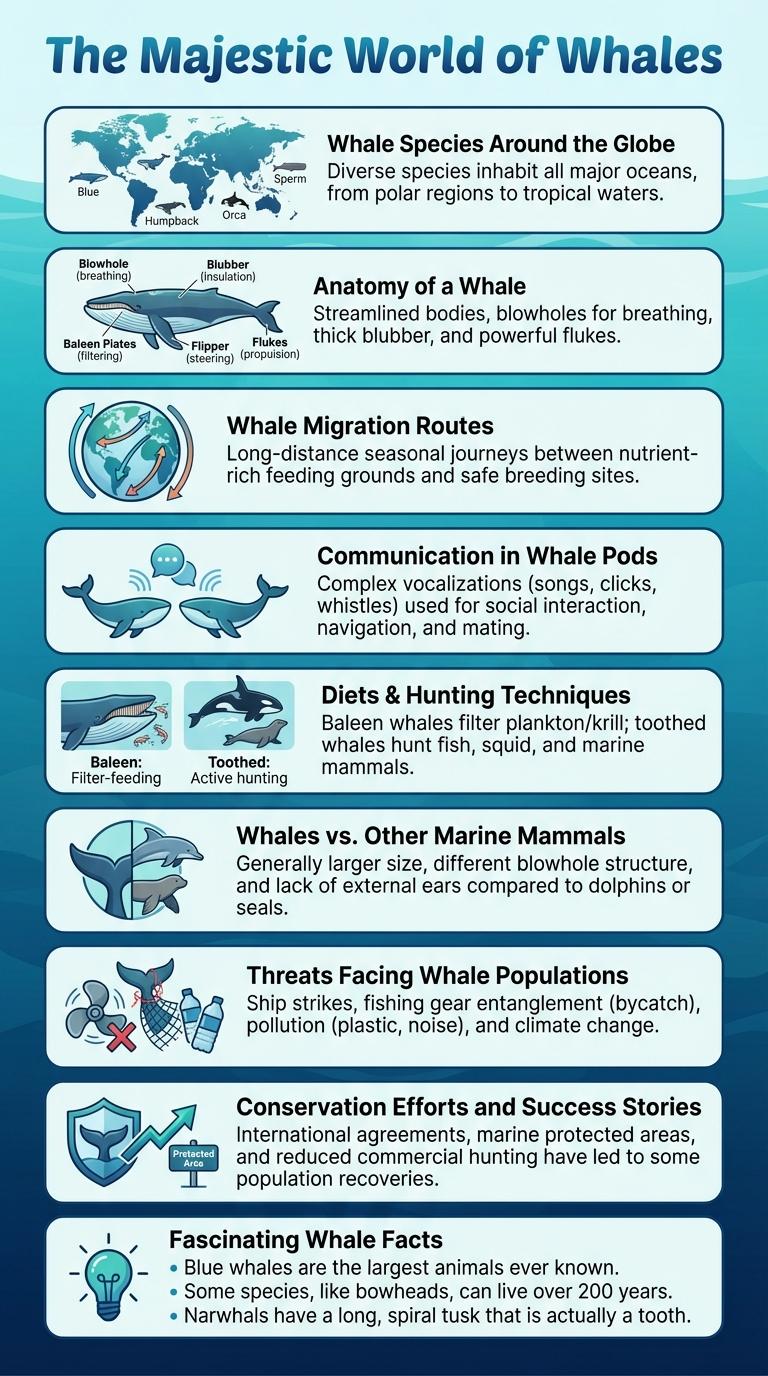
Whales are some of the largest and most majestic creatures on Earth, playing a vital role in marine ecosystems. They communicate through complex vocalizations and exhibit remarkable migratory behaviors across oceans. Infographics about whales illustrate their anatomy, species diversity, and conservation status, helping raise awareness about their importance and the threats they face.
The Majestic World of Whales
Whale Species Around the Globe
Whales are diverse marine mammals found in oceans worldwide, with over 80 recognized species. Species such as the Blue Whale, Humpback Whale, and Orca inhabit various global regions, each adapted to unique marine environments. Understanding whale distribution helps in conservation efforts to protect these magnificent creatures from threats like habitat loss and climate change.
Anatomy of a Whale
Whales have streamlined bodies designed for efficient swimming, featuring a thick layer of blubber for insulation. Their large flippers and tail flukes provide powerful propulsion through water. The blowhole on top of their heads allows them to breathe air while surfacing.
Whale Migration Routes
Whales undertake some of the longest migrations in the animal kingdom, traveling thousands of miles between feeding and breeding grounds. These migration routes are essential for their survival and reproduction.
- Gray Whale Migration - Gray whales migrate annually from the cold Arctic waters to the warm lagoons of Baja California, Mexico for breeding and calving.
- Humpback Whale Routes - Humpback whales travel between polar feeding areas and tropical or subtropical breeding waters across the Pacific, Atlantic, and Indian Oceans.
- Blue Whale Patterns - Blue whales follow ocean currents and seasonal food availability, migrating from polar regions in summer to equatorial waters in winter.
Understanding whale migration routes helps in conservation efforts and protecting critical habitats worldwide.
Communication in Whale Pods
Whales use complex communication within pods to maintain social bonds and coordinate activities. Their sounds travel long distances underwater, facilitating interaction across vast ocean spaces.
- Vocalizations - Whales produce clicks, whistles, and songs that convey information about identity, location, and emotional state.
- Pod Coordination - Communication helps whales synchronize hunting and navigate during migration.
- Social Structure - Sound patterns strengthen social hierarchies and relationships within pods.
Diets & Hunting Techniques
Whales exhibit diverse diets and specialized hunting techniques adapted to their environment and prey. These marine mammals employ unique methods to capture food ranging from tiny plankton to large fish and squid.
- Baleen Whales Filter Feed - They use baleen plates to strain small organisms like krill and plankton from seawater.
- Humpback Whales Use Bubble Nets - This technique involves creating circular bubbles to herd and trap fish before feeding.
- Orcas' Cooperative Hunting - Killer whales coordinate in pods to hunt larger prey including seals and dolphins.
Whales vs. Other Marine Mammals
Whales are among the largest marine mammals, distinct from dolphins, porpoises, seals, and sea otters. They belong to the cetacean family, which is divided into baleen and toothed whales.
Unlike seals and sea otters, whales are fully aquatic and cannot move efficiently on land. Baleen whales filter-feed using baleen plates, while toothed whales hunt prey with their teeth. Other marine mammals, such as seals, have limbs adapted for both swimming and walking on land.
Threats Facing Whale Populations
What are the main threats facing whale populations today?
Whale populations are increasingly endangered due to human activities such as ship strikes, entanglement in fishing gear, and pollution. Climate change also disrupts their food sources and migration patterns, affecting their survival.
How does ship traffic impact whales?
Ship strikes cause serious injuries and fatalities among whales, especially larger species like blue and humpback whales. Increasing maritime traffic in key migration routes raises the risk of collisions.
What role does fishing gear play in whale endangerment?
Fishing gear entanglement traps whales, leading to injury, restricted movement, or death. Ghost nets and abandoned gear remain a persistent hazard in many ocean areas.
In what ways does pollution threaten whales?
Chemical pollutants accumulate in whale tissues, weakening their immune systems and reproductive capabilities. Noise pollution interferes with whale communication and navigation.
How does climate change affect whales?
Rising ocean temperatures alter the distribution of krill and fish that whales rely on for food. Melting sea ice impacts Arctic species like bowhead whales by disrupting their habitat.
Conservation Efforts and Success Stories
Whale conservation efforts have significantly improved the population of several whale species through international protection laws and marine sanctuaries. Organizations like the International Whaling Commission play a key role in banning commercial whaling and promoting sustainable practices.
Success stories include the recovery of the humpback whale populations, which have rebounded due to targeted conservation measures. Continued monitoring and habitat protection remain essential to ensure the survival of endangered species like the blue whale and North Atlantic right whale.