
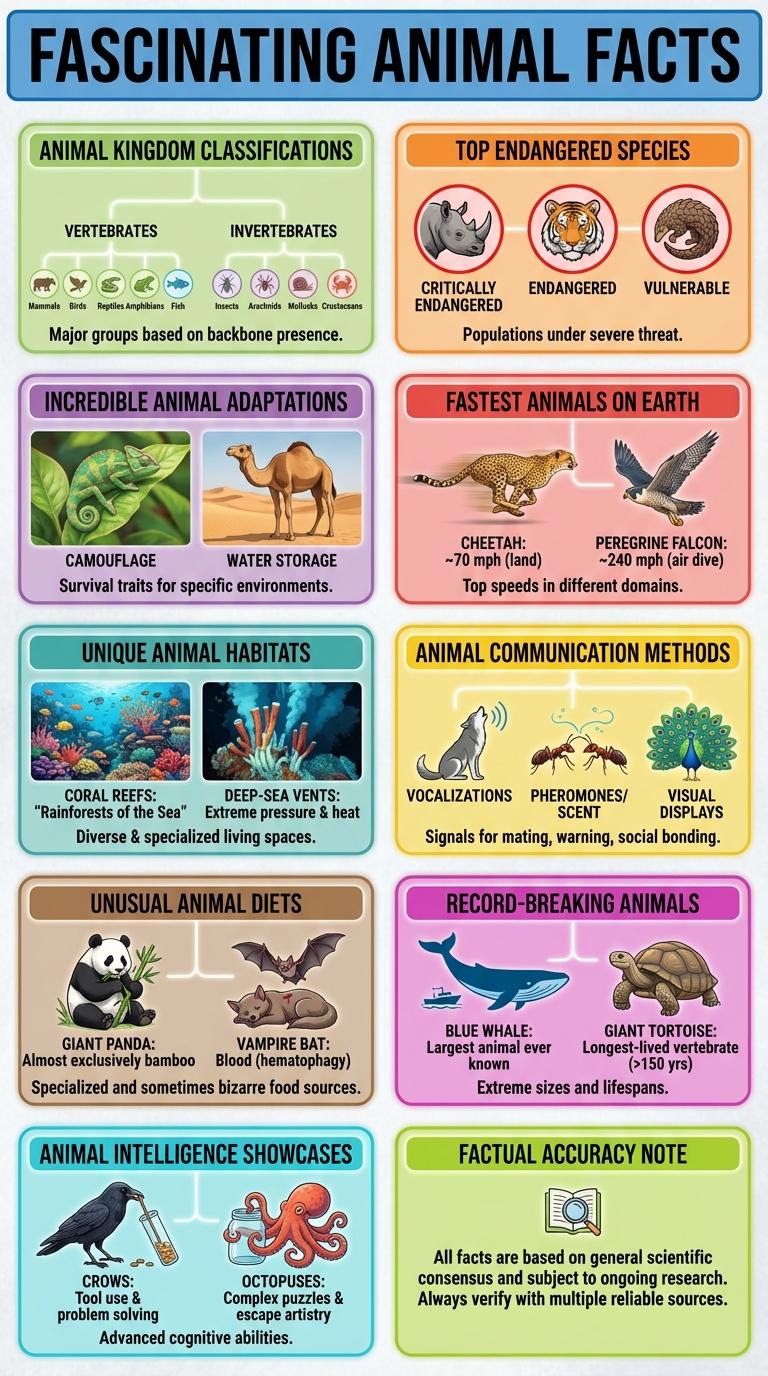
Exploring the diversity of the animal kingdom reveals fascinating facts about species from all corners of the globe. Infographics visually present data on animal behaviors, habitats, and characteristics, making complex information easy to understand. These visual tools highlight unique traits and ecological roles, deepening appreciation for wildlife conservation.
Fascinating Animal Facts
Animals exhibit remarkable diversity, with over 8.7 million species identified worldwide. Each species showcases unique adaptations that enhance survival and reproduction in various environments.
The blue whale is the largest animal ever recorded, reaching lengths of up to 100 feet and weights of 200 tons. Octopuses have three hearts and blue blood, enabling efficient circulation in cold ocean waters. Elephants communicate through infrasound, sounds below human hearing range, allowing long-distance interaction across several kilometers.
Animal Kingdom Classifications
What are the main classifications within the Animal Kingdom? The Animal Kingdom is divided into several major groups based on characteristics such as body structure, reproduction, and habitat. These classifications include Mammals, Birds, Reptiles, Amphibians, Fish, and Invertebrates, each representing unique biological traits and evolutionary paths.
Top Endangered Species
Top endangered species face critical threats from habitat loss, poaching, and climate change. Iconic animals like the Amur leopard, Javan rhino, and Hawksbill turtle now number in the hundreds or fewer. Conservation efforts focus on protecting habitats and enforcing anti-poaching laws to prevent extinction.
Incredible Animal Adaptations
| Animal | Incredible Adaptation |
|---|---|
| Arctic Fox | Seasonal fur color change providing camouflage in snow and tundra |
| Cuttlefish | Advanced camouflage using chromatophores to blend with surroundings instantly |
| Giraffe | Long neck to access high foliage and specialized cardiovascular system to pump blood |
| Axolotl | Regeneration of limbs, spinal cord, heart, and other organs |
| Emperor Penguin | Blubber and dense feathers for insulation against extreme Antarctic cold |
Fastest Animals on Earth
The fastest animals on Earth exhibit remarkable adaptations for speed, allowing them to excel in hunting or escaping predators. These creatures showcase nature's incredible engineering through swift movements on land, air, and water.
Speed ranking varies depending on the animal's environment and mode of locomotion, highlighting diversity among species.
- Peregrine Falcon - Reaches diving speeds over 240 mph, making it the fastest bird and fastest animal overall.
- Cheetah - The fastest land mammal, capable of bursts up to 75 mph over short distances.
- Sailfish - Known as the fastest fish, swimming at speeds up to 68 mph.
Unique Animal Habitats
Animals inhabit a wide range of unique habitats that support their survival and adaptation. These environments include deserts, rainforests, coral reefs, tundras, and wetlands.
Each habitat offers distinct resources like food, water, and shelter, which influence the animals' behaviors and physical traits. Understanding these diverse habitats helps in conservation efforts and promotes biodiversity protection.
Animal Communication Methods
Animal communication involves various methods such as vocalizations, body language, chemical signals, and visual displays. These methods help animals convey information about danger, mating, territory, and social bonding.
Vocal communication includes sounds like bird songs, whale calls, and primate calls. Non-vocal communication involves gestures, postures, pheromones, and bioluminescence to attract mates or warn predators.
Unusual Animal Diets
Animals exhibit a fascinating range of diets that often defy typical classifications. Exploring unusual animal diets reveals unique adaptations and survival strategies in the animal kingdom.
- Koalas eat eucalyptus leaves - Despite the leaves being toxic to most animals, koalas have specialized digestive systems to process them safely.
- Vampire bats feed on blood - These bats extract blood from other mammals using heat sensors and sharp teeth without killing their hosts.
- Leafcutter ants farm fungus - They harvest leaves not for direct consumption but to cultivate fungus, which serves as their primary food source.
Record-Breaking Animals
Record-breaking animals showcase incredible physical and behavioral feats in the natural world. These species hold extraordinary distinctions based on size, speed, longevity, and unique capabilities.
- Blue Whale - Largest Animal - The blue whale can reach lengths of up to 100 feet and weigh over 200 tons, making it the largest animal ever known.
- Cheetah - Fastest Land Animal - Capable of speeds up to 75 mph, the cheetah is the fastest terrestrial animal during short bursts.
- Tortoise - Longest Lifespan - Certain tortoise species, such as the Galapagos tortoise, can live over 150 years in the wild.
These record-breaking animals highlight the vast diversity and adaptability within the animal kingdom.