
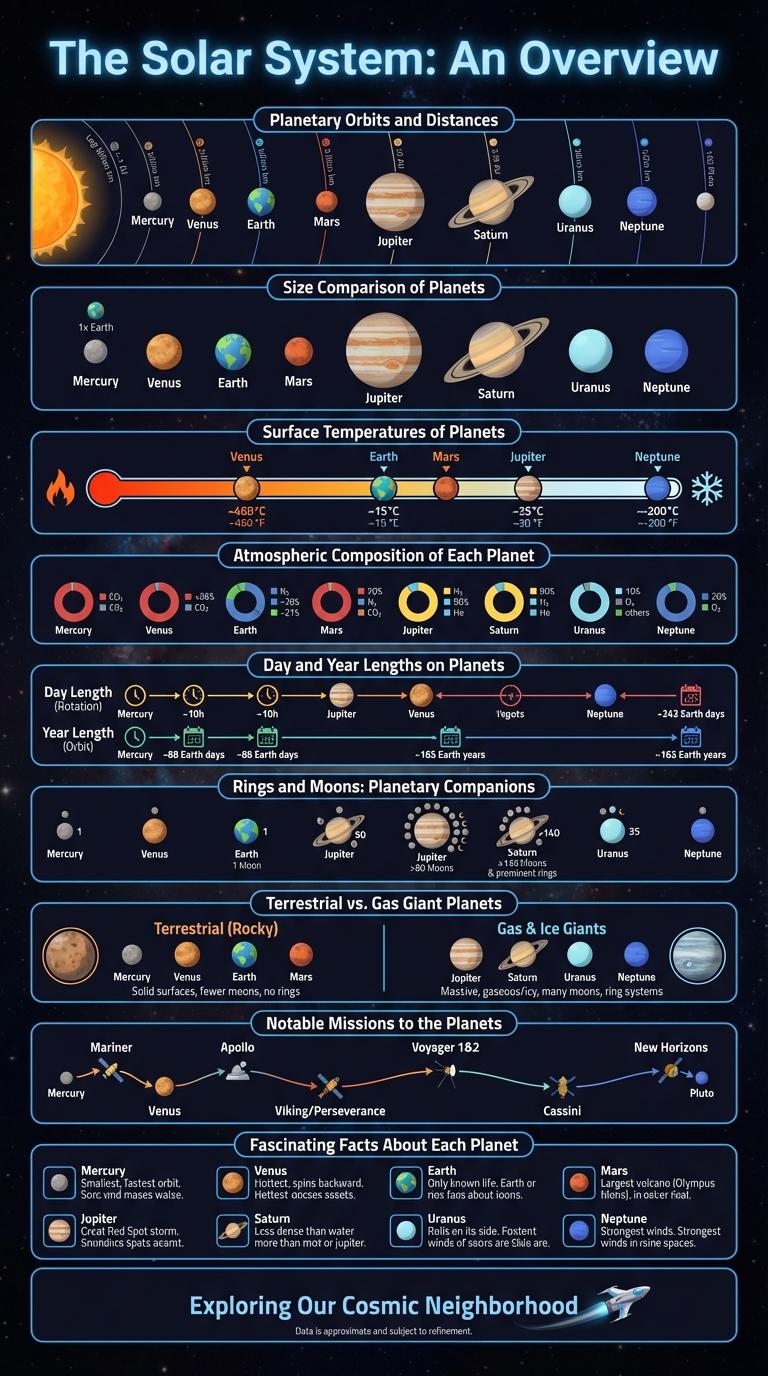
Explore the captivating details of our solar system with this vibrant infographic about planets, highlighting key features like size, composition, and distance from the sun. Each planet is visually represented to provide an easy-to-understand comparison, making complex astronomical data accessible. Discover fascinating facts that enhance your understanding of planetary science and space exploration.
The Solar System: An Overview
The Solar System consists of the Sun and all celestial bodies bound by its gravity. This includes eight major planets, dwarf planets, moons, asteroids, and comets.
Mercury, Venus, Earth, and Mars are terrestrial planets with solid surfaces. Jupiter, Saturn, Uranus, and Neptune are gas giants or ice giants, known for their large sizes and thick atmospheres. The asteroid belt separates the terrestrial planets from the gas giants, containing numerous rocky bodies.
Planetary Orbits and Distances
The planets in our solar system orbit the Sun at varying distances and speeds, with Mercury being the closest and Neptune the farthest. Each planet follows an elliptical path, contributing to differences in orbital periods, from Mercury's 88 days to Neptune's 165 years. Understanding these orbits helps scientists determine planet positions, study gravitational interactions, and explore potential space missions.
Size Comparison of Planets
Planets in our solar system vary significantly in size, from small rocky worlds to massive gas giants. Understanding size differences helps grasp the scale and composition of each planet.
The largest planet, Jupiter, has a diameter of about 139,820 km, while Mercury, the smallest, measures only 4,880 km. This vast size range highlights diverse planetary characteristics and formation histories.
Surface Temperatures of Planets
The surface temperatures of planets vary greatly depending on their distance from the sun and atmospheric conditions. Understanding these temperatures helps in studying planetary environments and potential habitability.
- Mercury's Surface Temperature - Mercury experiences extreme temperature fluctuations from about -173degC at night to 427degC during the day due to its thin atmosphere.
- Venus's Surface Temperature - Venus has the hottest surface temperature among planets, averaging around 465degC caused by a dense carbon dioxide atmosphere and strong greenhouse effect.
- Mars's Surface Temperature - Mars has a colder surface temperature averaging approximately -60degC, with significant variation between day and night due to its thin atmosphere.
Atmospheric Composition of Each Planet
The atmospheric composition of planets varies widely across the solar system. Understanding these differences helps in studying planetary environments and potential habitability.
- Mercury - Has a very thin atmosphere composed mostly of oxygen, sodium, and hydrogen, due to its weak gravity.
- Venus - Dominated by carbon dioxide with thick clouds of sulfuric acid, creating a strong greenhouse effect.
- Earth - Composed primarily of nitrogen and oxygen, supporting diverse life forms.
- Mars - Thin atmosphere mainly of carbon dioxide, with traces of nitrogen and argon.
- Jupiter - A thick atmosphere rich in hydrogen and helium, with ammonia clouds and storms like the Great Red Spot.
Day and Year Lengths on Planets
How do day and year lengths vary across planets in our solar system? Each planet has a unique rotation period, causing the length of its day to differ significantly. The time it takes for a planet to complete one orbit around the Sun determines the length of its year.
Which planet has the longest day and shortest year? Venus has the longest day, lasting about 243 Earth days, while Mercury has the shortest year, completing an orbit in just 88 Earth days. These extreme differences highlight the diverse rotational and orbital characteristics of planets.
Rings and Moons: Planetary Companions
Planets in our solar system are surrounded by fascinating rings and moons that offer clues about their formation and evolution. The diversity and composition of these planetary companions vary greatly across different planets.
- Saturn's Rings - Saturn possesses the most extensive and vivid ring system made primarily of ice particles and rock debris.
- Jupiter's Moons - Jupiter has over 79 confirmed moons, including the four large Galilean moons known for their geological activity.
- Uranus' Rings - Uranus features narrow, dark rings composed of larger bodies rather than fine particles.
Rings and moons play a crucial role in understanding the dynamic processes shaping planetary systems across the cosmos.
Terrestrial vs. Gas Giant Planets
Planets in our solar system are categorized into Terrestrial and Gas Giant types based on composition and size. Terrestrial planets like Mercury, Venus, Earth, and Mars have solid rocky surfaces, while Gas Giants such as Jupiter, Saturn, Uranus, and Neptune are composed mainly of hydrogen, helium, and other gases. The key differences include density, atmosphere, and core structure, making Terrestrial planets smaller and denser compared to the expansive and massive Gas Giants.
| Terrestrial Planets | Gas Giant Planets |
|---|---|
| Mercury, Venus, Earth, Mars | Jupiter, Saturn, Uranus, Neptune |
| Rocky, solid surfaces | Thick gaseous atmospheres |
| High density | Lower density |
| Smaller size | Larger size |
| Thin atmospheres | Strong magnetic fields |
Notable Missions to the Planets
| Planet | Notable Missions |
|---|---|
| Mercury | Mariner 10, MESSENGER, BepiColombo |
| Venus | Venera Series, Magellan, Akatsuki |
| Mars | Viking 1 & 2, Pathfinder, Curiosity, Perseverance |
| Jupiter | Pioneer 10 & 11, Voyager 1 & 2, Galileo, Juno |
| Saturn | Pioneer 11, Voyager 1 & 2, Cassini-Huygens |