
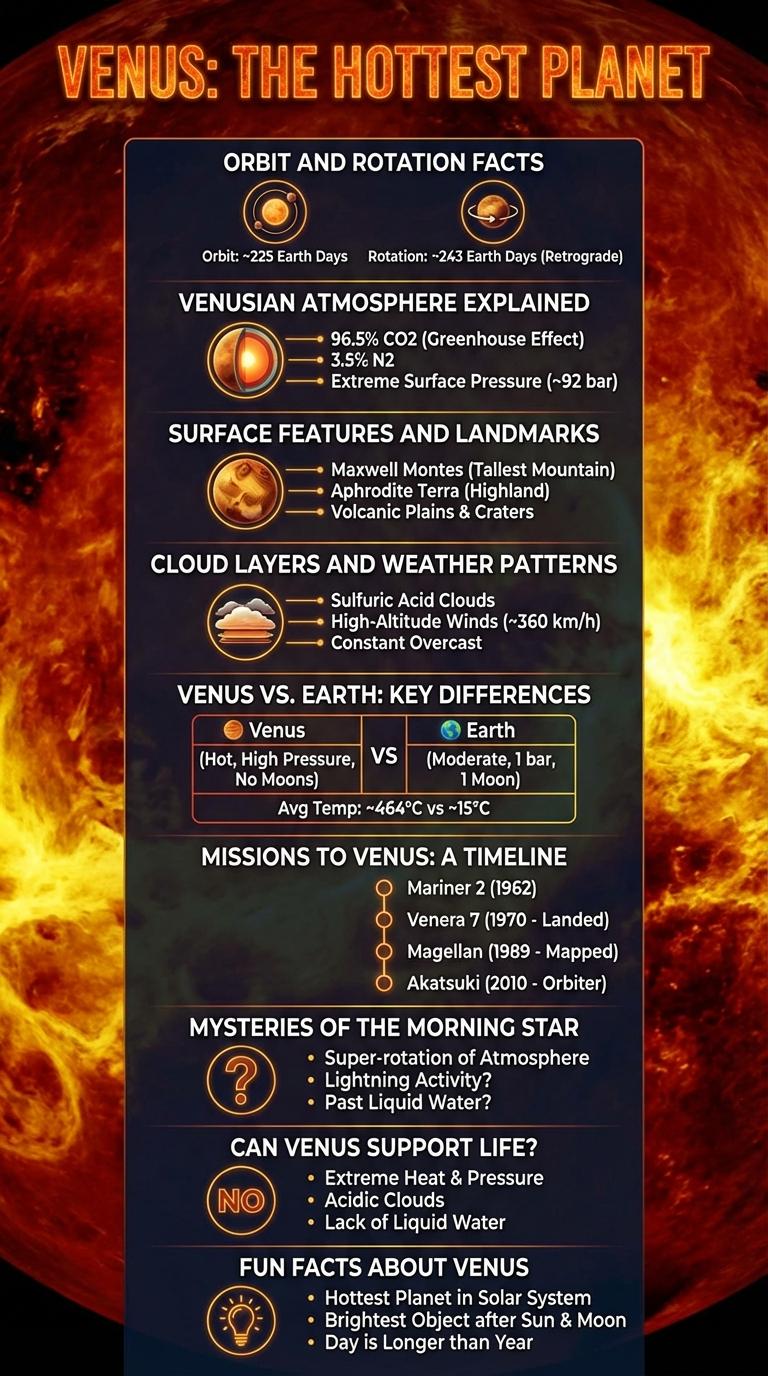
Venus, often called Earth's twin due to its similar size and composition, is shrouded in thick clouds of sulfuric acid that trap heat, creating a runaway greenhouse effect. Its surface temperature can reach up to 900 degrees Fahrenheit, making it the hottest planet in our solar system. This infographic highlights key facts about Venus's atmosphere, geology, and unique rotational patterns.
Venus: The Hottest Planet
Why is Venus considered the hottest planet in our solar system? Venus has a dense atmosphere composed mainly of carbon dioxide, creating a runaway greenhouse effect. Surface temperatures can reach up to 900 degrees Fahrenheit, hotter than Mercury despite being farther from the Sun.
Orbit and Rotation Facts
Venus orbits the Sun at an average distance of approximately 108 million kilometers, completing one orbit every 225 Earth days. Its rotation is uniquely retrograde, spinning in the opposite direction of most planets, with a single rotation lasting about 243 Earth days. This slow, backward rotation means a day on Venus is longer than its year.
Venusian Atmosphere Explained
Venus has a dense atmosphere composed mainly of carbon dioxide. Its atmosphere traps heat, creating the hottest surface temperatures among the planets in the solar system.
- Composition - Over 96% of Venus' atmosphere consists of carbon dioxide, with traces of nitrogen and sulfur compounds.
- Pressure - Surface pressure on Venus is about 92 times that of Earth, equivalent to being 900 meters underwater.
- Greenhouse Effect - Thick clouds of sulfuric acid reflect sunlight but also trap infrared radiation, causing extreme surface heating.
The Venusian atmosphere plays a critical role in shaping the planet's extreme climate and surface conditions.
Surface Features and Landmarks
Venus features a rocky surface marked by vast plains covered with volcanic lava and several large impact craters. Its dense atmosphere creates extreme surface temperatures averaging around 465degC (869degF).
Key landmarks include Maxwell Montes, the highest mountain on Venus, rising about 11 km above the surface. Another notable feature is Aphrodite Terra, a large highland region with extensive tectonic deformations and volcanic formations.
Cloud Layers and Weather Patterns
Venus is enveloped by thick cloud layers composed mainly of sulfuric acid droplets. These clouds drive extreme weather patterns with high-speed winds and acid rain that never reaches the surface.
- Cloud Composition - Venus' clouds consist primarily of sulfuric acid, making them highly reflective and corrosive.
- Cloud Layers - The cloud system is divided into three main layers extending from about 45 km to 70 km above Venus' surface.
- Wind Speeds - Super-rotating winds in the upper atmosphere reach speeds of up to 360 km/h, circling the planet every four Earth days.
Venus vs. Earth: Key Differences
Venus and Earth are often called sister planets due to their similar size and composition. Despite these similarities, they exhibit stark differences in atmosphere, surface conditions, and overall habitability.
Venus has an extremely thick atmosphere composed mainly of carbon dioxide, creating a runaway greenhouse effect that results in surface temperatures around 900degF (475degC). Earth's atmosphere contains nitrogen and oxygen, supporting life with moderate temperatures and liquid water.
Missions to Venus: A Timeline
Venus has been a key focus for planetary missions due to its extreme atmosphere and surface conditions. These missions have provided crucial data for understanding the planet's geology, climate, and potential for past habitability.
- Mariner 2 (1962) - The first successful mission to Venus, Mariner 2 performed the initial flyby and measured atmospheric temperatures and solar wind conditions.
- Venera Program (1961-1983) - A series of Soviet spacecraft, Venera probes conducted atmospheric studies and sent back the first images from Venus' surface.
- Magellan (1989-1994) - Used radar mapping to create detailed surface maps, revealing volcanic and tectonic features of Venus.
- Venus Express (2005-2014) - ESA's orbiter provided extensive atmospheric data, studying cloud layers and surface-atmosphere interactions.
- Akatsuki (2010 - Present) - Japan's spacecraft studies atmospheric dynamics and cloud activity to better understand Venus' weather systems.
Mysteries of the Morning Star
Can Venus Support Life?
Venus has extreme surface temperatures averaging around 465degC and a dense atmosphere composed mainly of carbon dioxide with clouds of sulfuric acid, making it inhospitable for known life forms. Despite harsh surface conditions, the planet's upper cloud layers have temperate temperatures and may contain water vapor, raising questions about potential microbial life. Research continues to explore the possibility of life in Venus's atmosphere, where conditions are less hostile than on the surface.