
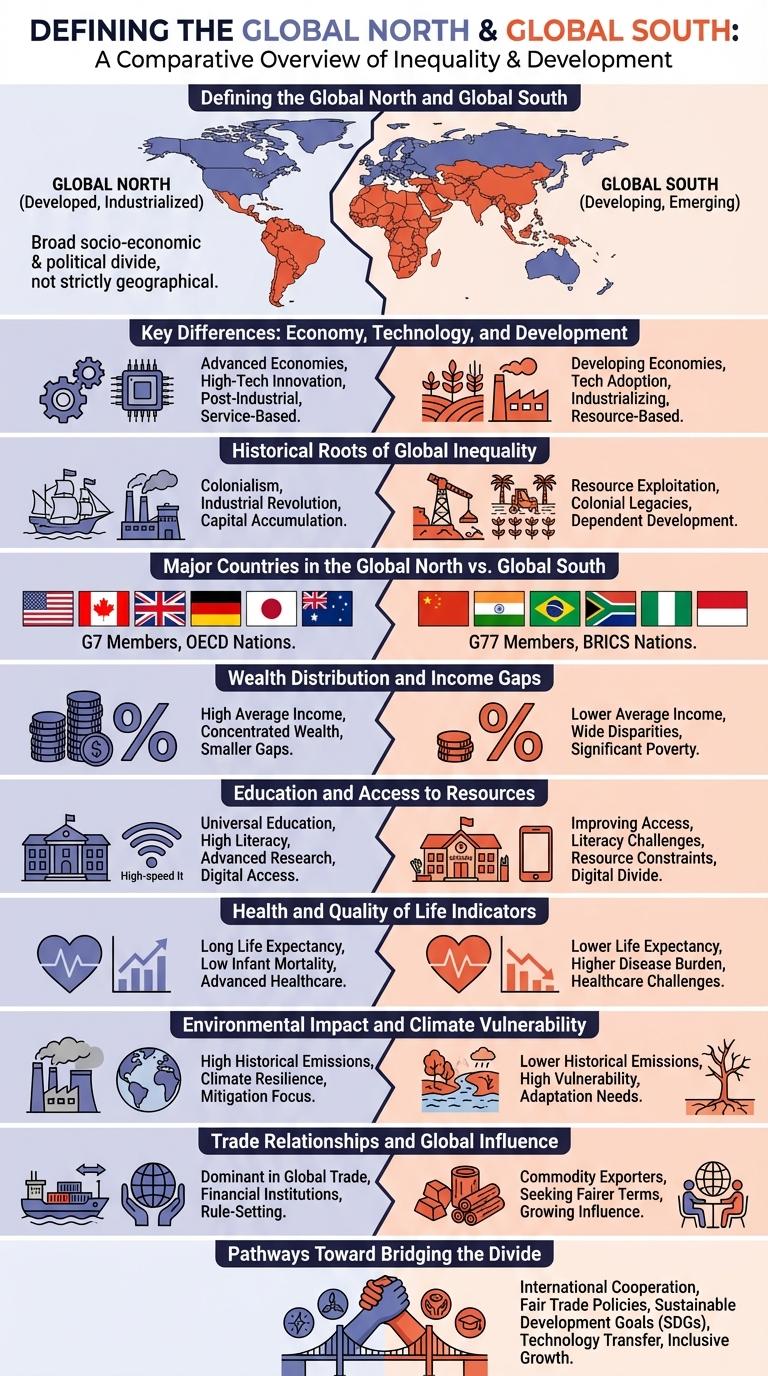
The infographic presents a clear comparison between the Global North and Global South, highlighting key economic, social, and environmental disparities. It visualizes data on income levels, access to education, and resource distribution to emphasize the ongoing inequalities between these regions. This visual tool aids in understanding the complex dynamics shaping global development and policy.
Defining the Global North and Global South
The Global North and Global South are terms used to describe economic and political divisions between countries. These distinctions often reflect disparities in wealth, development, and global influence.
- Global North - Refers to developed, industrialized countries with high income levels and strong political influence.
- Global South - Encompasses developing nations with lower income levels and limited access to resources and technology.
- Economic Divide - The Global North controls a majority of global wealth, while the Global South faces challenges like poverty and underdevelopment.
Understanding these terms helps contextualize global inequalities and guides international development efforts.
Key Differences: Economy, Technology, and Development
The Global North and Global South represent distinctions in economic status, technological advancement, and overall development. These terms highlight disparities between wealthier, industrialized nations and their less-developed counterparts.
The Global North typically includes countries with strong economies, advanced technology, and high standards of living, such as the United States, Canada, and most of Western Europe. The Global South consists mainly of developing countries in regions like Africa, Latin America, and parts of Asia, where economic growth and technological infrastructure lag behind. Development challenges in the Global South include limited access to education, healthcare, and modern technology, which impact overall progress.
Historical Roots of Global Inequality
The historical roots of global inequality trace back to colonization, where the Global North exploited resources and labor in the Global South. Industrialization in the Global North accelerated economic growth while many Global South regions remained underdeveloped due to extractive policies. These divergent historical paths have led to persistent disparities in wealth, education, and infrastructure between the two regions.
Major Countries in the Global North vs. Global South
What are the major countries in the Global North compared to the Global South? The Global North primarily includes economically developed countries with advanced infrastructure and high-income levels. In contrast, the Global South consists mostly of developing nations with emerging economies and varying levels of industrialization.
| Global North | Global South |
|---|---|
| United States | India |
| Canada | Brazil |
| United Kingdom | Nigeria |
| Germany | South Africa |
| Japan | Indonesia |
Wealth Distribution and Income Gaps
The Global North consists of wealthy, industrialized countries with high income levels and significant economic resources. These nations dominate global wealth distribution and maintain advanced infrastructure and technological development.
The Global South comprises predominantly developing countries characterized by lower income levels and limited access to capital. Income gaps remain stark, with large segments of populations experiencing poverty and restricted economic opportunities.
Education and Access to Resources
| Aspect | Global North |
|---|---|
| Education Enrollment Rate | Over 90% secondary school enrollment |
| Higher Education Opportunities | Extensive access to universities and vocational training |
| Access to Educational Resources | Wide availability of digital learning tools and libraries |
| Literacy Rate | Above 95% |
| Internet Access | Over 80% population with broadband connectivity |
| Aspect | Global South |
|---|---|
| Education Enrollment Rate | Approximately 60% secondary school enrollment |
| Higher Education Opportunities | Limited access, often concentrated in urban areas |
| Access to Educational Resources | Restricted access, low availability of digital tools |
| Literacy Rate | Varies between 60% to 80% depending on country |
| Internet Access | Below 40% population with broadband connectivity |
Health and Quality of Life Indicators
Health and quality of life indicators reveal significant disparities between the Global North and Global South. These differences are evident in metrics such as life expectancy, access to healthcare, and disease prevalence.
- Life Expectancy - Countries in the Global North typically experience an average life expectancy 10-15 years longer than those in the Global South due to better healthcare infrastructure.
- Access to Healthcare - The Global North generally has widespread access to advanced medical services, while many regions in the Global South face limited availability and affordability of healthcare.
- Disease Burden - Infectious diseases remain more prevalent in the Global South, whereas the Global North is more affected by chronic conditions linked to lifestyle and aging populations.
Environmental Impact and Climate Vulnerability
The Global North contributes the largest share of carbon emissions, driving climate change through industrial activities and high energy consumption. Countries in the Global South face greater climate vulnerability due to limited infrastructure, economic constraints, and geographic exposure to extreme weather events. This imbalance results in disproportionate environmental impacts, where those least responsible experience the harshest effects of global warming.
Trade Relationships and Global Influence
The Global North comprises economically developed countries with significant influence in international trade, predominantly exporting high-value goods and services. The Global South includes developing nations, often exporting raw materials and agricultural products, highlighting a trade imbalance.
Trade relationships tend to favor the Global North, which controls major multinational corporations and financial institutions, shaping global economic policies. The Global South relies on these trade links for economic growth but faces challenges like unequal terms of trade and limited market access.