
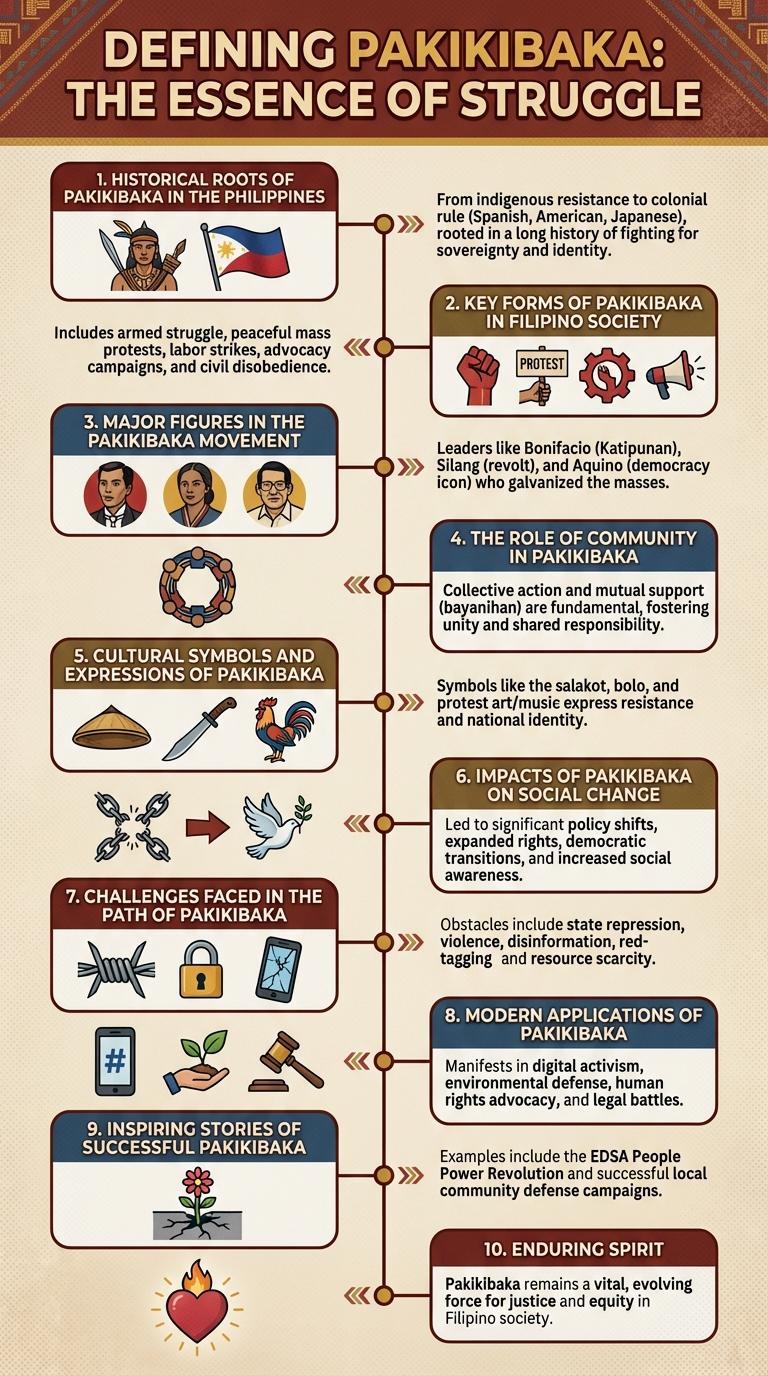
Pakikibaka represents the powerful spirit of resistance and struggle embedded in Filipino history and culture. This infographic visually captures key moments, movements, and figures that exemplify this collective fight for justice and freedom. Explore the vibrant legacy of resilience and determination that continues to inspire change across generations.
Defining Pakikibaka: The Essence of Struggle
Pakikibaka represents the fundamental spirit of struggle in Filipino culture, embodying resilience and collective resistance. It is a powerful concept that defines the fight for justice, freedom, and social change.
- Historical Roots - Pakikibaka originates from Filipino revolutionary movements against colonial rule and oppression.
- Collective Action - It emphasizes community solidarity and joint efforts in overcoming adversity.
- Endurance and Hope - Pakikibaka symbolizes continuous perseverance despite challenges and setbacks.
Historical Roots of Pakikibaka in the Philippines
What are the historical roots of pakikibaka in the Philippines?
Pakikibaka, meaning struggle or resistance, originates from the Filipino people's long history of fighting against colonization and oppression. It reflects the collective efforts during the Spanish, American, and Japanese occupations to assert national identity and social justice.
| Period | Significant Events |
|---|---|
| Pre-colonial Era | Indigenous communities' kinship-based resistance against early invaders. |
| Spanish Colonization (1521-1898) | Revolts like the Dagohoy Rebellion and the Philippine Revolution led by Andres Bonifacio. |
| American Period (1898-1946) | Resistance through the Philippine-American War and later, nationalist movements. |
| Japanese Occupation (1942-1945) | Guerrilla warfare and local uprisings against Japanese forces during World War II. |
| Post-Independence | People's movements for social justice, democracy, and indigenous rights. |
Key Forms of Pakikibaka in Filipino Society
Pakikibaka represents the collective struggles and resistance within Filipino society against social injustices and oppression. It manifests in various forms reflecting the diverse ways Filipinos assert their rights and fight for change.
- Labor Struggles - Filipino workers organize strikes and protests to demand fair wages and better working conditions.
- Student Activism - Students lead movements advocating for educational reforms and human rights.
- Indigenous Rights Movements - Indigenous groups campaign to protect their ancestral lands and cultural heritage.
Major Figures in the Pakikibaka Movement
The Pakikibaka movement represents the Filipino struggle for freedom and social justice. Major figures in this movement played crucial roles in inspiring and organizing the masses.
Prominent leaders include Jose Maria Sison, founder of the Communist Party of the Philippines, who advocated for revolutionary change. Another key figure is Ninoy Aquino, whose activism and martyrdom galvanized national resistance against dictatorship.
The Role of Community in Pakikibaka
Pakikibaka, a Filipino term meaning struggle or resistance, often centers on community efforts to overcome social and political challenges. The role of community in pakikibaka is crucial in building collective strength and solidarity.
Communities mobilize resources, share knowledge, and provide emotional support during struggles. Collective action empowers marginalized groups to voice their demands and pursue justice. The unity within a community amplifies the impact of pakikibaka, making it more effective and sustainable.
Cultural Symbols and Expressions of Pakikibaka
Pakikibaka, a term signifying struggle or resistance, is deeply embedded in cultural symbols and expressions across the Philippines. It reflects a collective fight for justice, freedom, and identity in Filipino history and society.
Traditional symbols like the "Bayanihan" spirit represent unity and cooperation in times of struggle. Artistic expressions, such as protest songs and street murals, vividly capture the resilience and voices of the people in their ongoing pakikibaka.
Impacts of Pakikibaka on Social Change
Pakikibaka, or collective struggle, has driven significant social change by empowering marginalized communities to demand justice and equality. Grassroots movements have used pakikibaka to challenge oppressive systems and promote human rights reforms. This form of resistance fosters solidarity and raises awareness, catalyzing long-term societal transformation.
Challenges Faced in the Path of Pakikibaka
| Challenge | Description |
|---|---|
| Social Oppression | Systematic discrimination leading to inequality and limited opportunities for marginalized groups. |
| Political Repression | Government measures such as censorship, arrests, and intimidation to suppress activism and dissent. |
| Economic Inequality | Poverty and lack of resources hinder the ability of communities to organize and sustain resistance efforts. |
| Internal Divisions | Differences in ideology and approach among groups create obstacles to unified action and strategy. |
| Media Manipulation | Distortion and misinformation in mainstream media to undermine movements and sway public opinion. |
Modern Applications of Pakikibaka
Pakikibaka, a Filipino concept of struggle and resistance, remains vital in modern contexts such as social justice movements, environmental activism, and labor rights campaigns. Its principles empower communities to challenge inequality, advocate for sustainable practices, and promote human rights. Contemporary applications of pakikibaka highlight the ongoing commitment to collective action and cultural resilience in the face of global challenges.