
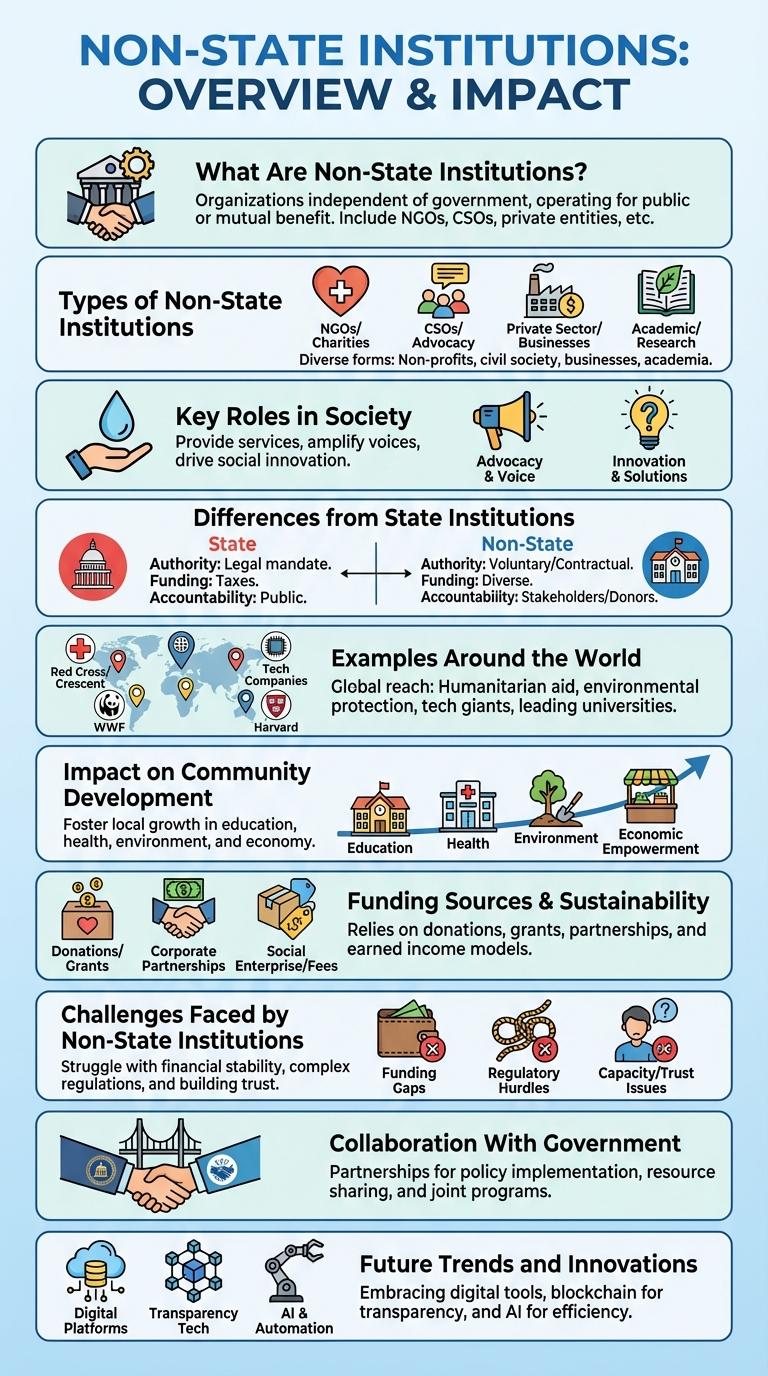
Non-state institutions play a crucial role in shaping social, economic, and political landscapes independent of government control. These organizations encompass a diverse range of entities, including NGOs, private associations, and civil society groups, which often address issues overlooked by the state. Highlighting their functions, impact, and challenges, this infographic provides a comprehensive overview of the vital contributions non-state institutions make worldwide.
What Are Non-State Institutions?
Non-state institutions refer to organizations or entities that operate independently from government control. They include non-governmental organizations (NGOs), private businesses, religious groups, and community organizations.
These institutions play a crucial role in society by providing services, advocating for various causes, and influencing policy outside the formal state structure. Their activities contribute to social, economic, and cultural development globally.
Types of Non-State Institutions
Non-state institutions are organizations operating independently from government control. They play a crucial role in various sectors including social, economic, and political fields.
Types of non-state institutions include non-governmental organizations (NGOs), private sector companies, and community-based organizations. Each type serves distinct functions such as advocacy, business operations, and local development.
Key Roles in Society
Non-state institutions play a crucial role in shaping societal norms and providing essential services outside government control. These organizations contribute to social stability and community development through diverse functions.
- Advocacy and Representation - Non-state institutions advocate for specific social, economic, or political interests representing marginalized groups or community causes.
- Service Provision - They deliver vital services such as education, healthcare, and humanitarian aid, complementing government efforts.
- Social Cohesion - These institutions foster community identity and trust by promoting cultural values and organizing social networks.
Differences from State Institutions
What defines a non-state institution compared to a state institution?
Non-state institutions operate independently from government control. They often focus on specific social, economic, or cultural objectives without direct state interference.
How is funding for non-state institutions different from state institutions?
Non-state institutions primarily rely on private funding sources, donations, or membership fees. State institutions receive funding mainly through government budgets paid by taxpayers.
What legal frameworks govern non-state institutions versus state institutions?
Non-state institutions are governed by civil law, private regulations, or internal rules. State institutions operate under public law and governmental regulations.
How do decision-making processes differ between these two types of institutions?
Non-state institutions often have autonomous decision-making bodies like boards or private stakeholders. State institutions follow bureaucratic procedures dictated by legislation.
What roles do non-state institutions play that state institutions might not?
Non-state institutions frequently address niche community needs, advocate specific interests, or provide alternative services. State institutions typically focus on public administration and delivering general welfare services.
Examples Around the World
Non-state institutions play a crucial role in governance and social development worldwide. Examples include international organizations, non-governmental organizations (NGOs), and community-based groups. These entities influence policies, provide services, and advocate for various causes beyond direct state control.
| Institution | Region |
|---|---|
| International Committee of the Red Cross (ICRC) | Global |
| Greenpeace | Global |
| Bharat Sevashram Sangha | India |
| Amnesty International | Global |
| Confederation of Indigenous Nationalities of Ecuador (CONAIE) | Ecuador |
Impact on Community Development
Non-state institutions significantly contribute to community development by addressing local needs and enhancing social welfare. Their involvement accelerates progress in education, health, and economic opportunities within communities.
- Empowerment - Non-state institutions empower individuals through capacity-building programs that foster self-reliance.
- Service Delivery - These organizations provide essential services such as healthcare and education where government reach is limited.
- Advocacy - They influence policy changes by representing community interests at local and national levels.
Collaboration between non-state institutions and local communities creates sustainable development outcomes that improve quality of life.
Funding Sources & Sustainability
Non-state institutions rely on diverse funding sources to maintain operations and ensure long-term sustainability. These sources range from private donations to revenue-generating activities tailored to their mission.
Primary funding originates from private donors, grants, and service fees, each contributing significantly to the financial health of the institution. Sustainable institutions implement strategic financial planning, including endowment funds and diversified income streams. Effective management of resources is essential for resilience against economic fluctuations and funding variability.
Challenges Faced by Non-State Institutions
Non-state institutions face funding limitations that hinder their ability to expand and sustain projects. Regulatory constraints and lack of official recognition often restrict their operational scope and impact. These organizations must also navigate societal mistrust and limited access to formal networks to effectively serve their communities.
Collaboration With Government
Non-state institutions play a crucial role in supplementing government efforts through strategic collaboration. These partnerships enhance service delivery and policy implementation in various sectors.
- Public-Private Partnerships - Non-state institutions engage in joint projects with government agencies to improve infrastructure and public services.
- Policy Advisory Role - They provide expert analysis and recommendations that influence government policy development.
- Resource Sharing - Collaborative efforts allow sharing of knowledge, funding, and technology to address social and economic challenges efficiently.