
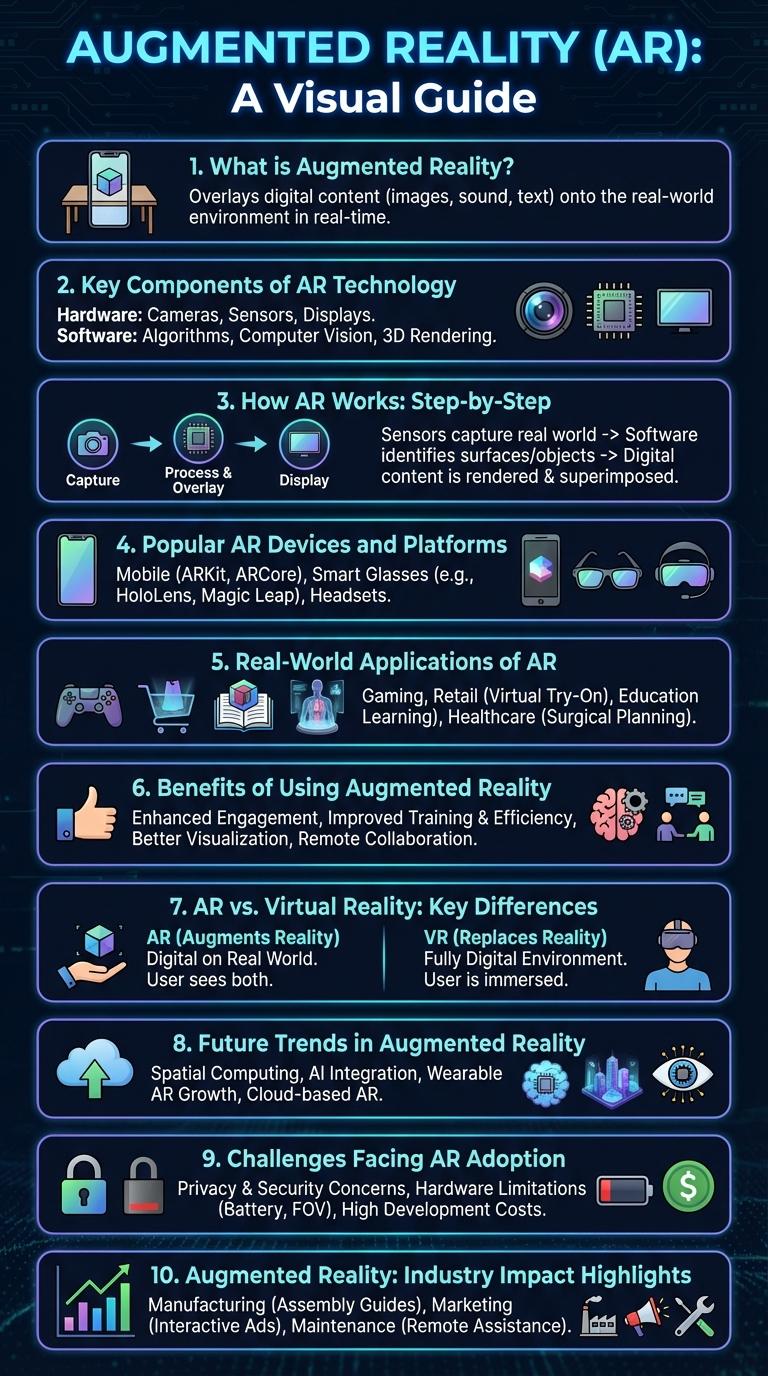
Augmented reality (AR) enhances real-world environments by overlaying digital information, creating immersive and interactive experiences. This technology transforms industries such as gaming, education, and retail by blending virtual content with physical surroundings. Explore this infographic to understand how AR works, its key applications, and emerging trends shaping the future.
What is Augmented Reality?
Augmented Reality (AR) overlays digital content onto the real world, enhancing the user's perception of their environment. AR integrates computer-generated images, sounds, and data with physical surroundings in real-time.
- Definition - AR combines virtual elements with the real environment, creating an interactive experience.
- Technology - AR uses devices like smartphones, tablets, and smart glasses to display augmented content.
- Applications - AR is widely used in gaming, education, healthcare, and retail to enrich user engagement.
Key Components of AR Technology
Augmented Reality (AR) technology blends digital content with the real world, enhancing user experiences across various applications. It relies on a combination of hardware and software components working seamlessly to overlay virtual elements onto physical environments.
Key components of AR technology include sensors and cameras that capture real-world data to interpret surroundings accurately. A processing unit analyzes this data and manages the rendering of virtual images. Display devices, such as AR glasses or smartphone screens, present the augmented content to users in real time.
How AR Works: Step-by-Step
| Step | Description |
|---|---|
| 1. Environment Scanning | AR devices use cameras and sensors to capture the real-world environment. |
| 2. Data Processing | Software analyzes the input from cameras and sensors to understand surroundings. |
| 3. Content Generation | Virtual objects, images, and data are created based on the environment analysis. |
| 4. Alignment & Mapping | Virtual content is aligned accurately with real-world objects and surfaces. |
| 5. Display | AR devices overlay digital content seamlessly onto the physical world for user interaction. |
Popular AR Devices and Platforms
What are the most popular devices used for augmented reality experiences? Augmented reality (AR) devices range from smart glasses to mobile apps, providing immersive interactions in gaming, education, and industry. Key platforms enable developers to create AR content accessible across various hardware.
| Popular AR Devices | Key Features |
|---|---|
| Microsoft HoloLens 2 | Advanced spatial mapping, hand tracking, enterprise-grade performance |
| Magic Leap 2 | Lightweight design, vibrant visuals, enterprise applications |
| Google ARCore | Android platform support, motion tracking, environmental understanding |
| Apple ARKit | iOS devices support, precise tracking, world mapping |
| Snapchat Spectacles | Wearable AR glasses, social media integration, 3D effects |
Real-World Applications of AR
Augmented Reality (AR) integrates digital information with the physical environment in real time. This technology enhances user experience by overlaying virtual objects onto the real world.
AR finds significant applications across various industries including healthcare, retail, and education. It improves surgical precision, customer engagement, and interactive learning through immersive visualizations.
Benefits of Using Augmented Reality
Augmented reality (AR) enhances the real world by overlaying digital information, transforming user experiences across various industries. AR integrates technology seamlessly into everyday environments, offering interactive and immersive content.
- Improved User Engagement - AR creates interactive experiences that capture attention and increase user participation.
- Enhanced Learning and Training - AR provides hands-on simulations, improving knowledge retention and skill development.
- Boosted Operational Efficiency - AR assists workers with real-time data, reducing errors and speeding up tasks.
Adopting augmented reality can drive innovation, improve productivity, and elevate customer satisfaction in multiple sectors.
AR vs. Virtual Reality: Key Differences
Augmented Reality (AR) overlays digital content onto the real world, enhancing user perception through devices like smartphones or AR glasses. Virtual Reality (VR) creates a fully immersive digital environment, isolating users from the physical world typically via VR headsets. Key differences include AR's integration with reality versus VR's complete virtual immersion, hardware requirements, and user interaction experiences.
Future Trends in Augmented Reality
Augmented Reality (AR) is rapidly evolving, transforming how users interact with digital content in real-world environments. Emerging trends highlight the technological advancements shaping the future of AR applications across industries.
- 5G Connectivity Integration - Enhanced network speeds and low latency from 5G enable seamless, real-time AR experiences with improved responsiveness.
- AI-Powered AR - Artificial Intelligence enhances object recognition and contextual understanding, creating smarter and more adaptive AR applications.
- Wearable AR Devices - Lightweight, comfortable AR glasses and headsets improve user experience and expand AR's use in daily life and professional settings.
Challenges Facing AR Adoption
Augmented reality (AR) adoption faces challenges such as high development costs and technical limitations like battery life and processing power. User experience issues, including discomfort and limited content availability, hinder widespread acceptance. Privacy concerns and lack of industry standards further slow AR integration across various sectors.