
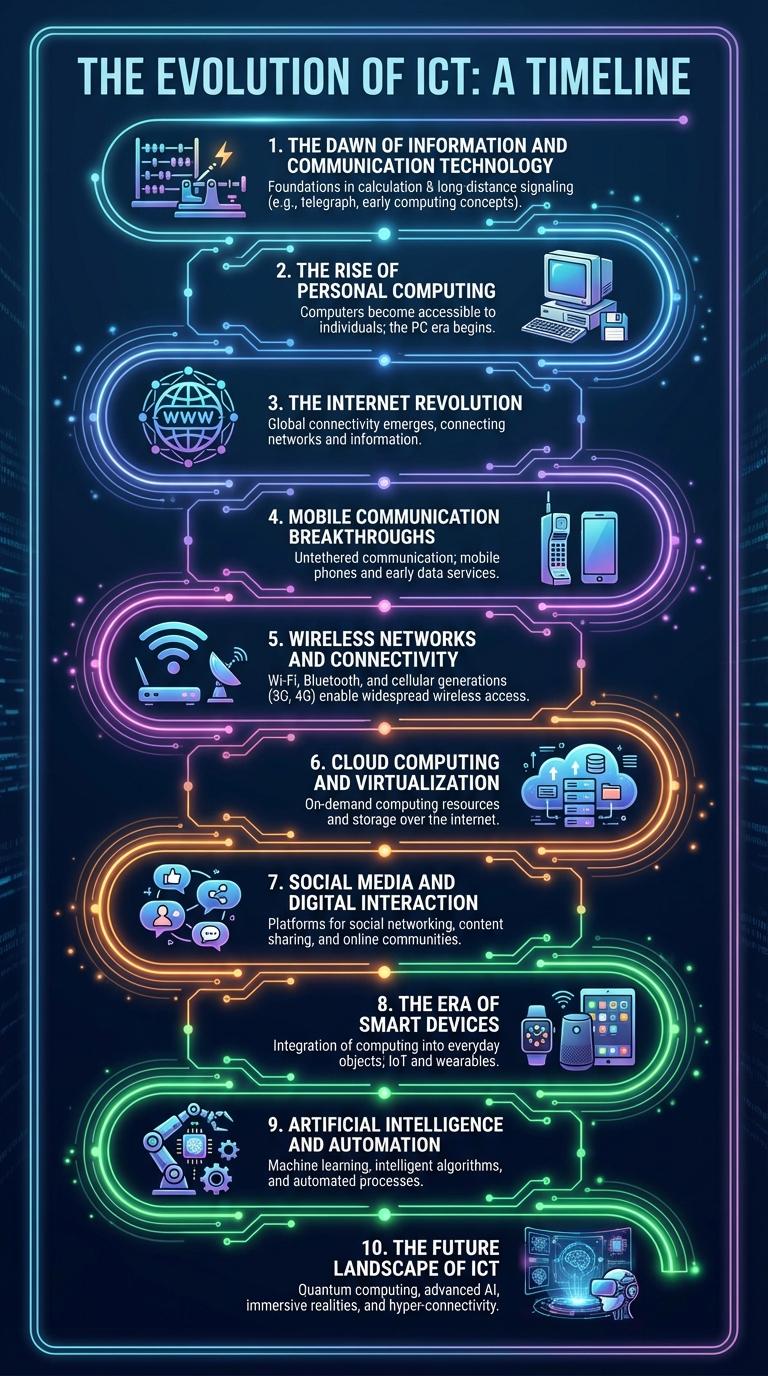
The infographic visually traces the transformative journey of Information and Communication Technology (ICT) from its early mechanical devices to today's advanced digital networks. Key milestones highlight innovations such as the invention of the telegraph, the rise of personal computers, and the expansion of the internet, illustrating rapid technological advancements. This evolution showcases how ICT continually reshapes communication, data processing, and global connectivity.
The Dawn of Information and Communication Technology
The dawn of Information and Communication Technology (ICT) marks the beginning of a revolutionary era in human interaction and data processing. Early innovations such as the telegraph and telephone laid the groundwork for modern digital communication.
Pioneers like Alexander Graham Bell and Samuel Morse introduced tools that transformed long-distance communication. These advancements initiated the shift from analog to digital systems, shaping the future of ICT.
The Rise of Personal Computing
The evolution of Information and Communication Technology (ICT) saw a major transformation with the rise of personal computing in the 1970s and 1980s. This era introduced affordable and accessible computers, changing how individuals interacted with technology.
- Introduction of Microprocessors - The development of microprocessors enabled the creation of compact and cost-effective personal computers.
- Apple and IBM Personal Computers - Apple's Apple II and IBM's PC revolutionized the market by offering user-friendly and programmable devices for homes and offices.
- Software Development Boom - The rise of personal computing sparked rapid growth in software applications, enhancing productivity and entertainment options.
The rise of personal computing laid the foundation for modern digital lifestyles and the expansion of ICT accessibility worldwide.
The Internet Revolution
| Year | Key Development |
|---|---|
| 1969 | Creation of ARPANET, the precursor to the Internet |
| 1989 | Invention of the World Wide Web by Tim Berners-Lee |
| 1993 | Launch of the first graphical web browser, Mosaic |
| 2004 | Rise of social media platforms expanding Internet use |
| 2020 | Global Internet penetration exceeds 60% of the population |
Mobile Communication Breakthroughs
The evolution of ICT has been profoundly shaped by breakthroughs in mobile communication, transforming how people connect and access information worldwide. Key innovations such as the introduction of 1G through 5G networks significantly enhanced speed, capacity, and reliability.
Mobile communication advancements enabled the rise of smartphones, mobile internet, and IoT devices, fueling global digital transformation. These milestones paved the way for real-time data exchange, remote work, and smart city developments.
Wireless Networks and Connectivity
The evolution of Wireless Networks has revolutionized global connectivity, enabling seamless communication and data exchange without physical cables. Wireless technologies have advanced from simple radio transmissions to high-speed 5G networks supporting the Internet of Things (IoT).
- Early Wireless Technology - Initial wireless communication relied on radio waves for basic voice and data transmission.
- Wi-Fi Emergence - Introduction of Wi-Fi enabled local area wireless networking with increased speeds and accessibility.
- Mobile Network Generations - Progression from 2G to 5G dramatically enhanced wireless bandwidth, latency, and device connectivity.
Cloud Computing and Virtualization
How has Cloud Computing transformed the evolution of Information and Communication Technology (ICT)? Cloud Computing enables on-demand access to computing resources, reducing the need for physical hardware and enhancing scalability. This shift supports businesses in agile operations and cost efficiency.
What role does Virtualization play in advancing ICT infrastructure? Virtualization allows multiple virtual systems to run on a single physical machine, maximizing resource utilization and flexibility. It forms the backbone for cloud services by providing isolated, scalable environments.
Social Media and Digital Interaction
The evolution of ICT has transformed social media platforms into vital tools for global digital interaction, enabling instant communication and content sharing. Early social media networks focused on text-based interaction, while modern platforms emphasize multimedia, live streaming, and augmented reality. Digital interaction now drives social connectivity, marketing, and information exchange on a massive scale.
The Era of Smart Devices
The Era of Smart Devices marks a significant evolution in Information and Communication Technology (ICT), driven by the integration of sensors and connectivity in everyday objects. This period is defined by the rise of smartphones, wearable technology, and Internet of Things (IoT) devices that enhance connectivity and data exchange.
- Proliferation of Smartphones - Smartphones have become the primary computing and communication devices globally, offering powerful processing capabilities and constant internet access.
- Growth of Wearable Technology - Devices like smartwatches and fitness trackers provide real-time health monitoring and seamless integration with mobile ecosystems.
- Expansion of IoT Networks - Smart devices connect to IoT networks, enabling automation and data-driven decision-making across homes, industries, and cities.
Artificial Intelligence and Automation
The evolution of Information and Communication Technology (ICT) has been significantly shaped by advancements in Artificial Intelligence (AI) and Automation. These technologies drive efficiency and innovation across various industries worldwide.
AI enables machines to learn, reason, and make decisions, transforming traditional ICT systems into intelligent networks. Automation streamlines repetitive tasks, reducing human error and operational costs. Together, AI and Automation accelerate digital transformation and enhance data management capabilities.