
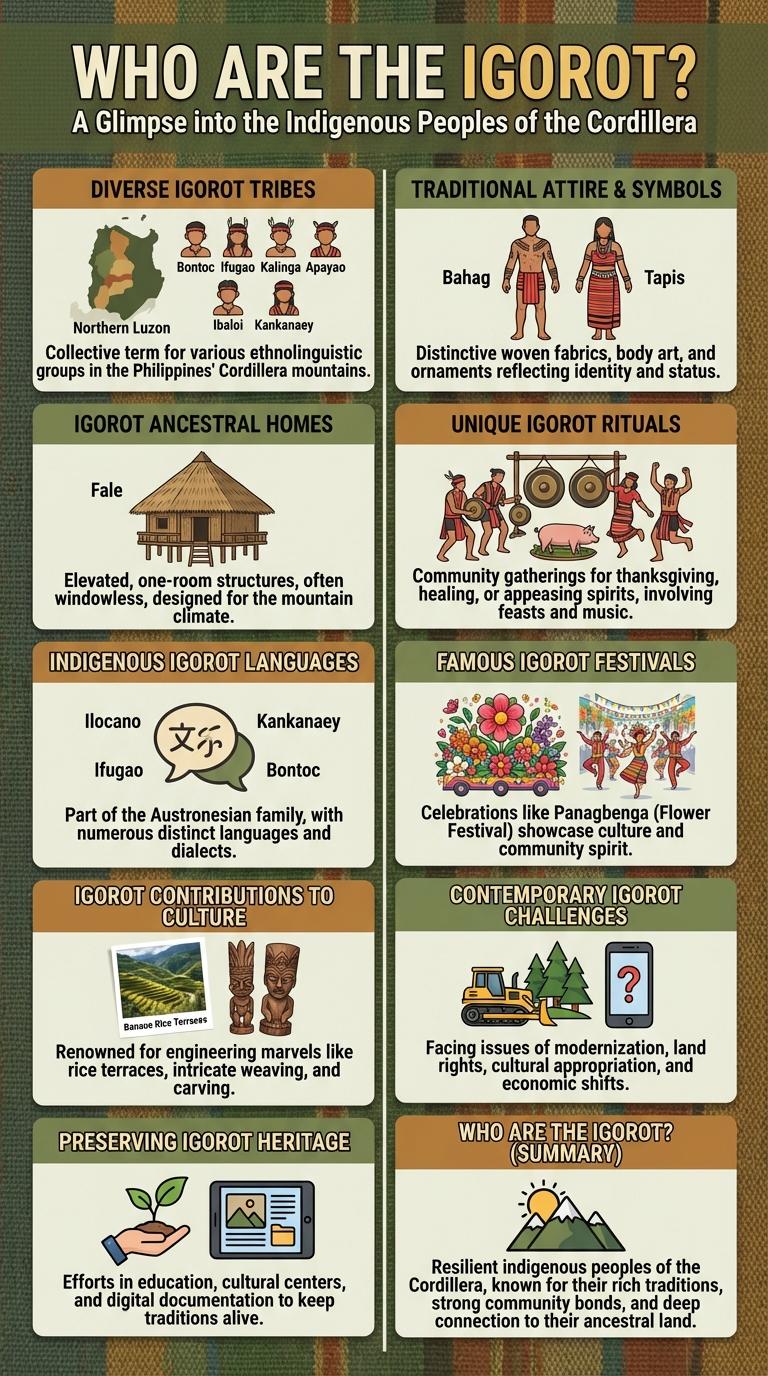
The Igorot people are indigenous inhabitants of the Cordillera region in the Philippines, known for their rich cultural heritage and traditional practices. Their unique customs, intricate weaving, and elaborate rituals highlight a deep connection to their ancestral land. This infographic explores key aspects of Igorot culture, history, and social structure.
Who Are the Igorot?
The Igorot are indigenous peoples from the mountainous regions of northern Luzon in the Philippines. They are known for their rich cultural heritage, traditional practices, and distinct ethnic identity.
- Ethnic Groups - The Igorot consist of several tribes, including the Bontoc, Kankanaey, Ifugao, and Kalinga, each with unique customs and languages.
- Traditional Practices - They are renowned for rice terrace farming, weaving, and elaborate rituals that sustain their community life.
- Geographic Location - The Igorot primarily inhabit the Cordillera mountain range, an area characterized by rugged terrain and rich biodiversity.
Diverse Igorot Tribes
The Igorot people comprise a diverse group of indigenous tribes residing in the Cordillera region of Northern Luzon, Philippines. Each tribe maintains distinct cultural practices, languages, and traditions that enrich the collective Igorot identity.
- Benguet Tribe - Known for their elaborate rice terraces and intricate beadwork, the Benguet people excel in traditional agriculture and craftsmanship.
- Kankanaey Tribe - The Kankanaey are recognized for their vibrant weaving techniques and strong community rituals centered around farming cycles.
- Igorot Applachian Tribe - Distinct for their mountain farming and hunting skills, they preserve ancient oral traditions passed through generations.
Traditional Attire & Symbols
| Traditional Attire | Symbols & Meanings |
|---|---|
| G-strings or Bahag for men | Represents bravery and warrior status |
| Wrap-around skirts or Tapis for women | Signifies femininity and cultural identity |
| Beaded accessories and belts | Symbolize social status and tribal affiliation |
| Headdresses adorned with feathers | Indicates leadership and honor |
| Red and black woven fabrics | Colors represent courage and the earth |
Igorot Ancestral Homes
Igorot ancestral homes, known as "Bale," are traditional wooden houses elevated on stilts, designed to adapt to the mountainous terrain of the Cordillera region in the Philippines. These homes utilize indigenous materials such as wood, bamboo, and cogon grass, reflecting the Igorots' sustainable architectural practices and deep connection to nature. The Bale serves as a symbol of Igorot cultural identity, showcasing craftsmanship passed down through generations and embodying communal values.
Unique Igorot Rituals
The Igorot people, indigenous to the Cordillera region in the Philippines, practice unique rituals deeply rooted in their ancestral traditions. These rituals serve as vital expressions of their vibrant culture and spiritual beliefs.
One notable ritual is the "Bodong," a peace pact ceremony that promotes harmony and conflict resolution among tribes. Another significant ritual is the "canao," a communal feast involving animal sacrifices to honor spirits and seek blessings for good harvests and health.
Indigenous Igorot Languages
The Igorot people of the northern Philippines speak a variety of indigenous languages. These languages belong to the Austronesian language family and reflect the rich cultural heritage of the Igorot tribes.
Major Igorot languages include Kankanaey, Ibaloi, and Ifugao, each with unique dialects and vocabulary. Preservation efforts focus on maintaining these languages through education and community programs.
Famous Igorot Festivals
The Igorot people, indigenous to the Cordillera region of the Philippines, celebrate vibrant festivals that showcase their rich culture and traditions. These festivals highlight their connection to nature, tribal customs, and ancestral heritage.
One of the most famous festivals is the Panagbenga Festival in Baguio City, celebrated with colorful flower floats and street dancing. The Guling-Guling Festival in Paoay pays tribute to the unity and history of Igorot tribes through ritual dances and music. Another notable event is the Lang-ay Festival in Mountain Province, where tribes gather to share their crafts, cuisine, and indigenous performances.
Igorot Contributions to Culture
The Igorot people contribute significantly to the cultural heritage of the Philippines through their rich traditions in weaving, music, and dance. Their intricate handwoven textiles, known as "ikat," showcase unique patterns passed down through generations. Igorot rituals and festivals, such as the Panagbenga flower festival, highlight their vibrant cultural identity and community spirit.
Contemporary Igorot Challenges
What are the key contemporary challenges faced by the Igorot communities?
Modern Igorot groups contend with cultural preservation amid rapid urbanization. Economic sustainability remains a critical issue as traditional livelihoods face decline.