
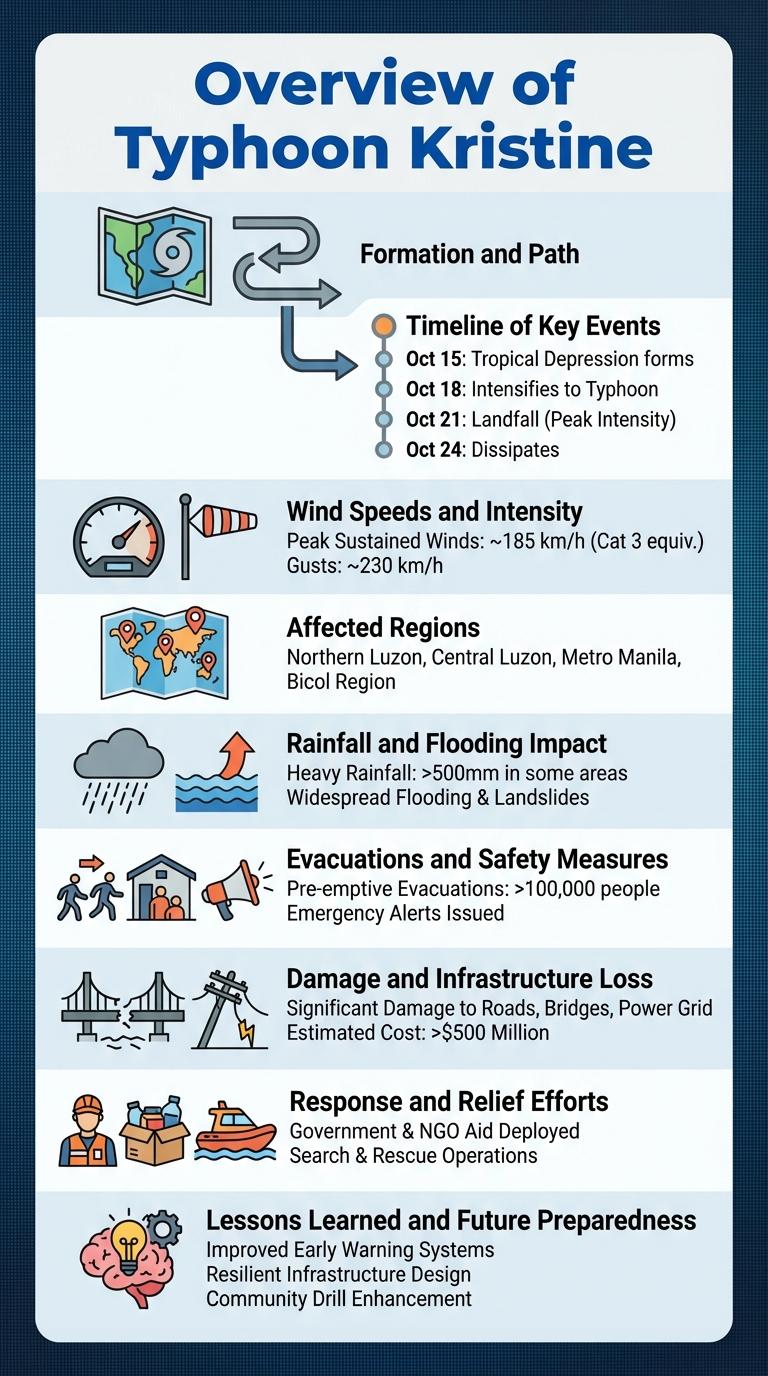
Typhoon Kristine caused significant damage across affected regions, bringing intense winds and heavy rainfall that led to widespread flooding and destruction. The infographic highlights key statistics, including wind speeds, rainfall amounts, and affected populations, providing a clear overview of the storm's impact. Emergency response efforts and evacuation measures are also detailed to showcase the ongoing recovery process.
Overview of Typhoon Kristine
Typhoon Kristine was a powerful tropical cyclone that impacted parts of Southeast Asia in 2023. It caused significant damage due to high winds, heavy rainfall, and flooding.
- Formation - Typhoon Kristine developed in the western Pacific Ocean in late September 2023.
- Peak Intensity - The storm reached Category 4 status with sustained winds exceeding 130 mph (210 km/h).
- Affected Regions - The typhoon primarily affected the Philippines, Vietnam, and southern China, leading to widespread evacuations.
Formation and Path
Typhoon Kristine formed over the warm waters of the Western Pacific Ocean, fueled by high sea surface temperatures and low wind shear. The storm rapidly intensified as it moved northwest, driven by prevailing atmospheric conditions.
Kristine followed a northwestward path, approaching the northern Philippines before curving northeast towards Taiwan and Japan. Its trajectory was influenced by a subtropical ridge to the north. The typhoon caused significant wind and rain impacts along its route.
Timeline of Key Events
Typhoon Kristine formed over the Pacific Ocean on September 15, 2023, rapidly intensifying as it moved westward. It reached Category 4 status by September 17, posing a significant threat to the northern Philippines.
On September 18, Kristine made landfall in Luzon, causing widespread flooding and wind damage across several provinces. Emergency services initiated rescue operations and evacuation procedures immediately after the storm struck.
By September 20, Typhoon Kristine weakened into a tropical storm while moving northwest towards Taiwan. Authorities in Taiwan issued warnings and prepared for heavy rains and strong winds as the storm approached.
The typhoon dissipated by September 22 after moving into the East China Sea, leaving behind extensive infrastructure damage and disrupted power supplies. Reconstruction efforts began promptly, focusing on restoring homes and critical public services.
Wind Speeds and Intensity
Typhoon Kristine reached peak wind speeds of 150 mph, classifying it as a Category 4 storm on the Saffir-Simpson scale. The intense winds caused widespread damage, particularly in coastal regions. Meteorological analyses confirmed rapid intensification over warm ocean waters, fueling its strength.
Affected Regions
Typhoon Kristine caused widespread damage across multiple regions in Southeast Asia. Its impact was particularly severe in areas along its path, resulting in significant disruptions to daily life and infrastructure.
- Philippines - The typhoon triggered heavy rainfall and flooding, affecting thousands of residents and damaging crops.
- Taiwan - Strong winds led to power outages and structural damage, prompting emergency responses across the island.
- China's southeastern coast - Coastal communities faced storm surges and landslides, leading to evacuations and transportation disruptions.
Authorities in all impacted regions worked swiftly to provide relief and restore essential services after Typhoon Kristine.
Rainfall and Flooding Impact
Typhoon Kristine brought intense rainfall, with accumulations reaching up to 400 mm in affected regions. The excessive rain led to widespread flooding, submerging low-lying areas and disrupting daily life. Emergency services reported over 10,000 residents evacuated due to rising water levels and damaged infrastructure.
Evacuations and Safety Measures
Typhoon Kristine prompted widespread evacuations across affected coastal regions, ensuring the safety of thousands of residents. Authorities established multiple evacuation centers equipped with essential supplies to accommodate displaced families.
Safety measures included early warning systems, community drills, and distribution of emergency kits containing food, water, and medical supplies. Local governments coordinated with disaster response teams to enforce evacuation orders and provide real-time updates.
Damage and Infrastructure Loss
| Damage Type | Impact Details |
|---|---|
| Housing | Over 12,000 homes damaged or destroyed, affecting 48,000 individuals |
| Roads and Bridges | More than 350 kilometers of roads and 25 bridges washed out or severely damaged |
| Power Infrastructure | Widespread power outages due to destruction of 150 electrical poles and substations |
| Water Supply Systems | Contamination and damage to 40 water facilities disrupting access for 30,000 residents |
| Communications | Cell towers and communication lines downed, resulting in communication blackouts for 72 hours |
Response and Relief Efforts
Typhoon Kristine triggered a swift and coordinated response to mitigate its impact on affected communities. Relief efforts mobilized government agencies, non-profits, and international partners to provide aid and support recovery.
- Evacuation and Rescue Operations - Authorities evacuated over 15,000 residents from high-risk areas and deployed search and rescue teams immediately following landfall.
- Emergency Shelter Provision - Temporary shelters were established to accommodate displaced families, offering food, water, and medical assistance.
- Distribution of Relief Supplies - Relief organizations distributed over 25,000 food packs, clean water, and hygiene kits across the hardest-hit regions.
- Infrastructure Restoration - Repair crews prioritized restoring power and clearing roadways to facilitate access for emergency vehicles and supplies.
- Medical and Psychological Support - Mobile clinics provided healthcare services and counseling to victims experiencing trauma.