
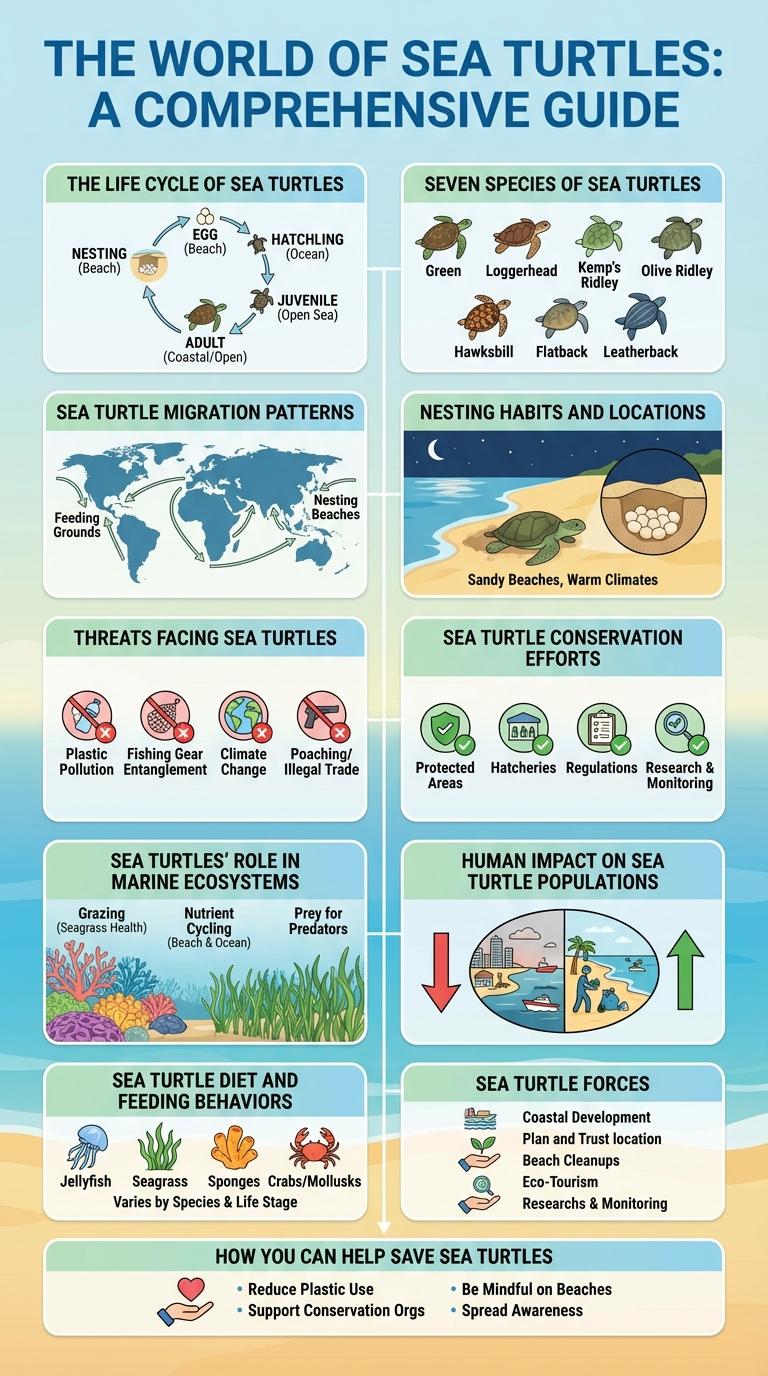
Sea turtles play a vital role in marine ecosystems, maintaining the health of seagrass beds and coral reefs. Their diverse species face numerous threats, including habitat loss, pollution, and climate change. Understanding their life cycle and conservation efforts is crucial for protecting these ancient ocean travelers.
The Life Cycle of Sea Turtles
Sea turtles undergo a fascinating life cycle that begins when females lay eggs on sandy beaches. These eggs hatch into hatchlings that instinctively make their way to the ocean.
Once in the water, young sea turtles enter the "lost years," a mysterious early stage spent in open ocean habitats. They grow and mature for decades before returning to the same beaches where they were born to reproduce.
Seven Species of Sea Turtles
Sea turtles are ancient marine reptiles essential to ocean ecosystems. Seven distinct species exist, each with unique characteristics and habitats.
- Green Sea Turtle - Known for its smooth carapace, it primarily feeds on seagrasses and algae.
- Loggerhead Sea Turtle - Characterized by a large head and powerful jaws, it consumes hard-shelled prey.
- Hawksbill Sea Turtle - Recognizable by its pointed beak, it prefers sponges found on coral reefs.
Sea Turtle Migration Patterns
How do sea turtles navigate during their long migrations? Sea turtles use Earth's magnetic field as a natural compass to guide them across vast ocean distances. This remarkable ability helps them return to the exact beaches where they were born to lay their eggs.
What are the common migration routes of sea turtles? Many species migrate thousands of miles between feeding grounds and nesting sites, often crossing entire ocean basins. For example, the leatherback turtle travels from tropical feeding areas to temperate nesting beaches.
Why is understanding sea turtle migration important? Tracking migration patterns helps scientists identify critical habitats and protect endangered populations. Conservation efforts focus on safeguarding these key routes to ensure sea turtle survival.
How long do sea turtle migrations typically last? Migrations can span several months and cover distances up to 12,000 miles. Sea turtles exhibit precise navigation skills to maintain their travel paths during these extensive journeys.
What threats impact sea turtle migration? Coastal development, fishing gear, and climate change disrupt migration and nesting behaviors. Protecting sea turtle corridors is vital for reducing mortality and supporting global population health.
Nesting Habits and Locations
Sea turtles exhibit unique nesting habits critical to their species survival. Their nesting locations are predominantly on sandy beaches across tropical and subtropical regions worldwide.
- Nesting Season - Most sea turtles nest during warm months, with peak activity varying by species and region.
- Beach Selection - Females return to the same beach where they hatched, demonstrating strong site fidelity.
- Clutch Size and Frequency - A female lays multiple clutches per season, typically ranging from 50 to 200 eggs per clutch.
Threats Facing Sea Turtles
Sea turtles face numerous threats including habitat loss, pollution, and accidental capture in fishing gear. Climate change disrupts their nesting sites and hatching success. Poaching and illegal trade also significantly impact sea turtle populations worldwide.
Sea Turtle Conservation Efforts
Sea turtle conservation efforts are critical for protecting these ancient marine reptiles from extinction. Various organizations and governments implement strategies to safeguard sea turtle populations and their habitats.
- Nesting Site Protection - Designated protected areas prevent disturbance and predation on nesting beaches.
- Marine Pollution Reduction - Initiatives to reduce plastic waste help minimize ingestion and entanglement hazards.
- Bycatch Mitigation - Use of turtle excluder devices in fisheries lowers accidental capture in fishing gear.
Global collaboration and public awareness campaigns continue to strengthen sea turtle conservation worldwide.
Sea Turtles' Role in Marine Ecosystems
Sea turtles play a crucial role in maintaining the health of marine ecosystems by controlling jellyfish populations and contributing to seagrass bed maintenance. Their grazing helps improve seagrass growth, which supports diverse marine life and stabilizes the ocean floor.
These reptiles also facilitate nutrient cycling by transferring nutrients from ocean habitats to beaches during nesting. Sea turtle conservation is essential for preserving the balance and biodiversity of marine environments worldwide.
Human Impact on Sea Turtle Populations
Human activities, including coastal development and pollution, significantly threaten sea turtle populations worldwide. Fishing practices often result in accidental bycatch, causing injury or death to many turtles each year. Conservation efforts, such as protected nesting sites and reduced plastic waste, are crucial for the survival of these marine reptiles.
Sea Turtle Diet and Feeding Behaviors
Sea turtles primarily feed on a variety of marine organisms, including jellyfish, seagrass, algae, and crustaceans. Different species have specialized diets, with some favoring herbivorous feeding while others are carnivorous or omnivorous.
Green sea turtles mainly eat seagrass and algae, which helps maintain healthy seagrass beds. Loggerhead turtles consume hard-shelled prey like crabs and clams using their powerful jaws. Hawksbill turtles prefer sponges and are known for their role in controlling sponge populations on coral reefs.