
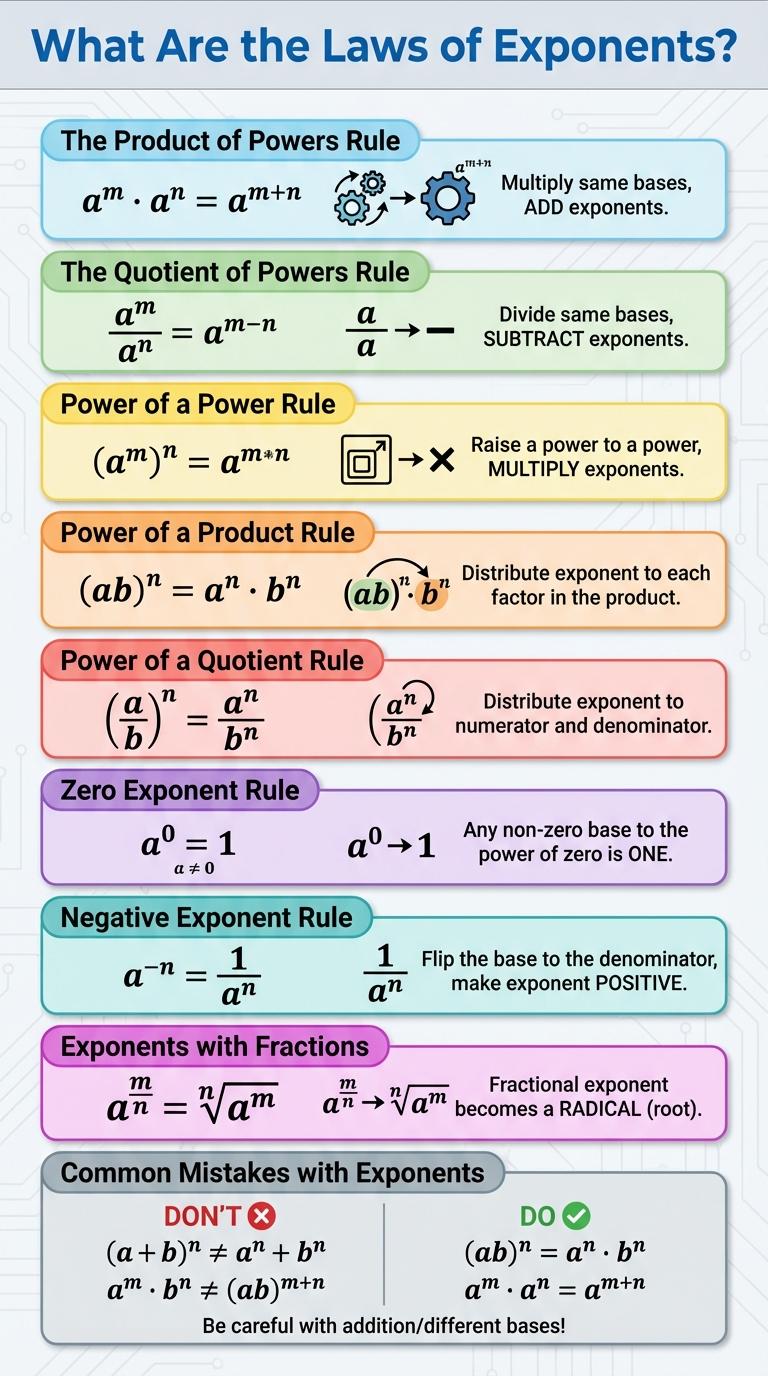
The law of exponents simplifies mathematical expressions by defining how to handle powers of numbers and variables. Mastering these rules allows for efficient calculation and problem-solving in algebra and beyond. This infographic visually breaks down the key exponent laws to enhance understanding and retention.
What Are the Laws of Exponents?
The laws of exponents describe how to simplify expressions involving powers of the same base. These rules include the product rule, quotient rule, power rule, zero exponent rule, and negative exponent rule. Understanding these laws helps in solving algebraic problems efficiently by manipulating exponential expressions correctly.
The Product of Powers Rule
| Law of Exponents: The Product of Powers Rule | |
|---|---|
| Rule Description | When multiplying two powers with the same base, add the exponents. |
| Mathematical Expression | am x an = am+n |
| Base Condition | The base a must be the same and nonzero. |
| Example | 53 x 54 = 53+4 = 57 = 78,125 |
| Important Note | The rule applies only to multiplication, not division or addition of powers. |
The Quotient of Powers Rule
The Quotient of Powers Rule states that when dividing exponential expressions with the same base, subtract the exponents. This rule simplifies expressions and helps in solving algebraic problems efficiently.
For example, a^m / a^n equals a^(m-n), where a is the base and m and n are the exponents. This property is essential for understanding the behavior of powers and exponents in mathematical operations.
Power of a Power Rule
The Power of a Power Rule in exponents states that when raising a power to another power, you multiply the exponents. This rule simplifies expressions like (x^m)^n into x^(mxn).
For example, (2^3)^4 equals 2^(3x4), which simplifies to 2^12. This rule helps in reducing complex exponential expressions efficiently. It applies to all real numbers and variables with exponents.
Power of a Product Rule
The Power of a Product Rule is a fundamental law of exponents used in algebra. It simplifies expressions where a product is raised to an exponent by applying the exponent to each factor inside the parentheses.
This rule helps in reducing complex exponential expressions and aids in solving equations efficiently.
- Rule Definition - For any nonzero numbers a and b, and any integer n, (ab)n = an x bn.
- Exponent Distribution - The exponent outside the parentheses distributes to each base within the product.
- Simplification - Applying the rule transforms a product raised to a power into the product of powers, making calculations simpler.
Power of a Quotient Rule
The Power of a Quotient Rule is a fundamental law of exponents used to simplify expressions involving powers of fractions. This rule helps in distributing exponents across the numerator and denominator inside the parentheses.
- Rule Statement - The power of a quotient rule states that (a/b)^n = (a^n) / (b^n) where a and b are nonzero real numbers and n is an integer.
- Exponent Distribution - The exponent outside the parentheses applies to both the numerator and the denominator inside the fraction separately.
- Application - This rule is useful for simplifying complex algebraic expressions and solving equations involving exponents.
Applying the Power of a Quotient Rule simplifies calculations and enhances understanding of exponent properties.
Zero Exponent Rule
What does the Zero Exponent Rule state?
Any nonzero number raised to the power of zero equals one. This rule simplifies expressions and is fundamental in algebraic operations.
Negative Exponent Rule
The negative exponent rule is a fundamental law in mathematics that helps simplify expressions with exponents. This rule converts negative exponents into positive exponents by taking the reciprocal of the base.
- Definition - A negative exponent indicates the reciprocal of the base raised to the opposite positive exponent.
- Formula - For any nonzero number a and integer n, a-n = 1/an.
- Application - This rule simplifies expressions by eliminating negative exponents for easier calculation and interpretation.
Exponents with Fractions
Exponents with fractions involve raising a base to a fractional power, which represents roots and powers. The numerator of the fraction is the power, while the denominator is the root.
For example, a^(m/n) means the nth root of a raised to the mth power, written as ([n]{a})^m. This concept is essential in simplifying expressions with roots and powers in algebra and calculus.