
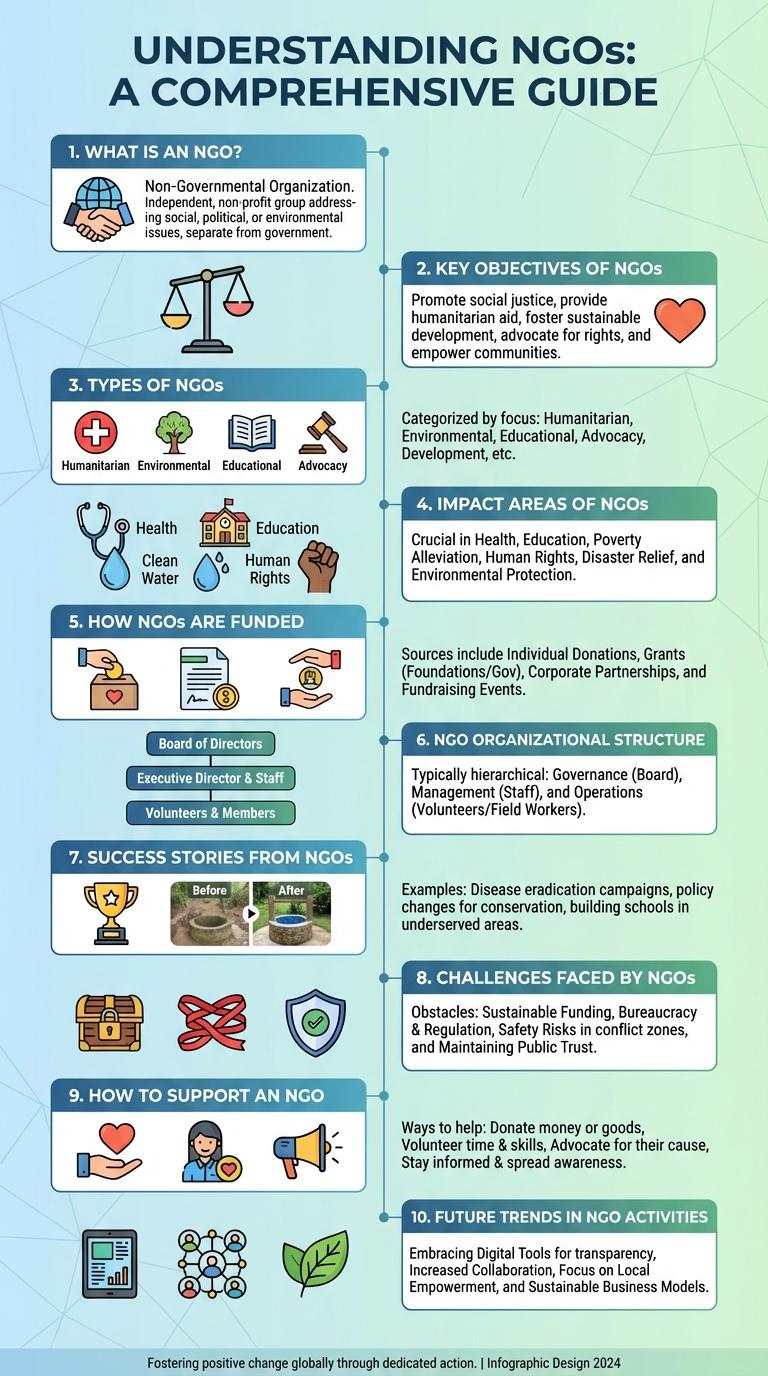
An infographic about NGOs highlights their vital role in addressing global challenges such as poverty, education, and healthcare. Visual data presentation enhances understanding of their impact, funding sources, and volunteer involvement. Clear charts and statistics illustrate how NGOs drive social change and mobilize resources efficiently.
What is an NGO?
Non-Governmental Organizations (NGOs) are independent groups that operate without direct government control to address social, environmental, or political issues. They work globally or locally to promote human rights, sustainable development, and social welfare.
NGOs play a crucial role in advancing humanitarian aid, policy advocacy, and community development worldwide.
- Independent Organization - NGOs function without government influence, ensuring unbiased support for various causes.
- Mission-Driven - Each NGO focuses on specific social, environmental, or human rights objectives.
- Global and Local Impact - NGOs operate at multiple levels to implement projects and influence policy changes.
Key Objectives of NGOs
Non-Governmental Organizations (NGOs) play a vital role in addressing social, environmental, and humanitarian issues worldwide. Their key objectives include promoting human rights, supporting sustainable development, and providing emergency relief in crisis situations. NGOs actively engage communities, influence policy, and mobilize resources to create lasting positive change.
Types of NGOs
Non-Governmental Organizations (NGOs) are classified based on their scope and focus areas. These organizations operate independently from governments to address social, environmental, and humanitarian issues.
There are several main types of NGOs: Operational NGOs focus on development projects, while Advocacy NGOs aim to influence policy and public opinion. Other categories include Charity NGOs, Community-based NGOs, and International NGOs, each serving specific functions and regions.
Impact Areas of NGOs
| Impact Area | Description |
|---|---|
| Education | NGOs improve access to quality education, develop learning materials, and support teacher training programs in underserved communities. |
| Healthcare | Efforts include providing medical services, health education, vaccination campaigns, and support for mental health initiatives. |
| Environmental Protection | Activities focus on conservation, climate change advocacy, waste management, and promotion of sustainable practices. |
| Human Rights | Programs aim to protect and promote civil liberties, gender equality, and fight against discrimination and exploitation. |
| Disaster Relief | NGOs provide emergency aid, rehabilitation, and long-term recovery support to communities affected by natural and man-made disasters. |
How NGOs are Funded
Non-Governmental Organizations (NGOs) rely on diverse funding sources to operate and fulfill their missions. These funds come from individuals, governments, corporations, and international bodies.
Donations from private individuals form a significant part of NGO funding, often collected through fundraising campaigns and online platforms. Government grants provide substantial support, enabling NGOs to implement large-scale projects. Corporate sponsorships and partnerships also contribute, offering financial resources and in-kind support.
NGO Organizational Structure
An NGO's organizational structure typically includes the Board of Directors, responsible for governance and strategic decisions. Below the board, the Executive Director manages daily operations and oversees various departments such as Programs, Fundraising, and Communications. Clear hierarchical roles ensure efficient project implementation and resource management.
| Position | Primary Role |
|---|---|
| Board of Directors | Governance and strategic oversight |
| Executive Director | Operational management |
| Program Managers | Project implementation |
| Fundraising Team | Resource mobilization |
| Communications Team | Public relations and outreach |
Success Stories from NGOs
Non-governmental organizations (NGOs) play a vital role in addressing social, environmental, and humanitarian issues worldwide. Their success stories highlight impactful change achieved through dedicated efforts and community collaboration.
- Eradication of Malaria in Rural Communities - NGOs implemented effective mosquito control and education programs reducing malaria cases by 70%.
- Empowering Women Entrepreneurs - Microfinance initiatives by NGOs enabled thousands of women to start sustainable small businesses.
- Reforestation and Climate Action - Tree planting campaigns restored over 1 million hectares of degraded land, improving biodiversity.
Challenges Faced by NGOs
What are the primary challenges faced by NGOs today?
NGOs often struggle with limited funding, making it difficult to sustain their operations and expand their impact. They also face regulatory hurdles in different countries that can restrict their activities and complicate compliance.
How does donor dependency affect the stability of NGOs?
Heavy reliance on a few donors can jeopardize an NGO's financial stability if funding priorities change. Diversifying funding sources remains a critical challenge to ensure long-term program continuity.
Why is transparency important for NGOs, and what challenges do they face in maintaining it?
Transparency builds trust with stakeholders but requires robust reporting systems that many NGOs find resource-intensive. Inadequate transparency can lead to decreased public support and difficulties in securing funding.
What operational challenges limit an NGO's effectiveness?
Many NGOs face challenges such as limited skilled personnel, logistical issues in remote areas, and inefficient technology infrastructure. These factors constrain program delivery and scalability of impact.
How do political and social environments impact NGO activities?
NGOs often operate in volatile political climates, facing restrictions on advocacy and freedom to operate. Social resistance or mistrust in certain regions can further hinder their outreach and project success.
How to Support an NGO
Supporting an NGO is vital for driving social change and community development. Understanding the practical ways to offer support empowers individuals to contribute effectively.
- Donate Funds - Financial contributions provide essential resources for NGO projects and operations.
- Volunteer Time - Donating time helps NGOs execute programs and expand their reach.
- Raise Awareness - Sharing information about an NGO's mission increases its visibility and support base.
- Participate in Events - Engaging in fundraisers or awareness campaigns strengthens community involvement.
- Advocate for Causes - Supporting policy changes aligns public priorities with NGO objectives.
Every form of support plays a crucial role in the sustainability and impact of NGOs.