
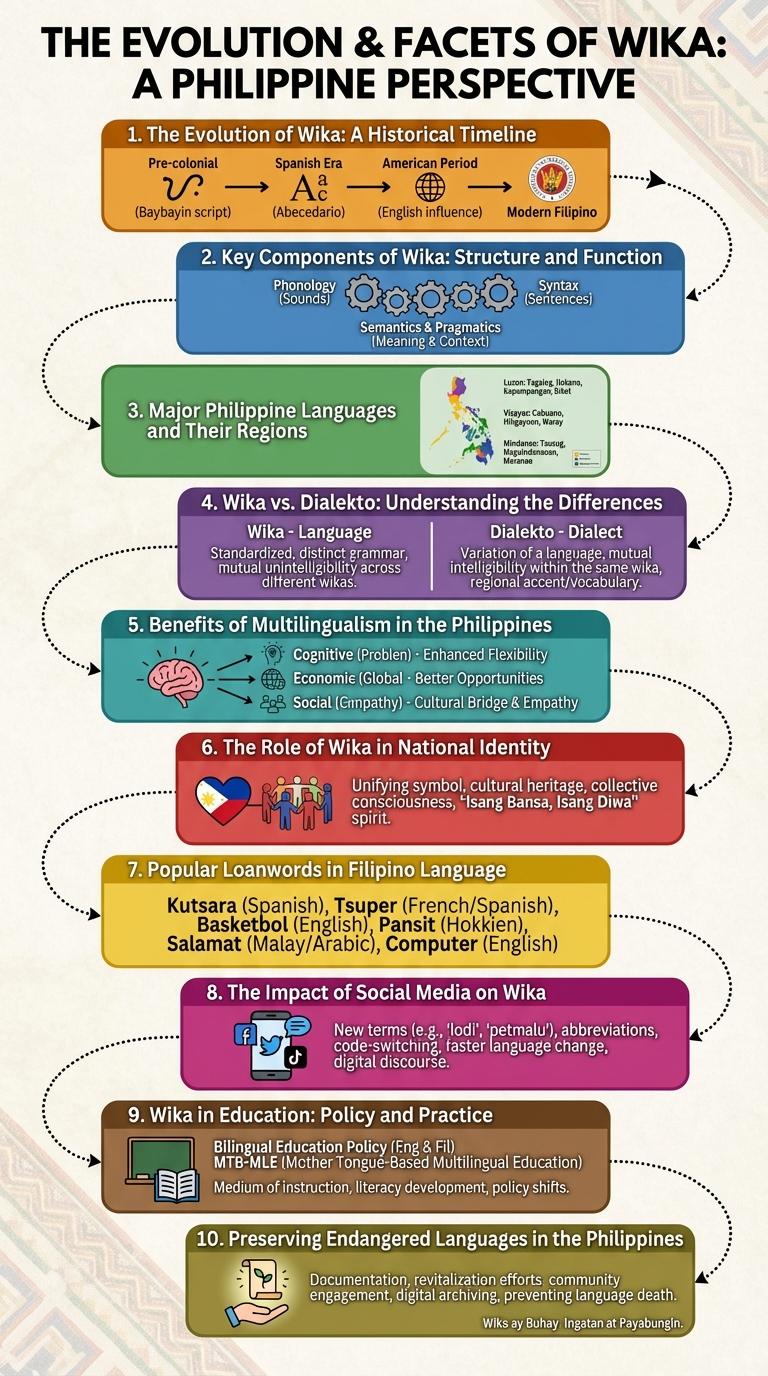
Wika is a vital component of cultural identity, reflecting the rich history and diversity of a community. This infographic visually presents key facts, statistics, and unique features of wika, highlighting its role in communication and social cohesion. Understanding wika's significance deepens appreciation for linguistic heritage and promotes effective language preservation.
The Evolution of Wika: A Historical Timeline
Wika, the Filipino term for language, reflects the rich cultural heritage of the Philippines. Its evolution highlights the diverse linguistic history influenced by trade, colonization, and globalization.
The origins of Wika date back to early indigenous languages spoken by various ethnic groups across the archipelago. Spanish colonization introduced a new linguistic era, merging native tongues with Spanish vocabulary. Today, Wika continues to evolve, embracing modern influences while preserving traditional roots.
Key Components of Wika: Structure and Function
Wika, the Filipino term for language, encompasses a rich structure essential for communication and cultural identity. It consists of interconnected components that contribute to its overall function in society.
- Phonology - The study of sounds and their systematic organization in Wika, crucial for pronunciation and meaning.
- Grammar - Rules and principles governing sentence structure and word forms, enabling coherent communication.
- Lexicon - Vocabulary or word bank of Wika, providing the fundamental units of meaning.
- Syntax - The arrangement of words and phrases to create well-formed sentences in Wika.
- Semantics - The meaning behind words and sentences, essential for understanding and interpretation.
These components work together to facilitate effective and expressive communication in Wika.
Major Philippine Languages and Their Regions
The Philippines is home to numerous languages, each rooted in specific regions reflecting the country's rich cultural diversity. Wika, meaning "language" in Filipino, represents the heart of communication among Filipino communities.
Major Philippine languages include Tagalog, Cebuano, Ilocano, Hiligaynon, and Waray. Each language corresponds to distinct provinces and regions, shaping local identity and traditions.
Wika vs. Dialekto: Understanding the Differences
Wika and dialekto are important linguistic concepts that shape how people communicate within different regions. Wika refers to a language as a whole, while dialekto pertains to regional or local variations of that language.
Wika serves as the primary means of communication among a community, encompassing grammar, vocabulary, and syntax. Dialekto includes distinctive pronunciation, vocabulary, and expressions unique to specific geographic areas or social groups.
Benefits of Multilingualism in the Philippines
The Philippines is a multilingual nation where diverse languages enrich communication and culture. Multilingualism offers significant cognitive, social, and economic advantages to Filipinos.
- Cognitive Benefits - Multilingual individuals in the Philippines demonstrate enhanced problem-solving skills and creativity.
- Social Cohesion - Speaking multiple languages fosters better understanding and unity among diverse Filipino communities.
- Economic Opportunities - Multilingualism increases employability and access to global markets for Filipinos.
The Role of Wika in National Identity
Wika plays a crucial role in shaping and preserving national identity by reflecting the culture, history, and values of a people. It serves as a unifying force that fosters a sense of belonging among citizens.
- Wika as Cultural Heritage - Language encapsulates traditions and customs passed down through generations, preserving national heritage.
- Wika Promotes Unity - A common language strengthens social cohesion and national solidarity among diverse communities.
- Wika Expresses National Pride - Speaking and promoting the native language reinforces pride and patriotism.
Popular Loanwords in Filipino Language
The Filipino language incorporates numerous loanwords from various languages, reflecting its rich cultural history. Spanish, English, and Chinese have significantly influenced Filipino vocabulary, bringing everyday terms into common use. These loanwords enhance communication and connect Filipino speakers with global cultures.
| Source Language | Popular Loanwords |
|---|---|
| Spanish | mesa (table), silya (chair), ligid (tire) |
| English | kompyuter (computer), telepono (telephone), basketbol (basketball) |
| Chinese | siopao (steamed bun), pansit (noodles), lumpia (spring roll) |
| Malay | guru (teacher), balat (skin), anak (child) |
The Impact of Social Media on Wika
| Aspect | Impact on Wika (Language) |
|---|---|
| Language Evolution | Introduction of new words, slang, and abbreviations from social media platforms. |
| Communication Style | Shift towards concise, informal, and visual-driven language usage. |
| Language Preservation | Increased opportunities to document and share indigenous and minority languages online. |
| Language Standardization | Challenges in maintaining grammatical correctness and standardized spelling. |
| Cross-cultural Exchange | Enhanced exposure to diverse languages leading to language blending and borrowing. |
Wika in Education: Policy and Practice
Wika plays a vital role in education by shaping policies that promote multilingual learning and cultural inclusion. Educational practices integrate wika to enhance comprehension, critical thinking, and student engagement across diverse linguistic backgrounds. Effective implementation of wika-focused curricula supports the preservation of indigenous languages while advancing academic success.