
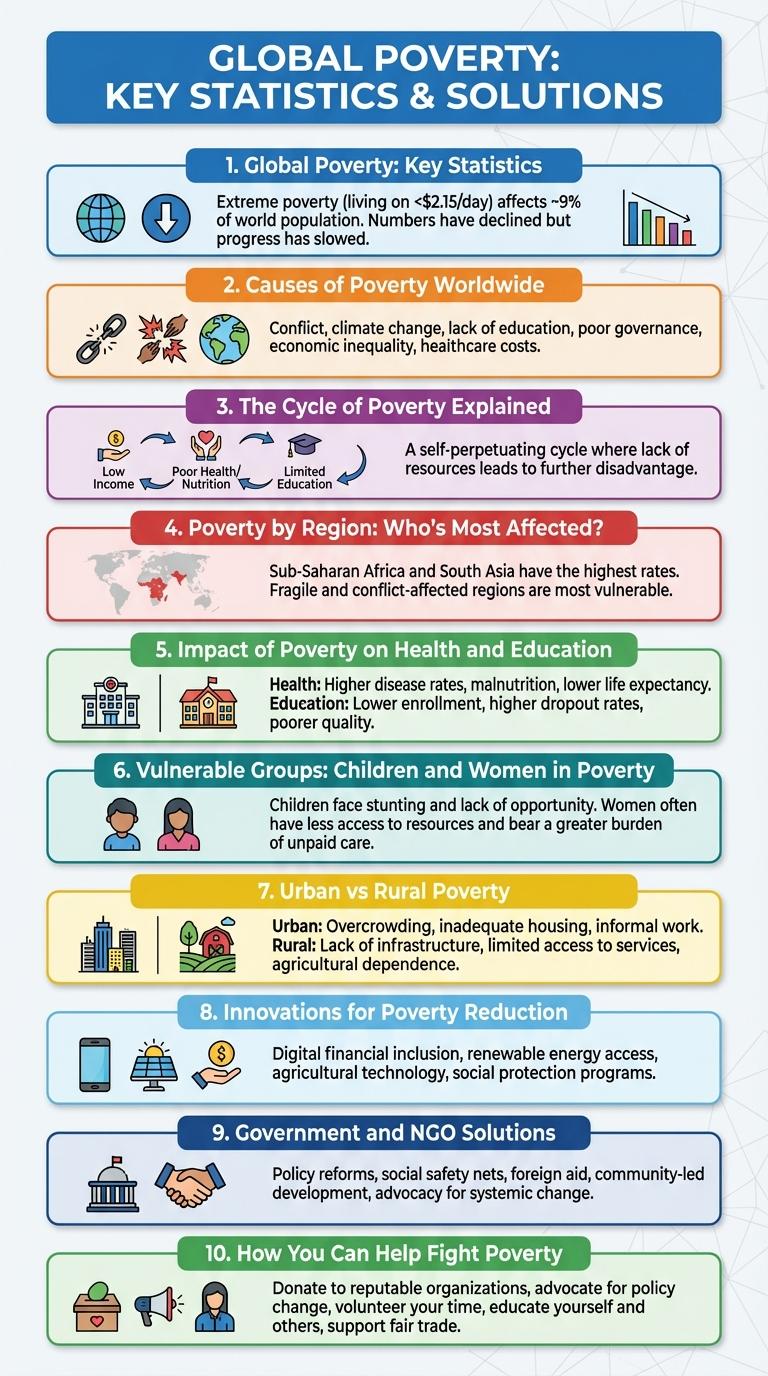
Poverty remains a pressing global challenge affecting millions of people's quality of life and access to basic necessities. Infographics visually highlight key statistics and trends, making complex data more accessible and understandable. This helps raise awareness and drives informed discussions on effective poverty alleviation strategies.
Global Poverty: Key Statistics
Global poverty remains a critical challenge affecting billions worldwide. Understanding key statistics helps in formulating effective policies to reduce poverty.
- Over 700 million people live on less than $1.90 a day, defined as extreme poverty by the World Bank.
- Children under 18 represent nearly half of the global poor, emphasizing the impact on younger generations.
- Sub-Saharan Africa has the highest poverty rate, with roughly 40% of its population living in extreme poverty.
Causes of Poverty Worldwide
What are the primary causes of poverty worldwide? Poverty is driven by multiple factors including lack of education, unemployment, and insufficient access to healthcare. Economic instability and social inequalities further exacerbate these conditions, trapping individuals and communities in cycles of poverty.
The Cycle of Poverty Explained
The cycle of poverty is a self-perpetuating condition where individuals or families experience poverty across generations. Limited access to education, healthcare, and economic opportunities restricts upward mobility. Breaking this cycle requires targeted interventions that address root causes and provide sustainable support.
Poverty by Region: Who's Most Affected?
| Region | Poverty Rate (%) |
|---|---|
| Sub-Saharan Africa | 40.6 |
| South Asia | 19.7 |
| Latin America & Caribbean | 11.3 |
| East Asia & Pacific | 7.3 |
| Middle East & North Africa | 2.8 |
Poverty affects regions unevenly, with Sub-Saharan Africa experiencing the highest rates. South Asia follows as the second most impacted region. Latin America and East Asia see significantly lower poverty percentages, while the Middle East and North Africa show the least impact. Targeted poverty reduction strategies can benefit most from focusing on the highest-rate regions.
Impact of Poverty on Health and Education
Poverty significantly affects both health and education outcomes worldwide. Limited resources lead to inadequate access to nutritious food, clean water, and healthcare services.
Children in poverty often experience higher rates of illness and developmental delays. Educational attainment suffers as financial constraints limit school attendance and access to learning materials.
Vulnerable Groups: Children and Women in Poverty
Poverty disproportionately affects vulnerable groups, with children and women bearing the highest burdens worldwide. These groups face unique challenges that hinder access to resources, education, and healthcare.
Understanding the impact of poverty on children and women is crucial for developing targeted interventions and policies.
- Children Living in Poverty - Over 370 million children globally live in extreme poverty, facing risks such as malnutrition, limited education, and poor health.
- Women in Poverty - Women represent nearly 70% of the world's poor due to wage gaps, unpaid labor, and restricted economic opportunities.
- Impact on Education - Poverty significantly reduces access to quality education for girls, perpetuating cycles of inequality and limiting future prospects.
Urban vs Rural Poverty
Poverty affects both urban and rural areas but manifests differently due to varying economic and social dynamics. Understanding urban vs. rural poverty helps target effective policies and interventions.
- Urban Poverty - Characterized by overcrowding, limited access to affordable housing, and higher unemployment rates in city environments.
- Rural Poverty - Often linked to inadequate infrastructure, lower educational opportunities, and dependence on agriculture or seasonal work.
- Income Disparities - Rural households generally face lower income levels but urban poor struggle with higher living costs and access to services.
Effective poverty reduction requires addressing the unique challenges of both urban and rural populations to ensure inclusive growth.
Innovations for Poverty Reduction
Poverty reduction has been accelerated by innovative solutions that leverage technology and community-based approaches. These innovations target key areas such as education, healthcare, and financial inclusion to create sustainable impact.
Mobile banking platforms enable millions of unbanked individuals to access financial services, fostering economic empowerment. Solar energy initiatives provide affordable power to remote regions, improving living conditions and productivity.
Government and NGO Solutions
Poverty remains a critical global issue, affecting millions across various regions. Governments and NGOs play a crucial role in addressing this challenge through targeted programs and support.
Government solutions include social welfare programs, affordable housing initiatives, and job creation schemes aimed at boosting economic opportunities. NGOs focus on community development, education, and healthcare services to empower vulnerable populations. Both sectors collaborate to ensure sustainable poverty reduction and improve quality of life.