
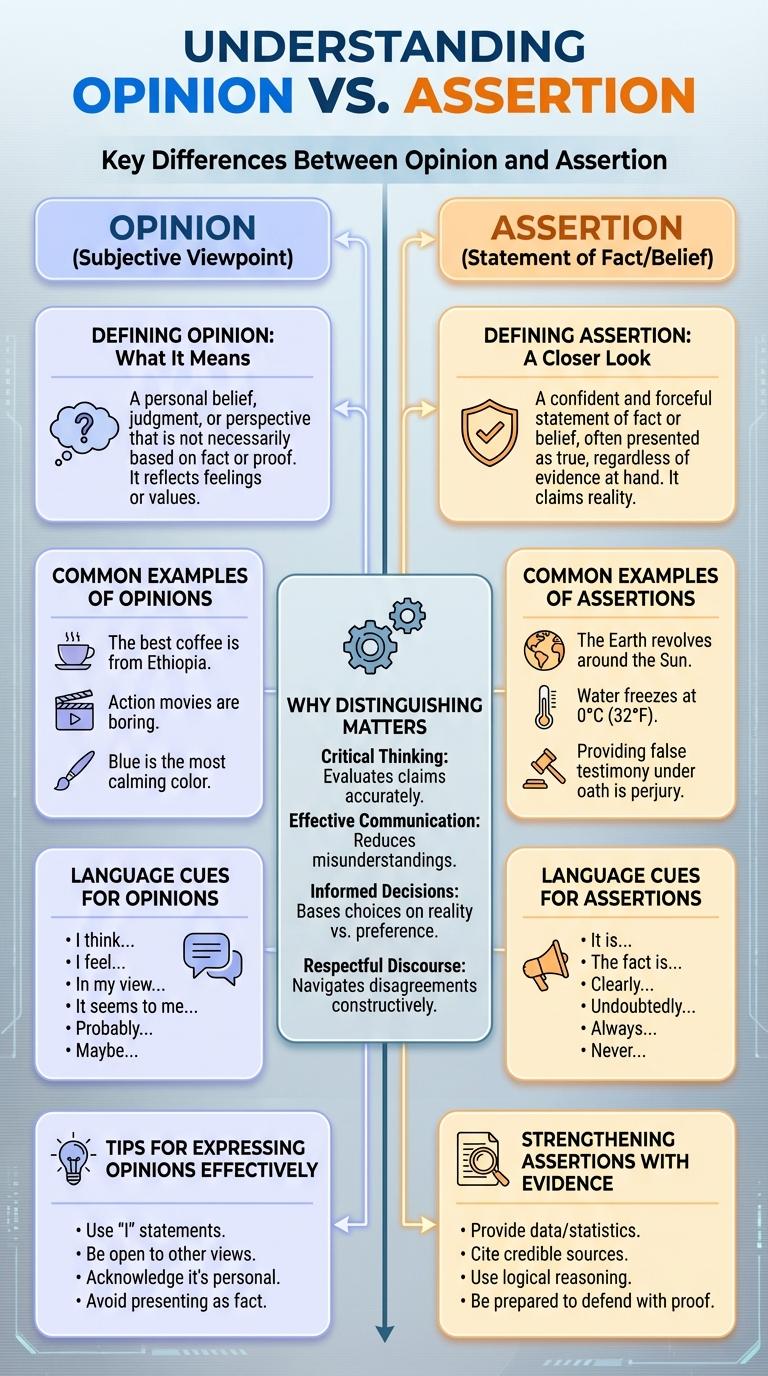
Opinions express personal beliefs or feelings, while assertions state facts or claims presented as true. Understanding the difference between opinion and assertion helps in evaluating information critically. Clear distinction improves communication and argumentation skills.
Understanding Opinion vs. Assertion
What is the difference between an opinion and an assertion?
An opinion reflects a person's beliefs or feelings, which can be subjective and vary from one individual to another. An assertion is a confident and forceful statement of fact or belief that claims to be true.
How can you identify an opinion in communication?
Opinions often include words like "I believe," "I think," or express personal preferences and feelings. These statements cannot be proven true or false objectively.
What defines an assertion in a statement?
An assertion presents information as a fact, often without providing evidence or support. It aims to convince the listener or reader of its truthfulness.
Why is distinguishing between opinion and assertion important?
Recognizing the difference helps in critical thinking and evaluating arguments effectively. It allows individuals to question unsupported claims and value personal perspectives appropriately.
Can opinions become assertions?
When opinions are stated confidently as facts without evidence, they take the form of assertions. Understanding this helps prevent misinformation and promotes clear communication.
Key Differences Between Opinion and Assertion
Understanding the key differences between opinion and assertion is crucial for effective communication. Both terms relate to expressing beliefs but vary in evidence and presentation.
- Definition - An opinion reflects personal beliefs or feelings without the necessity of proof.
- Evidence - An assertion is a confident statement presented as fact, often supported by evidence.
- Purpose - Opinions aim to express viewpoints, while assertions seek to establish truth or persuade.
Recognizing these distinctions enhances critical thinking and clarity in discussions.
Defining Opinion: What It Means
Opinions express personal beliefs, feelings, or thoughts that may vary between individuals. They reflect subjective views rather than objective facts.
- Subjectivity - Opinions are based on personal perspectives and experiences.
- Non-verifiability - Opinions cannot be proven true or false through evidence.
- Expression - Opinions are communicated through statements reflecting individual viewpoints.
Defining Assertion: A Closer Look
An assertion is a confident and forceful statement of fact or belief. It expresses a clear point of view without necessarily providing immediate evidence. Understanding assertions helps distinguish between mere opinions and strong, declarative claims.
Common Examples of Opinions
Opinions express personal beliefs or feelings and cannot be proven true or false. Common examples include preferences in food, movies, or music. Statements like "Chocolate is the best ice cream flavor" reflect subjective opinions.
Common Examples of Assertions
Assertions are statements that declare something to be true without requiring immediate proof. They express confidence and are often used to persuade or inform.
Common examples of assertions include opinions, beliefs, and factual claims. These statements convey a strong point of view or an accepted truth.
Language Cues for Opinions and Assertions
Opinions express personal beliefs, feelings, or thoughts, often indicated by words like "I think," "believe," or "feel." Assertions present statements as facts, using language that suggests certainty or evidence, such as "is," "are," or "proved."
Language cues for opinions include modal verbs like "might," "could," and phrases like "in my view" or "it seems." Assertions rely on definitive verbs and phrases like "shows," "demonstrates," or "has been confirmed."
Why Distinguishing Matters
| Aspect | Why Distinguishing Matters |
|---|---|
| Definition | Opinion expresses personal beliefs; assertion declares statements as facts. |
| Clarity | Differentiating helps in understanding the intention behind statements accurately. |
| Critical Thinking | Recognizing opinions versus assertions supports deeper analysis and evaluation. |
| Communication | Clear identification improves effective dialogue and reduces misunderstandings. |
| Decision Making | Aids in making informed choices based on evidence rather than subjective views. |
Strengthening Assertions with Evidence
Assertions express a clear viewpoint or claim, but their impact depends on the strength of supporting evidence. Opinions become persuasive when reinforced by relevant facts, data, or examples.
Providing credible evidence strengthens assertions by adding validity and depth. Facts, statistics, and expert testimony create trust and convince audiences effectively. Without evidence, assertions risk being perceived as mere opinions or assumptions.