
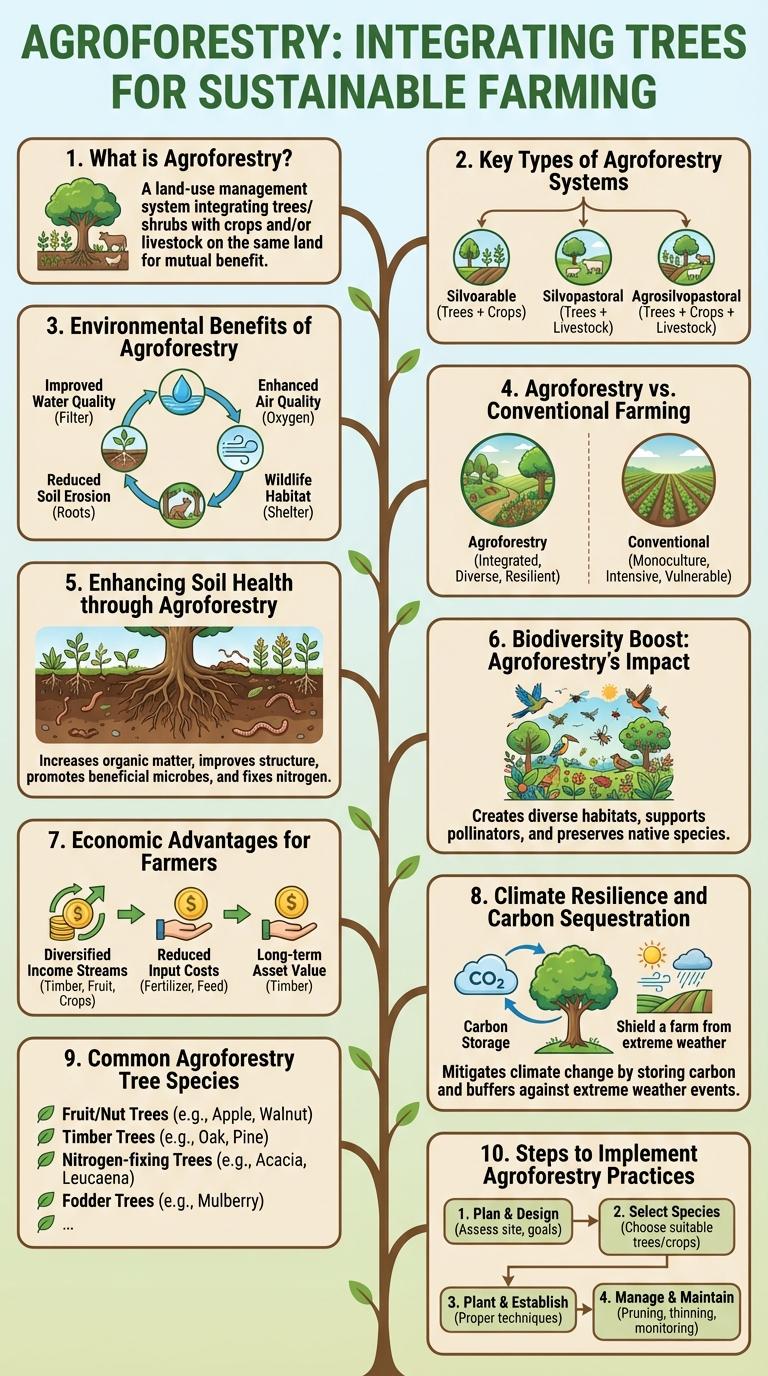
Agroforestry integrates trees and shrubs with crops and livestock to create sustainable and productive land-use systems. This approach enhances biodiversity, improves soil health, and increases resilience against climate change. The infographic highlights key benefits, practices, and environmental impacts of agroforestry.
What is Agroforestry?
What is agroforestry?
Agroforestry is a land management system that combines trees and shrubs with crops or livestock. This practice enhances biodiversity, improves soil health, and increases agricultural productivity.
Key Types of Agroforestry Systems
Agroforestry integrates trees and shrubs into agricultural landscapes to enhance biodiversity, productivity, and sustainability. This approach supports soil health, water management, and climate resilience in farming systems.
- Alley Cropping - Crop rows are planted between rows of trees to optimize land productivity and improve soil quality.
- Silvopasture - Trees are combined with livestock grazing, providing shade and shelter while maintaining pasture health.
- Forest Farming - Cultivation of high-value understory crops under a managed forest canopy supports biodiversity and income diversification.
- Windbreaks - Rows of trees or shrubs are planted to protect crops and soil from wind erosion and reduce evapotranspiration.
- Riparian Buffers - Vegetated areas near water bodies that filter runoff, stabilize banks, and enhance aquatic ecosystem health.
Environmental Benefits of Agroforestry
Agroforestry integrates trees and shrubs into agricultural landscapes, enhancing biodiversity and improving soil health. This system reduces erosion and increases water retention, promoting sustainable land use.
Trees in agroforestry act as carbon sinks, helping to mitigate climate change by absorbing CO2. The diverse plant species support wildlife habitats and contribute to cleaner air and water quality.
Agroforestry vs. Conventional Farming
Agroforestry integrates trees and shrubs into conventional farming systems, enhancing biodiversity and soil health. Conventional farming typically focuses on monoculture crops, which can lead to soil degradation and reduced ecosystem resilience. Agroforestry improves water retention, carbon sequestration, and provides diversified income sources compared to traditional methods.
Enhancing Soil Health through Agroforestry
Agroforestry integrates trees and shrubs into farming systems, significantly improving soil structure and fertility. Tree roots enhance nutrient cycling by fixing nitrogen and increasing organic matter content, leading to healthier, more resilient soils. This practice also reduces erosion and promotes water retention, supporting sustainable agricultural productivity.
Biodiversity Boost: Agroforestry's Impact
| Aspect | Impact on Biodiversity |
|---|---|
| Habitat Diversity | Creates layered vegetation, supporting diverse wildlife species |
| Soil Health | Enhances soil microbes and nutrient cycling, promoting plant diversity |
| Pollinators | Provides food and shelter, increasing pollinator populations |
| Wildlife Corridors | Connects fragmented habitats, allowing safe species movement |
| Carbon Sequestration | Supports tree growth, improving ecosystem resilience and species variety |
Economic Advantages for Farmers
Agroforestry integrates trees and shrubs into farmland, creating diverse income streams for farmers. This practice enhances economic resilience by combining agricultural and forestry products.
Farmers benefit from improved crop yields due to better soil quality and microclimates. Diversified products such as fruits, timber, and fodder provide multiple revenue sources. Reduced dependency on external inputs lowers overall farming costs, increasing profitability over time.
Climate Resilience and Carbon Sequestration
Agroforestry integrates trees and shrubs into agricultural landscapes, enhancing climate resilience and promoting carbon sequestration. This sustainable land use system supports biodiversity while mitigating climate change impacts.
Climate resilience and carbon sequestration in agroforestry contribute to healthier ecosystems and mitigate global warming effects.
- Carbon Storage - Trees in agroforestry systems capture atmospheric CO2, storing it in biomass and soil for long periods.
- Soil Health Improvement - Deep root systems enhance soil structure, increase organic matter, and reduce erosion, boosting resilience to extreme weather.
- Microclimate Regulation - Vegetation cover moderates temperature, conserves moisture, and protects crops from harsh climatic conditions.
Common Agroforestry Tree Species
Agroforestry integrates trees and shrubs into agricultural landscapes to enhance productivity and sustainability. Selecting appropriate tree species is crucial for maximizing ecological and economic benefits.
- Gliricidia sepium - A nitrogen-fixing tree that improves soil fertility and provides shade for crops.
- Leucaena leucocephala - Fast-growing species used for fodder, green manure, and firewood.
- Moringa oleifera - Known as the "drumstick tree," it offers nutritious leaves and grows well in diverse conditions.
- Acacia senegal - Source of gum arabic, it enhances soil quality and supports local economies.
- Albizia procera - Provides timber, fodder, and helps in nitrogen fixation to boost crop yields.
These tree species are widely adopted in agroforestry systems for their multifunctional benefits to farmers and the environment.