
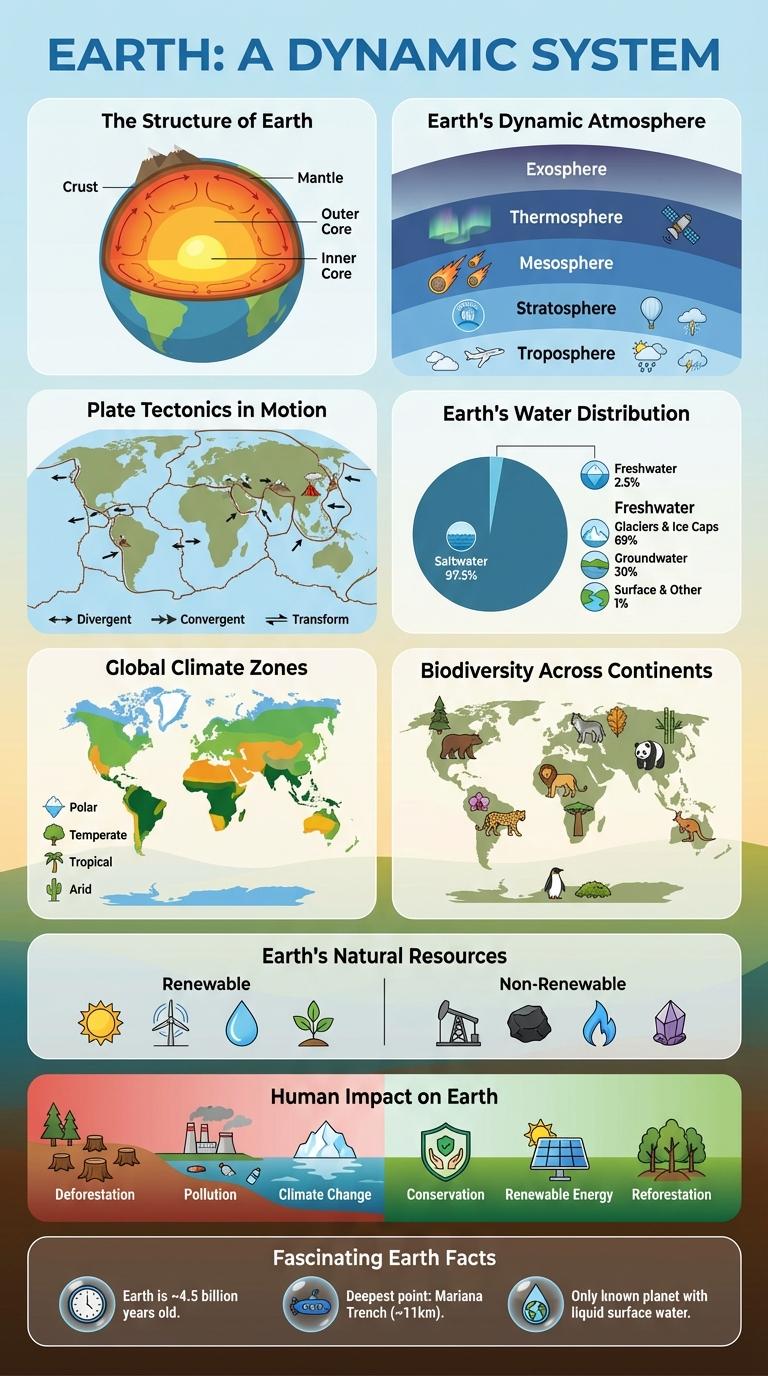
The infographic presents a detailed visual representation of Earth's key features, including its structure, climate zones, and biodiversity. It highlights critical data on geographical distribution, natural resources, and environmental challenges faced by the planet. The design uses clear icons and color-coded sections to enhance comprehension of Earth's complex systems.
The Structure of Earth
The Earth is composed of three main layers: the crust, the mantle, and the core. The crust is the thin, outermost layer that supports all life and varies in thickness. Beneath the crust lies the mantle, a thick layer of semi-solid rock, followed by the core, which consists of a liquid outer core and a solid inner core, both primarily made of iron and nickel.
Layers Beneath Our Feet
The Earth is composed of distinct layers that vary in composition, temperature, and density. These layers lie beneath our feet, extending from the crust down to the core.
The crust is the thin, outermost layer where we live, followed by the thick mantle made of semi-solid rock. Beneath the mantle lie the outer core, a liquid layer, and the solid inner core at the center of the Earth.
Earth's Dynamic Atmosphere
Earth's atmosphere is a complex layer of gases surrounding the planet, vital for sustaining life. It constantly changes due to interactions between solar energy, surface conditions, and human activities.
- Composition of Atmosphere - Composed mainly of nitrogen (78%) and oxygen (21%), with trace amounts of other gases like argon and carbon dioxide.
- Weather Systems - Driven by temperature differences, resulting in wind, storms, and precipitation patterns worldwide.
- Atmospheric Layers - Comprised of the troposphere, stratosphere, mesosphere, thermosphere, and exosphere, each with unique properties and functions.
The dynamic atmosphere regulates Earth's climate and protects life from harmful solar radiation.
Plate Tectonics in Motion
Earth's surface is divided into several large and small tectonic plates that constantly move. The motion of these plates shapes the planet's geology and causes phenomena such as earthquakes and volcanic activity.
- Plate Boundaries - Tectonic plates interact at boundaries classified as divergent, convergent, or transform, influencing the formation of mountains, ocean trenches, and fault lines.
- Continental Drift - The gradual movement of continents over millions of years results from tectonic plate motion, explaining the current distribution of continents and fossils.
- Seafloor Spreading - New oceanic crust forms at mid-ocean ridges as plates pull apart, driving the expansion of ocean basins and recycling Earth's lithosphere.
Earth's Water Distribution
Earth's water is distributed unevenly across various reservoirs, with the majority held in the oceans. Freshwater constitutes a small fraction, primarily locked in glaciers and underground aquifers.
Understanding water distribution is essential for managing Earth's vital freshwater resources effectively.
- Oceans - Contain about 97.5% of Earth's total water, making them the largest water reservoir.
- Glaciers and Ice Caps - Hold approximately 68.7% of the planet's freshwater, mostly in polar regions.
- Groundwater - Accounts for nearly 30.1% of freshwater, stored in underground aquifers worldwide.
Global Climate Zones
The Earth is divided into several global climate zones that influence weather patterns and ecosystems worldwide. These zones include Tropical, Dry, Temperate, Continental, and Polar, each characterized by distinct temperature ranges and precipitation levels. Understanding these climate zones is essential for studying biodiversity, agriculture, and climate change impacts.
Biodiversity Across Continents
How is biodiversity distributed across different continents? Biodiversity varies significantly, with tropical regions like South America and Africa hosting the highest number of species due to their warm climates and dense rainforests. Continents such as Australia and Asia also display unique biodiversity, featuring many endemic species found nowhere else on Earth.
Earth's Natural Resources
Earth is rich in natural resources essential for life and economic development. These resources include water, minerals, forests, and fossil fuels.
Water covers about 71% of Earth's surface, supporting marine life and human needs. Minerals such as iron, copper, and gold provide materials for technology and construction. Forests act as carbon sinks and supply timber, while fossil fuels like coal and oil are vital energy sources but contribute to environmental challenges.
Human Impact on Earth
| Aspect | Impact on Earth |
|---|---|
| Deforestation | Approximately 10 million hectares of forest lost annually, leading to habitat destruction and increased carbon emissions |
| Greenhouse Gas Emissions | Human activities contribute over 36 billion metric tons of CO2 annually, causing global warming and climate change |
| Pollution | Over 8 million tons of plastic waste enters oceans yearly, harming marine life and ecosystems |
| Land Use Change | Urbanization and agriculture transform over 50% of Earth's land surface, impacting biodiversity and natural habitats |
| Water Usage | Humans withdraw about 4,000 cubic kilometers of freshwater yearly, stressing freshwater resources |