
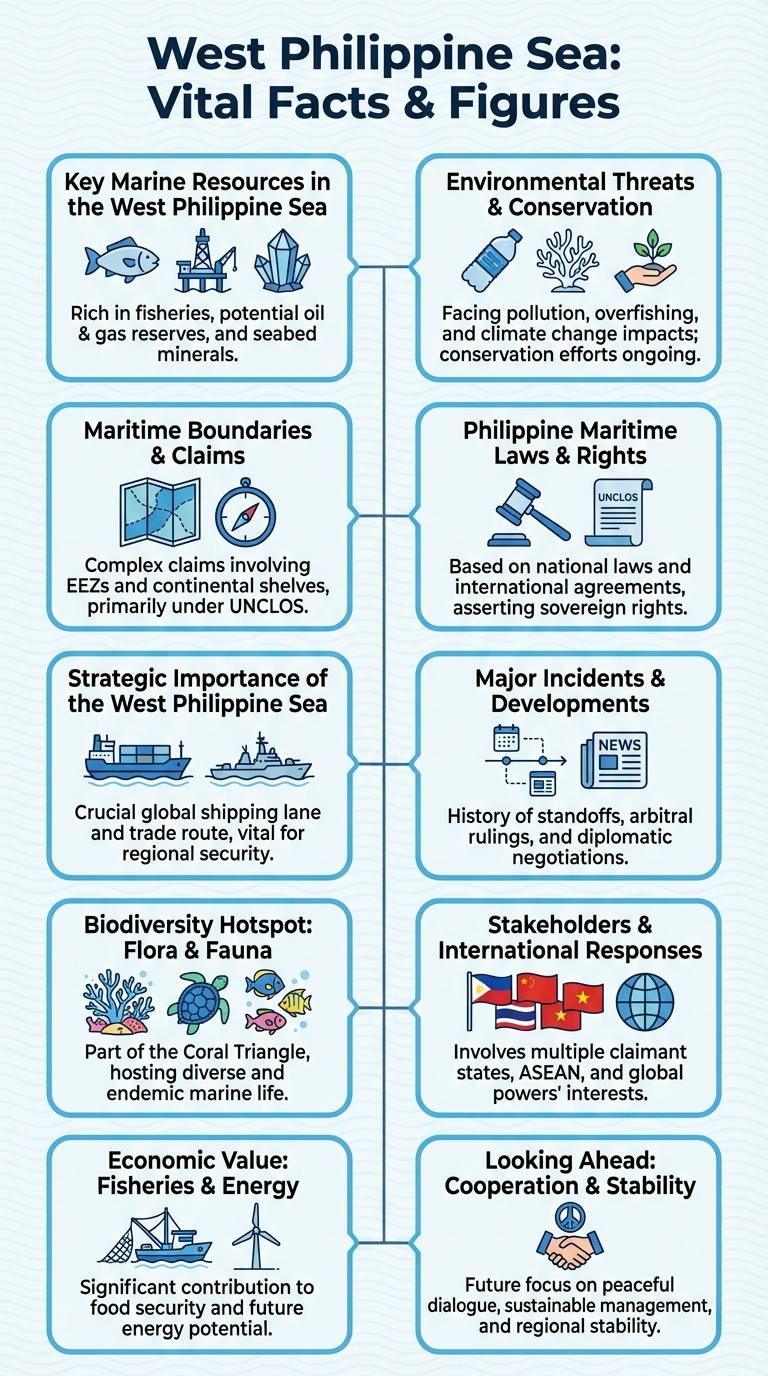
The West Philippine Sea is a crucial maritime area rich in natural resources and strategic importance. It features diverse marine ecosystems, vital shipping routes, and contested territories with significant geopolitical implications. Understanding this region is essential for appreciating its environmental, economic, and security challenges.
West Philippine Sea: Vital Facts & Figures
The West Philippine Sea is a significant maritime region within the South China Sea, rich in natural resources and strategic importance. It plays a crucial role in the Philippines' economy, security, and biodiversity.
The area is subject to overlapping territorial claims, making it a focal point in regional geopolitics and international law.
- Geographical Size - Encompasses approximately 260,000 square kilometers of water within the Philippine Exclusive Economic Zone.
- Marine Biodiversity - Home to over 3,000 species of marine life, supporting fisheries and ecological diversity.
- Economic Value - Estimated to contain vast reserves of oil and natural gas, crucial for the Philippines' energy security.
- Strategic Location - Located along major global shipping routes, pivotal for international trade and naval operations.
- Legal Framework - The United Nations Convention on the Law of the Sea (UNCLOS) supports the Philippines' claims under international law.
Key Marine Resources in the West Philippine Sea
The West Philippine Sea is rich in diverse marine resources vital for the country's economy and biodiversity. These resources support fisheries, energy potential, and ecological balance in the region.
- Fisheries Resources - The area hosts abundant fish species such as tuna, mackerel, and sardines, supporting local fishing industries and food security.
- Coral Reefs - Extensive coral reef systems provide habitat for marine life and protect coastlines from erosion.
- Natural Gas Reserves - Submarine natural gas fields in the West Philippine Sea offer significant energy prospects for the Philippines.
- Seaweed and Algae - Seaweed farming thrives in the region, contributing to local livelihoods and export markets.
- Marine Biodiversity - The Sea sustains a variety of marine mammals, mollusks, and crustaceans essential for ecological health and tourism.
Maritime Boundaries & Claims
| Maritime Boundary | Claims Overview |
|---|---|
| Defined by the United Nations Convention on the Law of the Sea (UNCLOS), Exclusive Economic Zone (EEZ) extends 200 nautical miles from the Philippine baseline. | The Philippines asserts sovereignty over parts of the West Philippine Sea, specifically in areas within its EEZ and continental shelf. |
| Territorial Sea extends up to 12 nautical miles from the baseline, granting the Philippines sovereignty over waters adjacent to its coasts and islands. | China claims almost the entire South China Sea, including the West Philippine Sea, using the "Nine-Dash Line," which overlaps Philippine EEZ zones. |
| The Philippines claims control over the Kalayaan Island Group, including several features recognized as part of its territory. | Other claimant countries include Vietnam, Malaysia, Brunei, and Taiwan, each with overlapping claims to parts of the West Philippine Sea. |
| The Permanent Court of Arbitration ruled in 2016 that China's Nine-Dash Line has no legal basis under international law, affirming the Philippines' maritime entitlements. | Despite the ruling, China's continued activities such as land reclamation and military presence affect the region's security and Philippine claims. |
Strategic Importance of the West Philippine Sea
The West Philippine Sea is a vital maritime region rich in natural resources and strategic military importance. It serves as a critical passageway for international shipping and regional geopolitical influence.
- Energy Resources - The area contains abundant oil and natural gas reserves essential for energy security.
- Fishing Grounds - The sea supports the livelihoods of millions through its rich fisheries and marine biodiversity.
- Geopolitical Position - Its location is key for naval dominance and securing trade routes in Southeast Asia.
Control and sustainable management of the West Philippine Sea are crucial for national security and regional stability.
Biodiversity Hotspot: Flora & Fauna
The West Philippine Sea is a vital biodiversity hotspot, home to a vast array of unique flora and fauna. Its coral reefs, mangroves, and seagrass beds support diverse marine life, making it an ecological treasure.
Endemic species such as the giant clams, hawksbill turtles, and various reef fish thrive in this region. Conservation efforts focus on protecting these habitats to sustain the rich biological diversity essential for environmental health and local livelihoods.
Economic Value: Fisheries & Energy
The West Philippine Sea is a critical area rich in marine biodiversity, supporting a thriving fisheries industry essential to the local economy. It holds vast untapped potential for energy resources, including natural gas and oil deposits.
Fisheries in the West Philippine Sea contribute significantly to food security and livelihoods for millions of Filipinos. The region is estimated to produce over 2 million metric tons of fish annually, sustaining both domestic consumption and export markets. Energy exploration efforts focus on the Reed Bank area, which is believed to contain substantial natural gas reserves worth billions of dollars.
Environmental Threats & Conservation
What are the major environmental threats facing the West Philippine Sea?
The West Philippine Sea faces significant environmental threats including marine pollution, overfishing, and habitat destruction. These issues severely impact biodiversity and the sustainability of marine resources.
How does marine pollution affect the West Philippine Sea's ecosystem?
Marine pollution from plastic waste, oil spills, and chemical runoff contaminates the water, harming fish and coral reefs. This disrupts the food chain and endangers marine species dependent on the sea.
What role does overfishing play in the environmental decline of the West Philippine Sea?
Overfishing depletes key fish populations, threatening the balance of marine ecosystems and the livelihoods of local communities. Illegal, unreported, and unregulated fishing further exacerbates this problem.
How is habitat destruction impacting biodiversity in the West Philippine Sea?
Destruction of coral reefs and mangroves due to coastal development and destructive fishing practices reduces habitats for numerous marine species. This loss diminishes species richness and weakens ecological resilience.
What conservation efforts are in place to protect the West Philippine Sea?
Conservation programs focus on marine protected areas, sustainable fishing regulations, and pollution control initiatives. Collaboration between government agencies, local communities, and environmental organizations is critical for effective conservation.
Philippine Maritime Laws & Rights
The West Philippine Sea is a vital area governed by the Philippines' maritime laws, including the Philippine Archipelago Baselines Law and the Republic Act No. 9522, which define the country's territorial waters and exclusive economic zone (EEZ). The United Nations Convention on the Law of the Sea (UNCLOS) supports the Philippines' sovereign rights over resources within its EEZ, extending 200 nautical miles from the baseline. Philippine maritime rights emphasize protection of marine resources, enforcement of fishing regulations, and sovereignty over natural resources in the West Philippine Sea.
Major Incidents & Developments
The West Philippine Sea has been a hotspot for geopolitical tensions due to overlapping territorial claims primarily involving the Philippines, China, and other Southeast Asian nations. Major incidents include the 2012 Scarborough Shoal standoff between Philippine and Chinese vessels, escalating regional disputes.
In 2016, the Permanent Court of Arbitration ruled in favor of the Philippines, invalidating China's extensive claims based on the "nine-dash line." Recent developments emphasize ongoing militarization and resource exploration, heightening the need for diplomatic resolutions.