
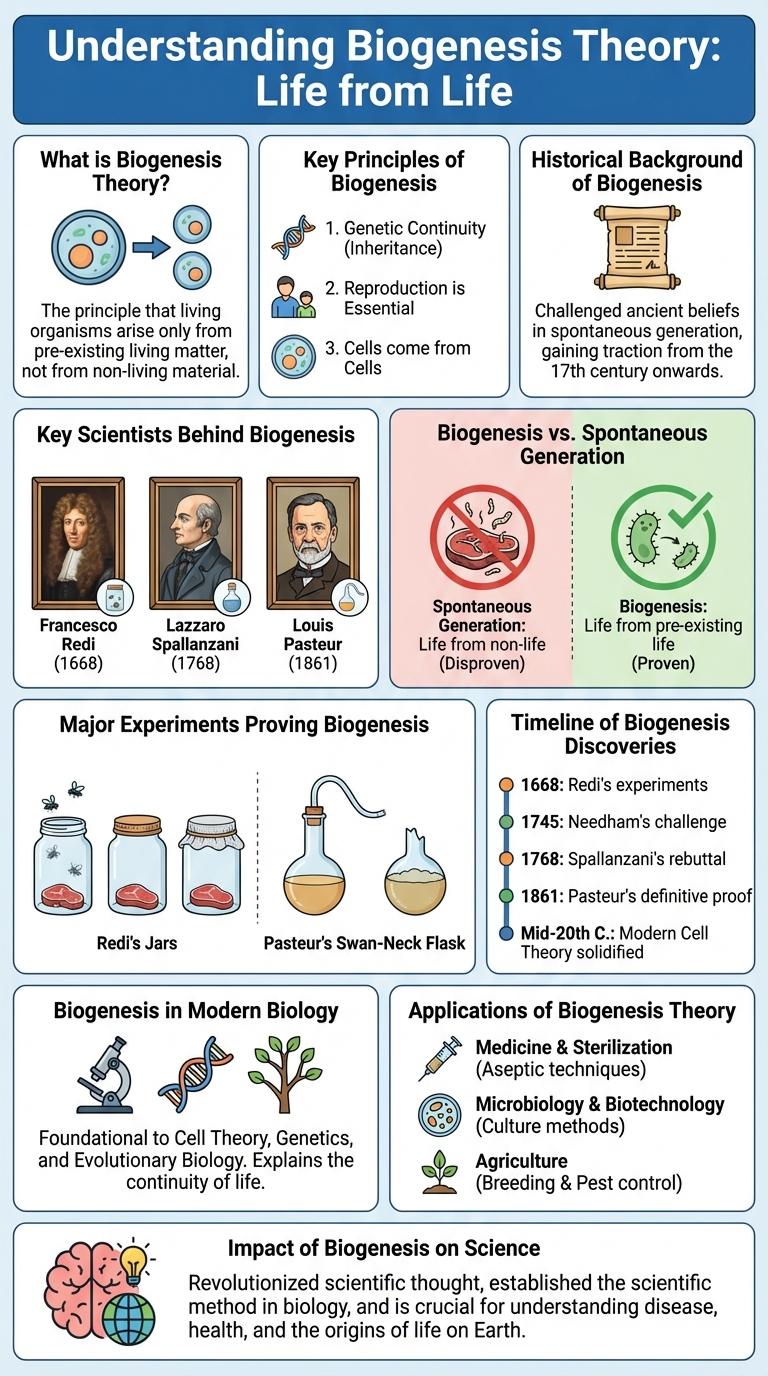
Biogenesis theory explains that living organisms arise only from pre-existing life, rejecting the idea of spontaneous generation. This fundamental concept underscores the continuity of life through reproduction and cellular division. Understanding biogenesis is essential for grasping the principles of biology and the origins of life on Earth.
What is Biogenesis Theory?
Biogenesis Theory states that living organisms originate only from pre-existing living organisms. This principle opposes the idea that life can arise spontaneously from non-living matter.
The theory was established through experiments by scientists like Louis Pasteur in the 19th century. It forms a foundational concept in biology, emphasizing the continuity of life through reproduction.
Key Principles of Biogenesis
What is the foundational concept behind the biogenesis theory? Biogenesis states that all living organisms originate from pre-existing living cells, not from non-living matter. This principle challenged earlier beliefs in spontaneous generation.
What are the key principles of biogenesis? The theory emphasizes that life arises only from existing life, cells are the basic unit of life, and all cellular functions are inherited from parent cells. These principles are fundamental to modern biology and microbiology.
How did scientific experiments support the biogenesis theory? Louis Pasteur's experiments demonstrated that sterilized broth remained free of microbial life unless exposed to existing microorganisms. This confirmed that life does not spontaneously arise from non-living material.
What role does cell division play in biogenesis? Cells reproduce through processes like mitosis and meiosis to generate new cells, ensuring continuity of life. This cellular replication is a core concept supporting biogenesis.
Why is biogenesis important in understanding life? It explains the origins and reproduction of life forms, helping to guide research in genetics, evolution, and medicine. Biogenesis remains a foundational principle in life sciences.
Historical Background of Biogenesis
The biogenesis theory, which states that living organisms arise only from pre-existing life, was first proposed in the 17th century by Francesco Redi through experiments disproving spontaneous generation. In the 19th century, Louis Pasteur's swan-neck flask experiments provided conclusive evidence supporting biogenesis. This theory laid the foundation for modern microbiology and the understanding of life's origins.
Key Scientists Behind Biogenesis
The biogenesis theory states that living organisms arise only from pre-existing living cells. Key scientists behind this theory include Louis Pasteur, who disproved spontaneous generation through his swan-neck flask experiment. Other notable contributors are Rudolf Virchow, who proposed "Omnis cellula e cellula," meaning all cells come from cells, and Robert Remak, who provided evidence for cell division.
Biogenesis vs. Spontaneous Generation
The biogenesis theory states that living organisms arise only from pre-existing living organisms. It directly opposes the spontaneous generation theory, which posits that life can emerge from non-living matter.
- Biogenesis Theory - Life originates exclusively from existing life through reproduction.
- Spontaneous Generation - Life can arise spontaneously from inanimate objects or organic decay.
- Louis Pasteur's Experiment - Demonstrated that sterilized broth exposed to air did not produce life, supporting biogenesis.
Scientific evidence overwhelmingly supports biogenesis as the source of all life on Earth.
Major Experiments Proving Biogenesis
The biogenesis theory states that life originates from existing life, not from non-living matter. This concept opposed the earlier theory of spontaneous generation.
- Francesco Redi's Experiment - Demonstrated that maggots on meat came from eggs laid by flies, disproving spontaneous generation for larger organisms.
- Lazzaro Spallanzani's Experiment - Showed that boiling broth prevented microbial growth, indicating microbes did not arise spontaneously.
- Louis Pasteur's Swan Neck Flask Experiment - Confirmed that sterile broth remained free of microbes unless exposed to preexisting microorganisms, solidifying biogenesis theory.
Timeline of Biogenesis Discoveries
The biogenesis theory states that living organisms arise only from pre-existing living organisms. This idea contrasts with the earlier belief in spontaneous generation, where life was thought to emerge from non-living matter.
In 1668, Francesco Redi conducted experiments that challenged spontaneous generation by showing that maggots on decaying meat came from flies. Later, Louis Pasteur's 1861 swan-neck flask experiment provided strong evidence that microorganisms come from other microorganisms, solidifying the biogenesis theory.
Biogenesis in Modern Biology
Biogenesis theory states that all living organisms arise from pre-existing life. This principle is fundamental to modern biology and contrasts with the outdated theory of spontaneous generation.
Biogenesis emphasizes that cells and organisms originate only through reproduction by other living cells. This concept supports the continuity of life and underpins research in cell biology, genetics, and microbiology. Experimental evidence, such as Louis Pasteur's work, confirmed that life does not spontaneously arise from nonliving matter.
Applications of Biogenesis Theory
| Applications of Biogenesis Theory | Description |
|---|---|
| Medical Microbiology | Supports understanding that pathogens arise from existing microorganisms, guiding infection control and sterilization practices. |
| Pharmaceutical Development | Enables growth of microorganisms for antibiotic production, vaccines, and biotechnology products based on living cell cultures. |
| Food Industry | Biogenesis principles used in fermentation and ensuring food safety by controlling microbial contamination. |
| Cell Culture Techniques | Foundation for laboratory methods allowing the propagation of cells for research, diagnostics, and regenerative medicine. |
| Environmental Microbiology | Helps in biodegradation and bioremediation by utilizing living organisms to break down pollutants and recycle nutrients. |