
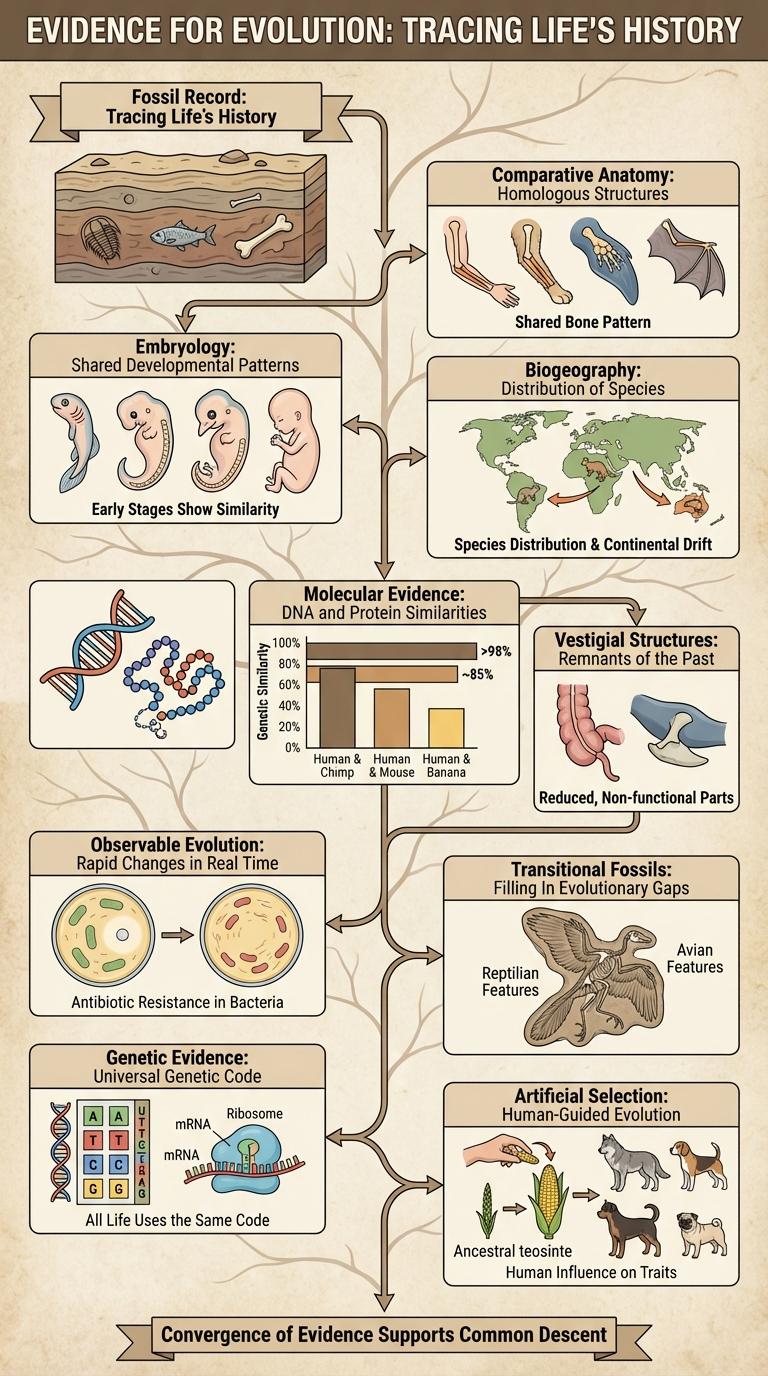
Evidence of evolution is revealed through fossil records, genetic similarities, and observable changes in species over time. Comparative anatomy shows how different organisms share common structures, indicating shared ancestry. Molecular biology further confirms evolutionary relationships by tracing DNA sequences across diverse species.
Fossil Record: Tracing Life's History
| Fossil Record Aspect | Key Evidence |
|---|---|
| Transitional Fossils | Show intermediate traits linking ancient species to modern ones (e.g., Archaeopteryx between dinosaurs and birds) |
| Stratification | Older fossils found in deeper rock layers; younger fossils in upper layers support chronological evolution |
| Homologous Structures | Similar bone structures in different species suggest common ancestry documented in fossils |
| Extinct Species | Fossils of species no longer existing demonstrate species change and extinction over time |
| Radiometric Dating | Determines fossil ages, confirming timelines of evolutionary events spanning millions of years |
Comparative Anatomy: Homologous Structures
What are homologous structures in comparative anatomy? Homologous structures are body parts in different species that share a common ancestral origin despite their diverse functions. These similarities provide strong evidence of evolutionary relationships among species.
How do homologous structures support the theory of evolution? They demonstrate how species have diverged from a common ancestor through adaptive changes over time. Examples include the forelimbs of humans, whales, and bats, all containing similar bone structures adapted for different uses.
| Species | Homologous Structure |
|---|---|
| Human | Forelimb (arm bones) |
| Whale | Forelimb (flipper bones) |
| Bat | Forelimb (wing bones) |
| Cat | Forelimb (paw bones) |
Embryology: Shared Developmental Patterns
Embryology provides crucial evidence for evolution by revealing shared developmental patterns among different species. These similarities suggest common ancestry and evolutionary relationships.
- Pharyngeal Arches - Embryos of vertebrates develop pharyngeal arches, structures that give rise to different organs, indicating a shared evolutionary origin.
- Tail Formation - Many vertebrate embryos temporarily form tails during development, showing a common ancestral trait even if the tail is lost in adults.
- Limb Buds - Early limb buds appear in similar locations and stages across vertebrate embryos, reflecting inherited developmental pathways.
Biogeography: Distribution of Species
Biogeography studies the geographic distribution of species across the planet, revealing patterns that support evolutionary theory. Species found on isolated islands often resemble those on the nearest mainland, indicating a common ancestry.
For example, unique species of finches in the Galapagos Islands have evolved from a common ancestor, adapting to different ecological niches. This distribution pattern provides strong evidence for natural selection and speciation driven by geographic isolation.
Molecular Evidence: DNA and Protein Similarities
Molecular evidence for evolution is found in the similarities of DNA and proteins among different species. These similarities indicate a common ancestry and the gradual changes that occur over time.
DNA sequences of closely related species show high levels of similarity, reflecting inherited genetic material. Proteins, made up of amino acids coded by DNA, also reveal evolutionary links by exhibiting comparable structures and functions. Comparing molecular data helps scientists trace evolutionary pathways and understand how species diverged.
Vestigial Structures: Remnants of the Past
Vestigial structures are anatomical features that have lost their original function through evolution. They serve as evidence of an organism's evolutionary history by revealing remnants of ancestral traits.
- Human Appendix - A small, tube-like structure in the digestive system, once used for digesting cellulose in herbivorous ancestors.
- Pelvic Bones in Whales - Vestigial pelvic bones indicating their descent from land-dwelling mammals with hind limbs.
- Wing Claws in Flightless Birds - Claws on wings of birds like ostriches, reflecting their evolution from flying ancestors.
Vestigial structures provide compelling physical evidence supporting the theory of evolution by natural selection.
Observable Evolution: Rapid Changes in Real Time
Observable evolution provides real-time evidence of species adapting through rapid genetic changes. Scientists document these changes in organisms like bacteria developing antibiotic resistance and insects evolving pesticide resistance. These instances demonstrate evolution occurring within human timescales, confirming the dynamic nature of life adapting to environmental pressures.
Transitional Fossils: Filling In Evolutionary Gaps
Transitional fossils provide crucial evidence connecting ancient and modern species, illustrating evolutionary changes over time. These fossils reveal intermediate traits, bridging gaps in the fossil record and supporting the theory of evolution.
- Archaeopteryx - Displays features of both dinosaurs and birds, highlighting the evolution of flight.
- Tiktaalik - Exhibits characteristics of both fish and early tetrapods, marking the transition from aquatic to terrestrial life.
- Ambulocetus - Shows adaptations between land mammals and whales, illustrating marine mammal evolution.
Genetic Evidence: Universal Genetic Code
All living organisms share the universal genetic code, which is composed of the same nucleotide bases: adenine, thymine, cytosine, and guanine. This consistent genetic language across species supports the theory that all life forms share a common ancestor. The universality of DNA sequences and codon usage provides strong genetic evidence for evolution.