
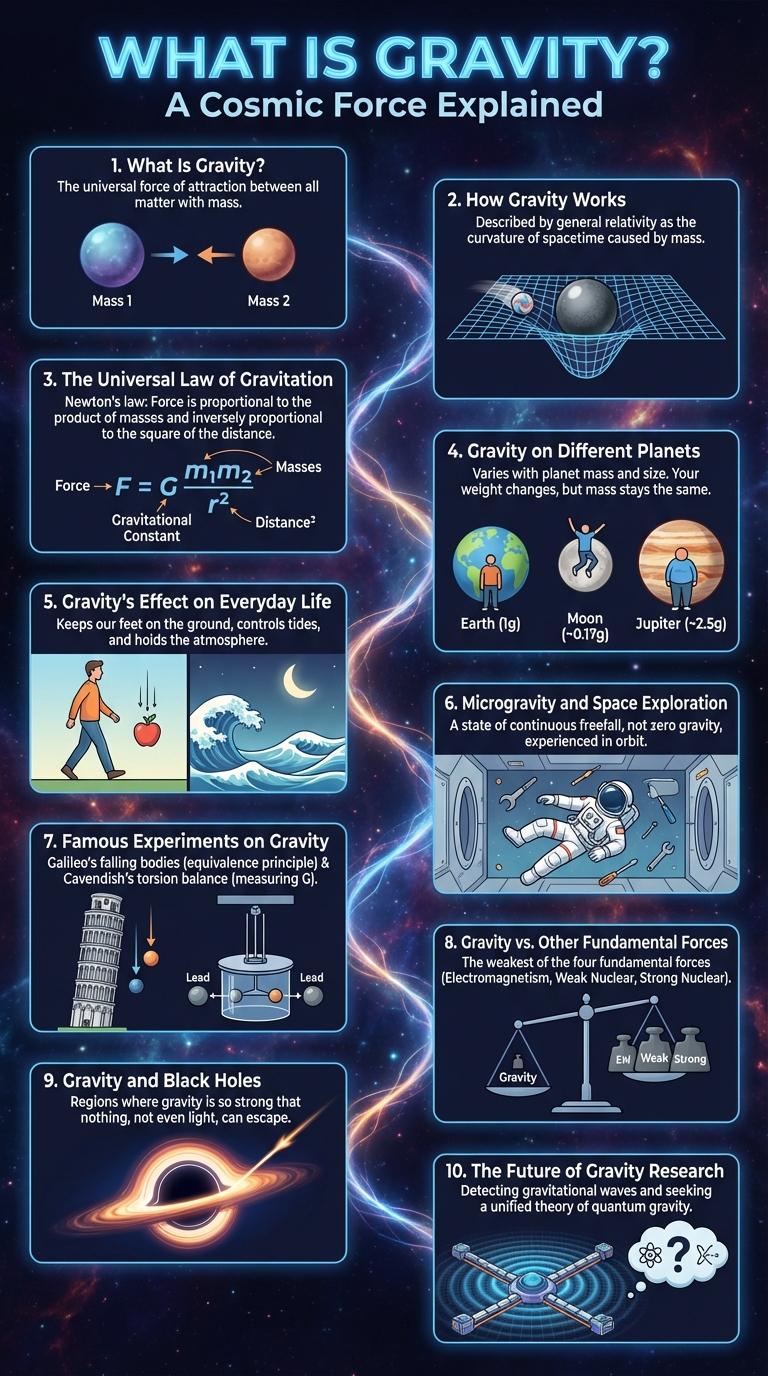
Gravity is a fundamental force that shapes the universe by attracting objects toward each other. It governs the motion of planets, stars, and galaxies, influencing everything from tides on Earth to the orbit of satellites. Understanding gravity helps explain the structure and behavior of celestial bodies and the forces at work in everyday life.
What Is Gravity?
Gravity is a fundamental force that attracts objects with mass toward each other. It governs the motion of planets, stars, and galaxies throughout the universe.
- Newton's Law of Universal Gravitation - States that every mass exerts an attractive force on every other mass proportional to their masses and inversely proportional to the square of the distance between them.
- Einstein's Theory of General Relativity - Describes gravity as the curvature of spacetime caused by mass and energy.
- Gravity's Role on Earth - Keeps objects anchored to the surface and causes rivers to flow downhill.
Gravity affects all matter and energy, shaping the structure and evolution of the cosmos.
How Gravity Works
| Concept | Explanation |
| Gravity | A force that attracts two bodies toward each other, proportional to their masses and inversely proportional to the square of the distance between them. |
| Newton's Law of Universal Gravitation | Every particle attracts every other particle with a force equal to G * (m1 * m2) / r2, where G is the gravitational constant. |
| Gravitational Constant (G) | 6.67430 x 10⁻¹¹ m3 kg-1 s-2, defines the strength of gravity in the equation. |
| Effect on Objects | Gravity causes objects to fall towards Earth and keeps planets in orbit around the sun. |
| Gravity and Space-Time | According to Einstein's theory, gravity results from the curvature of space-time caused by mass and energy. |
The Universal Law of Gravitation
The Universal Law of Gravitation states that every mass attracts every other mass in the universe with a force directly proportional to the product of their masses and inversely proportional to the square of the distance between their centers. This force, known as gravitational force, governs the motion of planets, stars, and galaxies. Sir Isaac Newton formulated this fundamental principle in 1687, revolutionizing our understanding of celestial mechanics.
Gravity on Different Planets
Gravity varies significantly across different planets in our solar system due to variations in mass and radius. This force influences everything from an object's weight to the behavior of the planet's atmosphere.
For example, gravity on Earth is 9.8 m/s2, while on Mars it is only 3.7 m/s2, making objects feel lighter there. Jupiter, being the largest planet, has a gravity of 24.8 m/s2, which is much stronger than Earth's.
| Planet | Surface Gravity (m/s2) |
|---|---|
| Mercury | 3.7 |
| Venus | 8.9 |
| Earth | 9.8 |
| Mars | 3.7 |
| Jupiter | 24.8 |
Gravity's Effect on Everyday Life
Gravity is a fundamental force that pulls objects toward the Earth, influencing everything from walking to water flow. It ensures that we remain grounded and objects fall when dropped.
Gravity affects everyday activities such as drinking, as it pulls liquids downward into our mouths. It also governs natural phenomena like tides, caused by the gravitational pull between the Earth and the Moon.
Microgravity and Space Exploration
Microgravity occurs when gravitational forces are significantly weaker than on Earth, creating an environment of near weightlessness. Space exploration leverages microgravity to conduct scientific experiments impossible under Earth's gravity.
- Microgravity Definition - Microgravity is the condition in which objects appear to be weightless due to minimal gravitational pull.
- International Space Station (ISS) - The ISS provides a unique microgravity laboratory for astronauts to study physical, biological, and chemical processes.
- Scientific Advancements - Space missions use microgravity to develop new materials and medical treatments not feasible under normal gravity.
Famous Experiments on Gravity
Gravity is a fundamental force that attracts objects with mass toward each other. Understanding gravity has been essential in physics and astronomy for centuries.
Isaac Newton's famous apple experiment led to the law of universal gravitation, explaining how objects attract with a force proportional to their masses and inversely proportional to the square of the distance between them. Henry Cavendish measured the gravitational constant in 1798, allowing precise calculation of Earth's mass. More recently, the Gravity Probe B mission tested Einstein's theory of general relativity by measuring spacetime curvature around Earth.
Gravity vs. Other Fundamental Forces
Gravity is one of the four fundamental forces that govern interactions in the universe. It is the weakest but acts over infinite distances, influencing the structure of galaxies and planetary orbits.
- Gravity - The weakest fundamental force with infinite range, responsible for the attraction between masses.
- Electromagnetic Force - A much stronger force acting between charged particles, with infinite range and responsible for electricity, magnetism, and light.
- Strong Nuclear Force - The strongest force, acting only at subatomic distances to bind protons and neutrons in the atomic nucleus.
- Weak Nuclear Force - Responsible for radioactive decay and neutrino interactions, operating at very short ranges inside the nucleus.
Gravity and Black Holes
Gravity is a fundamental force that pulls objects toward one another, governing the motion of planets, stars, and galaxies. Black holes are regions in space where gravity is so intense that nothing, not even light, can escape from them. The immense gravitational pull of black holes warps spacetime, leading to phenomena such as event horizons and gravitational waves.