
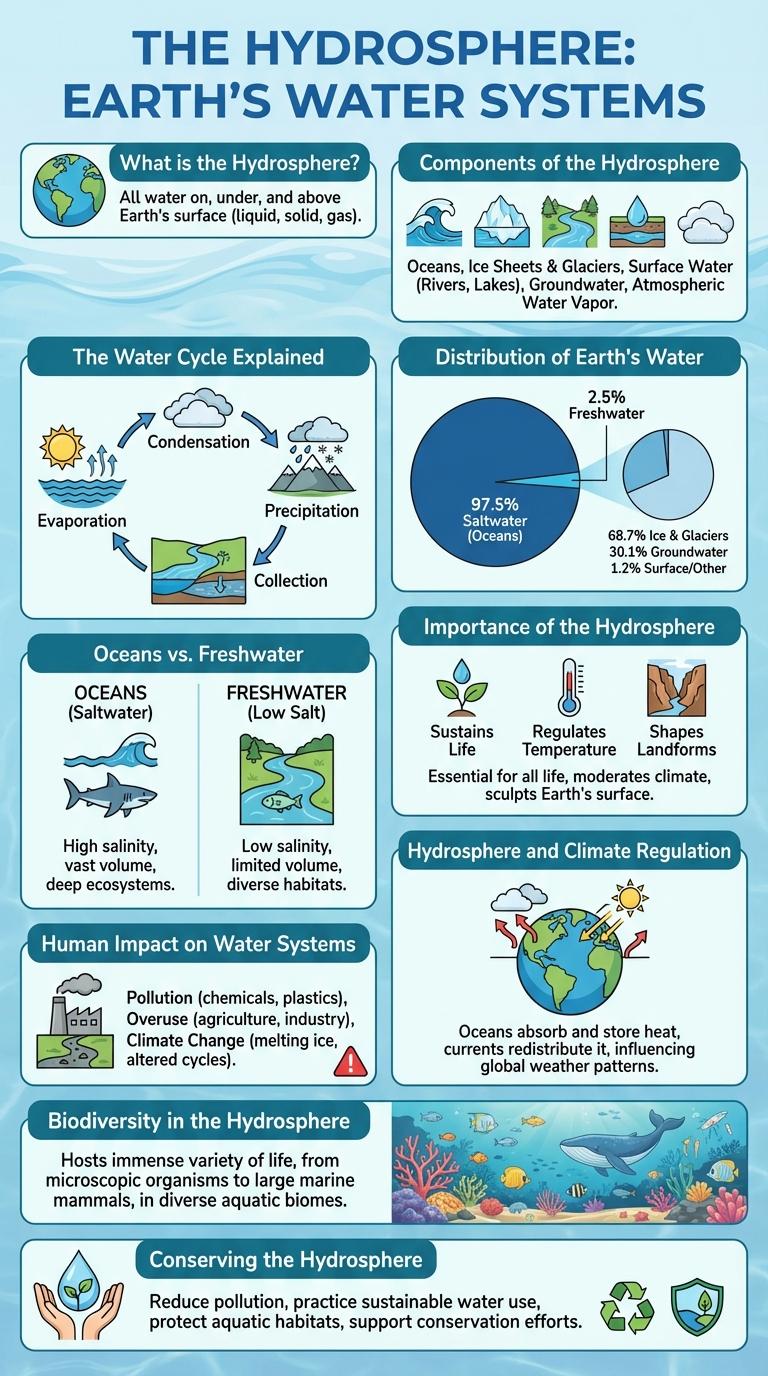
The hydrosphere encompasses all water found on, under, and above the Earth's surface, including oceans, rivers, lakes, glaciers, and atmospheric moisture. This infographic visually represents the distribution, movement, and significance of water within the Earth's system. Understanding the hydrosphere is essential for grasping the planet's climate dynamics, ecosystems, and water resources.
What is the Hydrosphere?
What is the hydrosphere? The hydrosphere encompasses all water found on, under, and above the Earth's surface. It includes oceans, rivers, lakes, glaciers, groundwater, and atmospheric moisture.
Components of the Hydrosphere
The hydrosphere encompasses all water found on, under, and above the Earth's surface. It includes various forms such as liquid, solid, and vapor states of water.
Key components of the hydrosphere include oceans, which cover about 71% of the Earth's surface and contain 97% of the Earth's water. Freshwater sources like rivers, lakes, and glaciers make up a smaller portion but are vital for ecosystems and human consumption. Groundwater stored in aquifers also plays a critical role in sustaining life and maintaining environmental balance.
The Water Cycle Explained
The hydrosphere encompasses all water on Earth, including oceans, rivers, lakes, and underground reservoirs. It plays a crucial role in sustaining life and regulating the planet's climate.
The water cycle describes the continuous movement of water through evaporation, condensation, precipitation, and collection. This cycle ensures the distribution and renewal of Earth's freshwater resources.
Distribution of Earth's Water
The hydrosphere encompasses all water found on, under, and above the Earth's surface. Water distribution is uneven, with most stored in oceans and limited freshwater accessible for human use.
- Oceans - Oceans contain about 97.5% of Earth's total water, making them the largest water reservoir.
- Glaciers and Ice Caps - Approximately 1.74% of Earth's water is locked in glaciers and polar ice, serving as freshwater reserves.
- Groundwater - Groundwater accounts for nearly 1.7% of Earth's water, critical for drinking and agriculture.
- Surface Water - Lakes, rivers, and wetlands hold about 0.3% of Earth's freshwater, essential for ecosystems and human activities.
- Atmosphere - The atmosphere contains a tiny fraction of Earth's water as vapor, influencing climate and weather patterns.
This distribution highlights the scarcity of accessible freshwater despite the abundance of global water resources.
Oceans vs. Freshwater
The hydrosphere encompasses all water on Earth, including oceans and freshwater sources. Oceans cover about 71% of the Earth's surface and contain 97% of the planet's water, making them the largest water reservoir. Freshwater, found in rivers, lakes, and glaciers, accounts for only 3% of Earth's water but is vital for human consumption and ecosystems.
| Feature | Oceans |
|---|---|
| Water Composition | Saline (about 3.5% salt) |
| Water Volume | Approximately 1.35 billion cubic kilometers |
| Surface Coverage | 71% of Earth |
| Biodiversity | Contains a vast range of marine species |
| Feature | Freshwater |
|---|---|
| Water Composition | Low salinity (less than 0.05%) |
| Water Volume | About 35 million cubic kilometers |
| Surface Coverage | Less than 3% of Earth |
| Biodiversity | Supports diverse freshwater organisms |
Importance of the Hydrosphere
The hydrosphere encompasses all water on Earth, crucial for sustaining life and regulating climate. It supports ecosystems, provides drinking water, and enables agriculture and industry. The hydrosphere also plays a vital role in the Earth's water cycle, influencing weather patterns and global temperatures.
Human Impact on Water Systems
The hydrosphere encompasses all water on Earth, vital for sustaining life and maintaining ecological balance. Human activities increasingly alter water systems, affecting water quality and availability globally.
Human impact on water systems includes pollution, overuse, and habitat disruption, leading to significant environmental consequences.
- Water Pollution - Industrial discharge and agricultural runoff introduce harmful substances, contaminating rivers, lakes, and oceans.
- Overextraction of Water - Excessive withdrawal for agriculture, industry, and domestic use depletes groundwater and surface water sources.
- Habitat Destruction - Construction of dams and land development degrade aquatic ecosystems, reducing biodiversity and altering water flow.
Hydrosphere and Climate Regulation
The hydrosphere encompasses all water found on, under, and above the Earth's surface. It plays a crucial role in regulating the planet's climate by distributing heat and moisture globally.
Oceans absorb solar energy and redistribute it through currents, impacting weather patterns and temperature. The hydrosphere also controls carbon dioxide levels, influencing greenhouse gas concentration and climate stability.
Biodiversity in the Hydrosphere
The hydrosphere encompasses all water bodies on Earth, supporting diverse ecosystems and life forms. Biodiversity in the hydrosphere plays a crucial role in maintaining ecological balance and sustaining human livelihoods.
- Marine species diversity - Oceans contain over 230,000 known species, with many more yet to be discovered.
- Freshwater ecosystems - Rivers, lakes, and wetlands house approximately 10% of all known species, including numerous endemic fish and amphibians.
- Coral reef habitats - Coral reefs cover less than 1% of the ocean floor but support around 25% of marine species globally.