
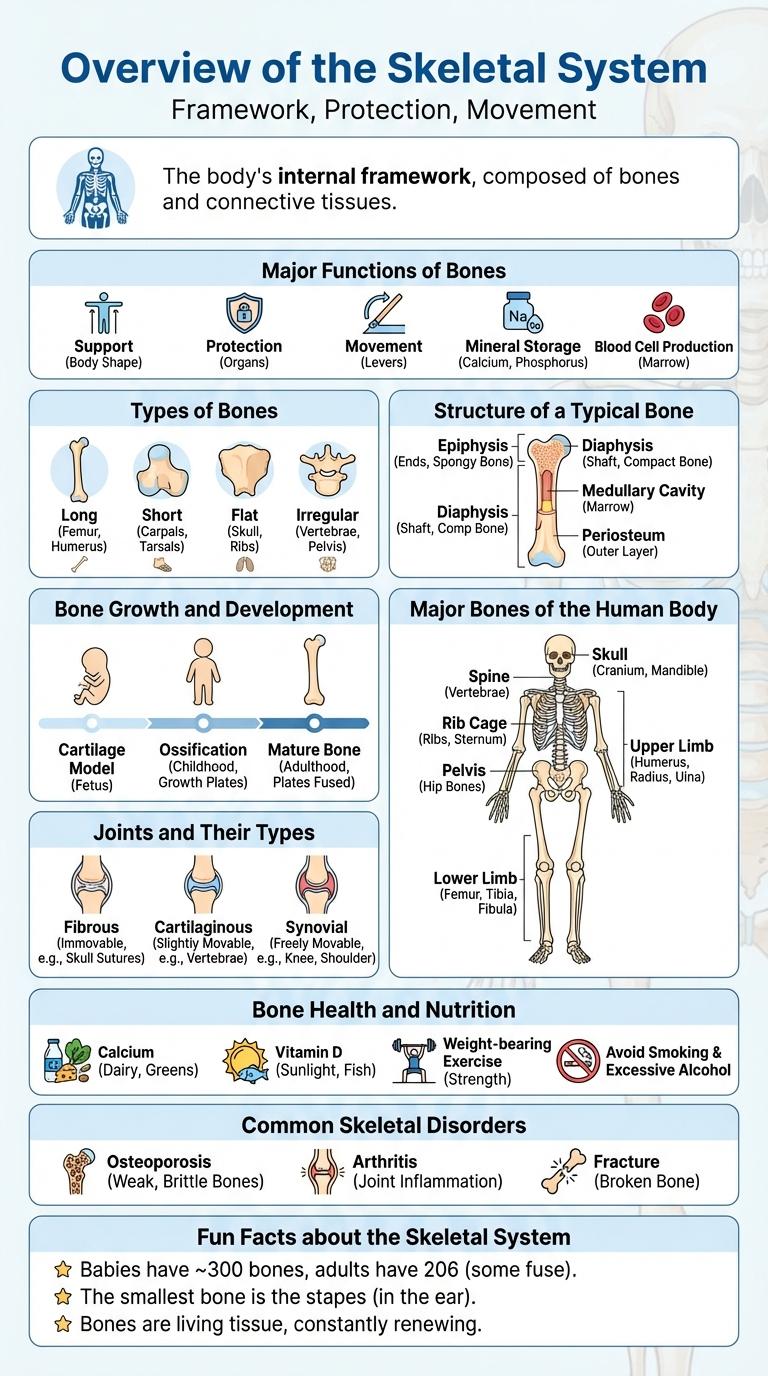
The skeletal system provides essential support and structure to the human body, protecting vital organs and enabling movement. Composed of bones, cartilage, ligaments, and joints, it plays a crucial role in maintaining balance and facilitating mobility. This infographic visually breaks down the components and functions of the skeletal system for easy understanding.
Overview of the Skeletal System
What is the skeletal system, and why is it essential for the human body?
The skeletal system is a complex framework of bones and cartilage that supports the body's shape and protects vital organs. It plays a crucial role in movement, mineral storage, blood cell production, and structural integrity.
Major Functions of Bones
The skeletal system provides essential support and structure for the human body. It protects vital organs by forming rigid barriers around them.
Bones enable movement by serving as attachment points for muscles, facilitating leverage and mobility. They also store minerals such as calcium and phosphorus, which are critical for various bodily functions.
Types of Bones
The skeletal system supports the body, protects organs, and enables movement through various types of bones. Each bone type has a unique shape and function crucial for overall skeletal structure.
- Long Bones - These bones are longer than they are wide and primarily function in movement and support, such as the femur and humerus.
- Short Bones - Generally cube-shaped, short bones provide stability and some movement, examples include carpals and tarsals.
- Flat Bones - Flat bones protect internal organs and offer broad surfaces for muscle attachment, like the sternum and scapula.
Structure of a Typical Bone
The skeletal system provides the framework for the human body, supporting and protecting vital organs. A typical bone is a complex structure designed to withstand stress and facilitate movement.
The outer layer, called the periosteum, is a dense membrane rich in nerves and blood vessels. Beneath this is compact bone, which is hard and dense, offering strength and rigidity.
Bone Growth and Development
The skeletal system provides structural support and protects vital organs throughout life. Bone growth and development are dynamic processes influenced by genetics and environmental factors.
Bone growth occurs primarily at the epiphyseal plates, which allow lengthening during childhood and adolescence.
- Osteoblasts Role - Osteoblasts are cells responsible for new bone formation and mineralization.
- Osteoclasts Function - Osteoclasts break down bone tissue, facilitating remodeling and calcium regulation.
- Calcification Process - Bone matrix hardens through deposition of calcium phosphate crystals during calcification.
Major Bones of the Human Body
| Major Bone | Description |
|---|---|
| Skull | Protects the brain and forms the structure of the face. |
| Spine (Vertebral Column) | Supports the body, protects the spinal cord, and allows flexible movement. |
| Rib Cage | Protects vital organs such as the heart and lungs. |
| Femur | Longest bone in the body, supports weight in the upper leg. |
| Humerus | Upper arm bone, connects shoulder to elbow. |
Joints and Their Types
The skeletal system supports the body and enables movement through its joints, where two or more bones meet. Joints are classified into three main types: fibrous, cartilaginous, and synovial, each allowing different ranges of motion. Synovial joints, such as hinge and ball-and-socket joints, provide the greatest mobility essential for daily activities.
| Joint Type | Characteristics |
|---|---|
| Fibrous | Immovable, connected by dense connective tissue |
| Cartilaginous | Partially movable, joined by cartilage |
| Synovial | Freely movable, contain synovial fluid |
| Examples | Skull sutures (fibrous), vertebral joints (cartilaginous), knee and shoulder (synovial) |
Bone Health and Nutrition
The skeletal system provides structural support and protects vital organs while enabling movement. Maintaining bone health is crucial for overall well-being and preventing conditions such as osteoporosis.
Proper nutrition plays a significant role in maintaining strong bones. Key nutrients include calcium, vitamin D, and protein, which support bone density and repair. Regular intake of these nutrients, combined with weight-bearing exercise, promotes optimal bone health.
Common Skeletal Disorders
The skeletal system provides structural support, protects internal organs, and facilitates movement. Common skeletal disorders include osteoporosis, osteoarthritis, rheumatoid arthritis, and fractures. Early diagnosis and treatment are essential to prevent complications and improve quality of life.
| Disorder | Description |
|---|---|
| Osteoporosis | Loss of bone density leading to fragile bones. |
| Osteoarthritis | Degeneration of joint cartilage causing pain and stiffness. |
| Rheumatoid Arthritis | Autoimmune inflammation affecting joints. |
| Fractures | Breaks or cracks in bones due to trauma or stress. |